Chevron plans to clean up tar at Alameda Point refinery site in Spring 2026

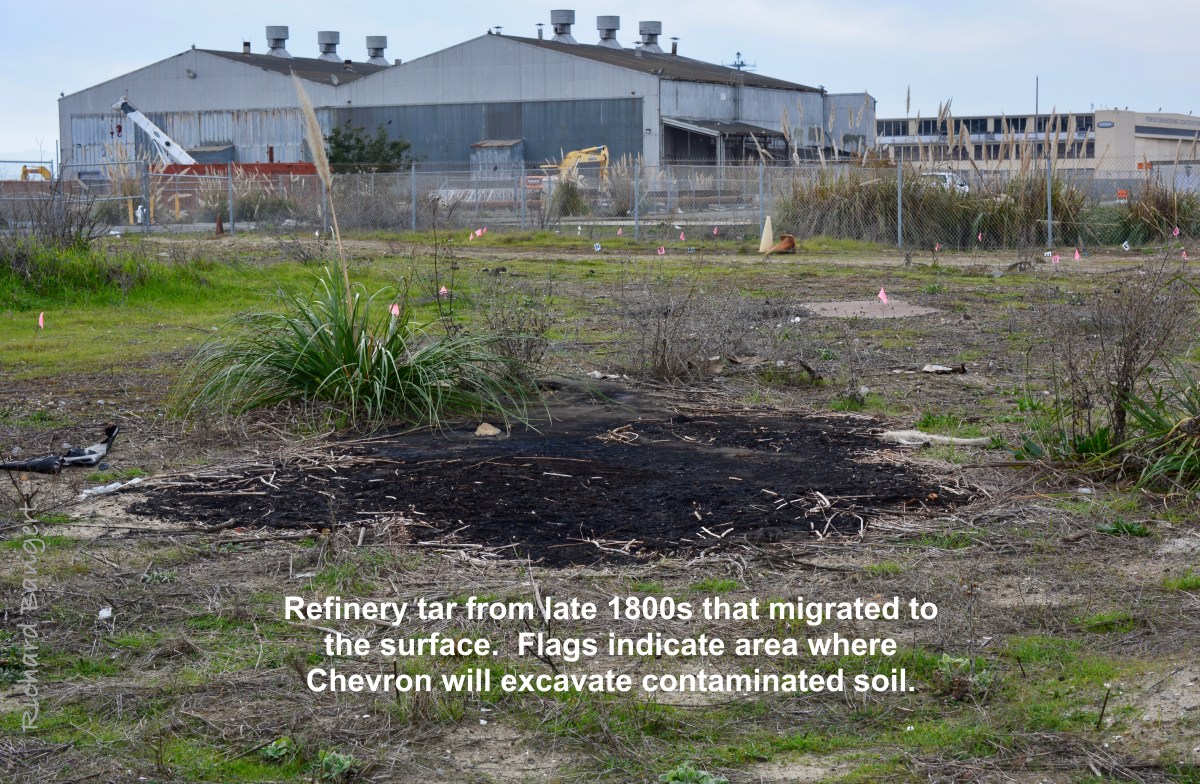
At the urging of the San Francisco Bay Regional Water Quality Control Board (Water Board) in 2021, Chevron agreed to return to Alameda Point and clean up the tar waste left behind when its refinery that produced kerosene was closed in 1903.  The site was eventually filled with up to 10 feet of soil during construction of the Naval Air Station.

Chevron began the process of cleaning up buried tar at its old refinery site in May 2023 by taking 43 soil samples to characterize the extent of contamination.  The sampling pipes were driven down 20 feet.  But a plan for digging up the tar was not submitted to the Water Board until September 2025. 

The Water Board and Chevron are currently in the process of ironing out details of the plan, with formal approval by the Water Board expected soon.

Continue reading “Chevron plans to clean up tar at Alameda Point refinery site in Spring 2026”

Handling Alameda’s beach erosion problem

The City of Alameda had just endorsed concept designs to address sea level rise for its north shore, when recent storms shifted attention to the south shore.  

The erosion of sand from our shoreline yet again raises an important question that the city is not considering in its adaptation planning:  Should maintaining the beach be the primary objective in dealing with sea level rise and increasing powerful storms?

On the shelf sits a 1981 environmental assessment by the U.S. Army Corps of Engineers (Corps) that could help answer the question. A hardcopy is located in the reference section of the Alameda Free Library, 1550 Oak Street. 

Continue reading “Handling Alameda’s beach erosion problem”

Maximum tidal wetland design approved for De-Pave Park

Environmental groups are celebrating an historic decision on what is now destined to become a model for shoreline ecological adaptation around San Francisco Bay.

At issue was whether to keep Building 25, a 55-foot-tall hangar, as a source of lease revenue, or remove it to maximize natural habitat. 

On November 7th, ten years after the De-Pave Park concept was first introduced, the City Council approved moving forward with a plan to remove the building to make way for a park that will welcome sea level rise.  The term “de-pave” refers to the removal of paving.  The paving will be recycled on site to provide the elevated observation overlook and the elevated entrance.  The decision was the latest step in the process of developing a Master Plan that will provide the foundation for receiving a multitude of regulatory permits and construction grant funds. 

Continue reading “Maximum tidal wetland design approved for De-Pave Park”

De-Pave Park master plan kick-off meeting April 15th

If participating in creating a wetland ecological park in Alameda is of interest to you, mark your calendar for this upcoming outdoor event.

The master planning process for De-Pave Park on the west side of Alameda Point’s Seaplane Lagoon begins with an in-person workshop on Saturday, April 15, from 3:00 to 5:00 p.m.

Continue reading “De-Pave Park master plan kick-off meeting April 15th”

Opening of park at Seaplane Lagoon highlights climate change

On April 9, 2022, the first phase of the terraced Alameda Point Seaplane Lagoon waterfront park officially opened with cultural performances.  One of the groups christening the new three-acre park was Fog Beast, in collaboration with the Shawl Anderson Youth Ensemble.  Their performances captured the nature of the park, highlighting climate change and sea level rise.

Continue reading “Opening of park at Seaplane Lagoon highlights climate change”

Developer proposes changes that would cheapen waterfront area

On Monday, December 9, 2019, the Planning Board will consider approving changes to the Waterfront Park and Block 11 at Site A at Alameda Point that were previously approved in 2016 “in an effort to reduce escalating construction costs and long term maintenance costs for both the building and the park.”  The City has already granted numerous modifications to the development agreement, with good reasons.  The current request does not merit approval because it would cheapen the waterfront focal point. Continue reading “Developer proposes changes that would cheapen waterfront area”

Unexpected Environmental Review of VA Project

The City of Alameda announced on February 22 that it will be preparing an environmental impact report (EIR) on the Department of Veterans Affairs (VA) project for a health clinic and columbarium cemetery at Alameda Point. The VA completed its environmental review for the project in 2013. The deadline for commenting on what the city should evaluate is March 22.

The belated environmental review was triggered by California regulations requiring a state EIR in order for the Regional Water Quality Control Board to approve the VA’s wetland mitigation plan.

An EIR is also required for City of Alameda approvals. “Although construction of federal facilities by federal agencies is typically exempt from local land use regulations and review,” said city planner Andrew Thomas, “in this case, the VA plans to construct an access utility/road on approximately 6-acres of city land to the east of the VA Transfer Parcel and two new storm drains across city-owned land to the north of the VA property, which will require approval of easements from the city, which are discretionary actions subject to CEQA [California Environmental Quality Act].”

Revisiting the project’s environmental impacts six years after the VA completed its review presents an opportunity to evaluate the potential environmental benefits of locating the medical clinic and benefits offices in the business “Enterprise District” rather than in the open space on the former airfield. Continue reading “Unexpected Environmental Review of VA Project”