Scenic Alameda Point wildlife refuge section to be off limits with security fence

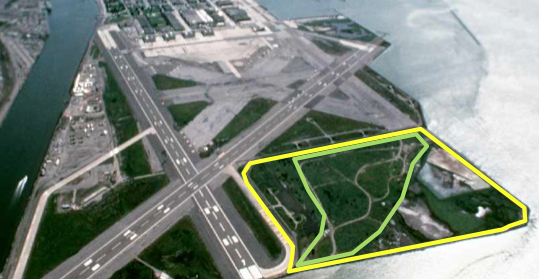
Alameda Point with the Port of Oakland on the left. Yellow outline shows Site 2 cleanup area. Green outline shows area where waste is buried. All but the wetlands in the bottom right corner of yellow area will be covered with clean soil. Fence and gates will be on landward sides of yellow border. Photo-graphic credit: US Navy.

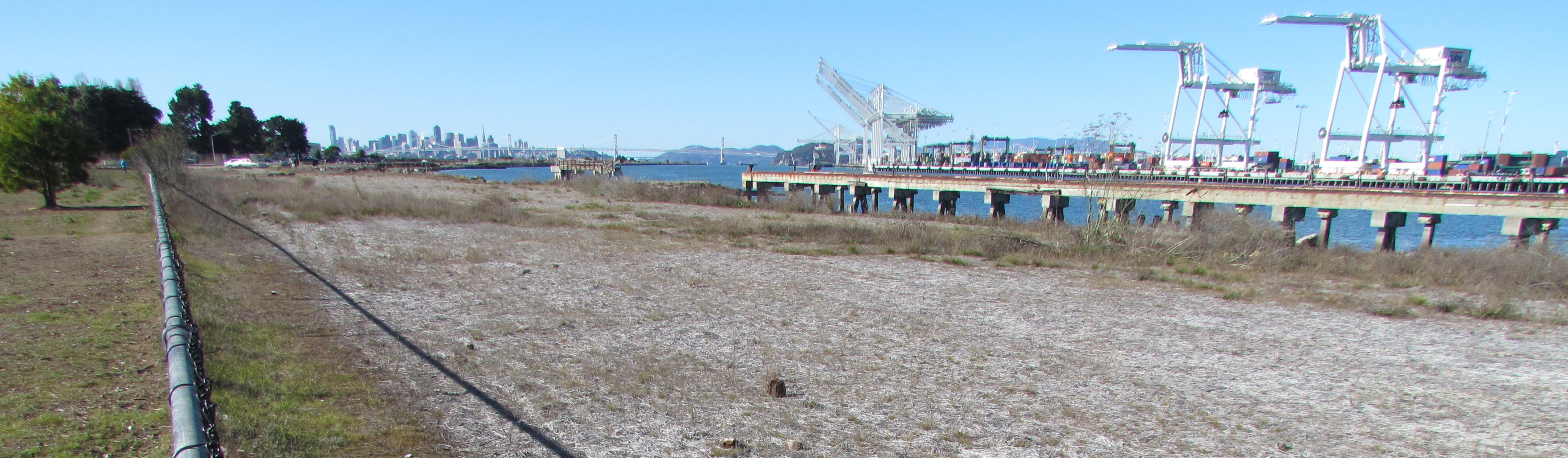
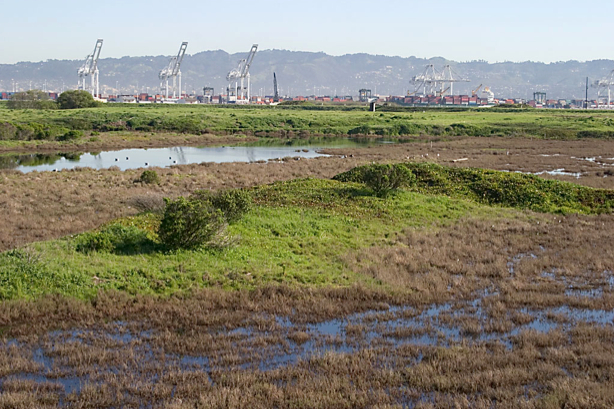
Even after all the cleanup work is completed, the Navy proposes to put a permanent chainlink fence topped with barbared wire around a scenic shoreline section of the wildlife refuge at Alameda Point.

“Good grief!  If a fence is needed, will Site 2 be clean enough for our community?” Leora Feeney, co-chair of the Audubon Society’s Friends of the Alameda Wildlife Refuge, said upon first learning about the fence.   

The Navy used the site for underground waste disposal from 1956 to 1978.  According to representatives at the U.S. Environmental Protection Agency, the California Department of Toxic Substances Control, and the Regional Water Quality Control Board, the permanent fence has nothing to do with human health risks at the site.

According to the answer that the regulatory agencies provided collectively, “Potential human health exposure is unlikely to occur during recreational use on top of the soil cover such as walking or sitting.”  The soil cover will be seeded with native grasses.

The fencing is aimed at reducing maintenance costs for the new landowner, the U.S. Department of Veterans Affairs (VA).   “While the fence is not mandatory and recreational use without soil cover disturbance will not pose a risk to human health or the environment, the ongoing management of the protective cover in an area with public use without more direct supervision will increase risks and costs,” representatives from the agencies jointly stated.  

The VA’s annual expense for operating, maintaining, monitoring, and compliance reporting for the cleanup site, without added supervision, is pegged at $101,715, according to an advisory paragraph in the work plan.  ”There are numerous groundwater monitoring wellheads and landfill gas probes that require security to maintain monitoring integrity,” regulators stated. 

The Navy’s plans indicate that access to the shoreline trail will remain open.  But according to the regulators, “The perimeter road should have gates.  This concern will be clarified with the Navy.”
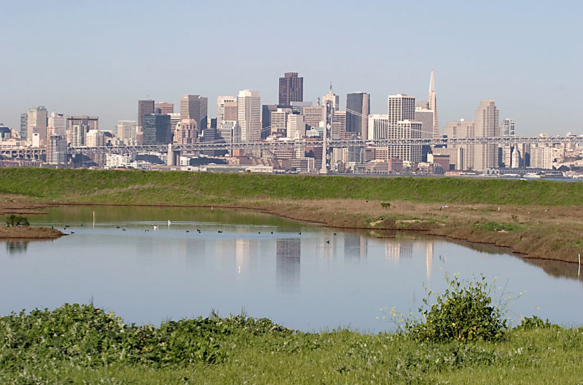
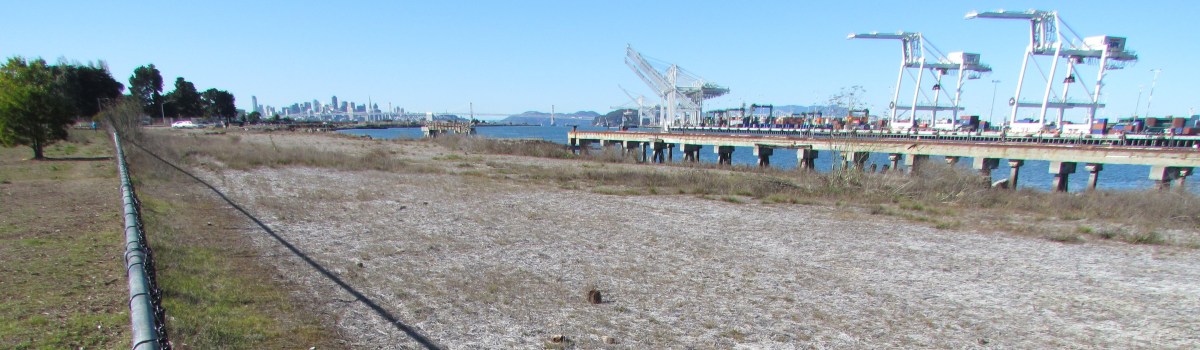
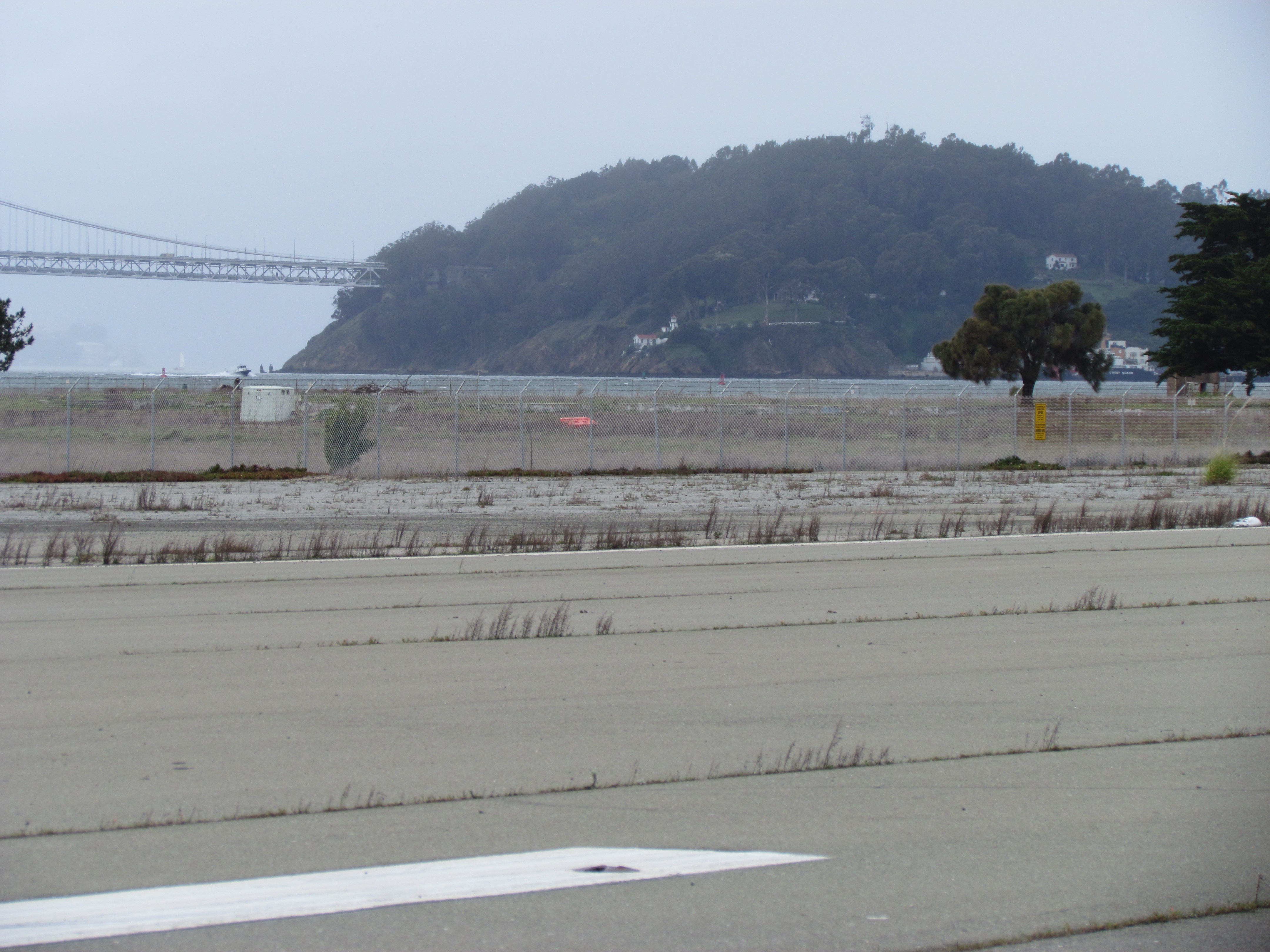
A view that will be off limits to the public if security fence is installed.
Photo by Eleanor Briccetti

The security fence, which will be inside the fenced off refuge area, departs from longstanding expectations for the refuge. Ironically, the off-limits wetlands area at this site is showcased on an Audubon Society brochure about the refuge.  Docent and ranger-led bird watching and nature walks have been part of the expected uses at the wildlife refuge since the mid-1990s.

By 1998, the US Fish & Wildlife Service had drafted its guiding document for creating the Alameda National Wildlife Refuge.  It envisioned supervised activity.  It was to be run in the same manner as other refuges, with controlled and monitored use, two law enforcement officers, and a cooperative agreement with the East Bay Regional Park District “to augment [Fish & Wildlife] Service efforts.”  Talks between the Fish & Wildlife Service and the Navy collapsed around 2004 over cleanup issues.

The shoreline restrictions imposed by the fence and gates are also at odds with the San Francisco Bay Plan, which is administered by the San Francisco Bay Conservation and Development Commission.  While permits are not required for federal projects, the official “Record of Decision” for this cleanup site states that plans will be in accord “with substantive provisions of the San Francisco Bay Plan.”  One of the keystones of the Bay Plan is maximum feasible shoreline public access.   “The city is discussing the provisions of remedial design for Site 2 with the Navy to support a future perimeter trail around the shoreline of the fed-to-fed parcel, which the city is strongly committed to,” said Jennifer Ott, Chief Operating Officer for Alameda Point.

Another of the Bay Plan’s guidelines avoids undesirable visual impacts on the shoreline.  One of the details in the work plan calls for 30 ten-foot tall, four-inch diameter, white PVC soil gas vent pipes for methane gas.  This array of pipes will be visible from the outside seating areas behind beverage purveyors on Monarch Street such as St. George Spirits.  “The city and Navy will discuss ways to minimize the visual impact of any new and/or replacement pipes, including the possibility of reducing their height,” Ott said.

Releasing methane into the environment has 21 times the greenhouse gas impact as burning it and turning it into carbon dioxide.  The city currently burns off the methane gas produced at the city’s old municipal dump, Mt. Trashmore.

Public comments on the draft Remedial Action Work Plan for Site 2 will be accepted by the Navy until Monday, July 9.  Responses to comments and a finalized plan will be announced in August.  A copy of the plan is available in the information repository in City Hall West, 950 West Mall Square at Alameda Point.  A rare opportunity to visit the site will take place on Saturday, June 23, when the Navy hosts the annual site tour.  To comment, or to sign up for the tour, contact the Navy’s Environmental Coordinator Derek Robinson at derek.j.robinson1@navy.mil.

 Site 2 details

The 110-acre cleanup site lies on the southwestern corner of Alameda Point within the 549-acre wildlife refuge, and includes 30 acres of wetlands and the 60-acre disposal area. 

Remedial work at the site is expected to commence in the fall of 2012 and be completed by summer 2013.  As a base layer for the soil cap, the Navy will use some 75,000 cubic yards of soil that it dredged from the Seaplane Lagoon and deemed clean enough for reuse.  The Navy will then barge between 400,000 and 600,00 cubic yards of clean soil from Decker Island in the Sacramento River near the town of Rio Vista.  The Navy says this will save at least 22,000 semi-truck trips.

The work plan document allays longstanding fears about underground toxic chemicals leaching into the Bay.  According to groundwater monitoring results in 2011, and comparing them to 16 years of data, all chemicals of concern are below risk levels and either stable or trending downward.  The plan includes the option of eliminating the groundwater monitoring wells in five years.

“Overall, the Navy believes that the soil cover remedy for IR Site 2 is directly compatible with the anticipated future reuse of the site.”

Navy, in Record of Decision, 2010

Seaplane Lagoon cleanup dredging completed [video and slideshow]

Dredging northwest corner of Seaplane Lagoon

Environmental cleanup of the Seaplane Lagoon has centered on two areas where storm sewers drain into the lagoon.  It was commonplace to discharge all sorts of chemicals down storm sewer lines prior to the passage of the federal Clean Water Act in the early 1970s.  Contaminants such as PCBs, cadmium, lead, pesticides, and radium have been found in the sediment around the sewer discharge points.

Prior to dredging, sewer lines leading to the northeast and northwest corners were either replaced or flushed out.  An underwater debris pile of metal and wood was also removed at the northeast corner before dredging.

The Northeast Corner

Setup for the 6.5-acre northeast dredging area began in late 2010, and dredging was completed in April of 2011.  The total amount of sediment removed was 75,628 cubic yards.  Even though the contamination depth was three feet, the dredging went to five feet.

Only 1,719 cubic yards of sediment were transported to hazardous waste disposal sites, of which 11 cubic yards went to a low-level radiological waste disposal site because of the radium-226.  The rest of the sediment was determined to be safe enough for reuse, in large part because the contaminants were diluted by the over-dredging of clean sediment.  The clean sediment has been stockpiled on the western end of the Wildlife Refuge for future use in capping the landfill disposal sites 1 and 2.

All of the drying pad materials for the northeast corner have been removed, which will allow for the fence to be moved.

The Northwest Corner

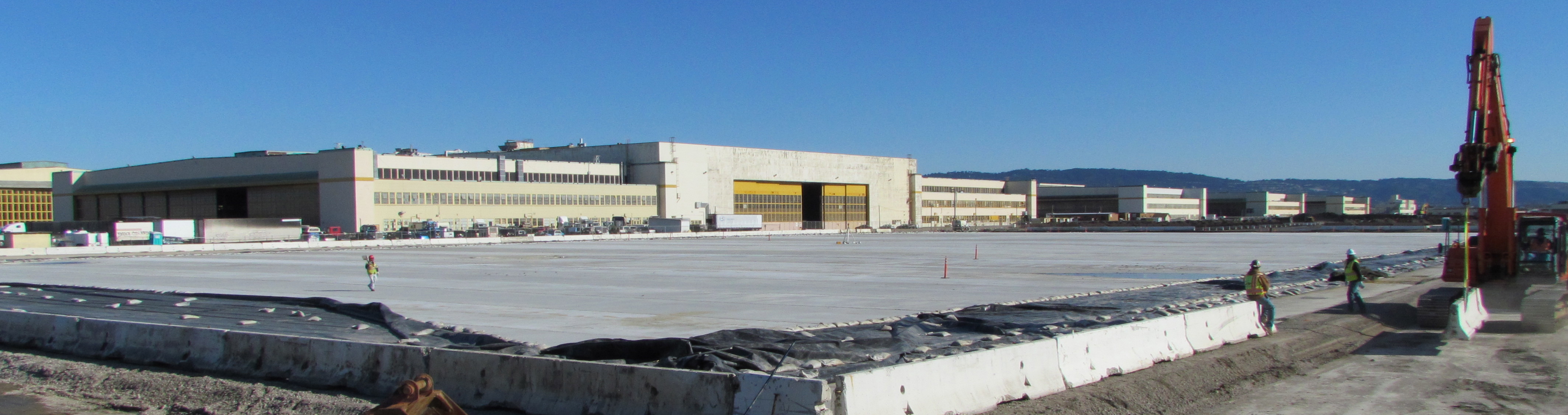
Concrete drying pad installed at northwest corner of Seaplane Lagoon

Setup for the 3.3-acre northwest corner began in October of 2011 with the construction of a concrete, waterproof drying pad.  Prior to dredging, a sunken barge was demolished and removed.  The barge pieces were scanned for radiation, but none was found.  The 66 tons of scrap iron was sent to a recycling facility.

Dredging started on January 16 and ended on February 22.  The dredging at the NW corner went much faster than the early dredging, partly because of the smaller area, and partly because of heftier dredging equipment.

Unlike the NE corner, however, the sediment here is expected to contain higher levels of radium-226 because the sewer line leading here was highly contaminated.  As was the case at the NE corner, this sediment will have to dry out before being tested and disposed of.  The project should be completed and everything removed by December.

The price tag for all of the Seaplane Lagoon dredging and hauling away sediment, when completed:  $46 million.


This slideshow requires JavaScript.

March cleanup meeting announced

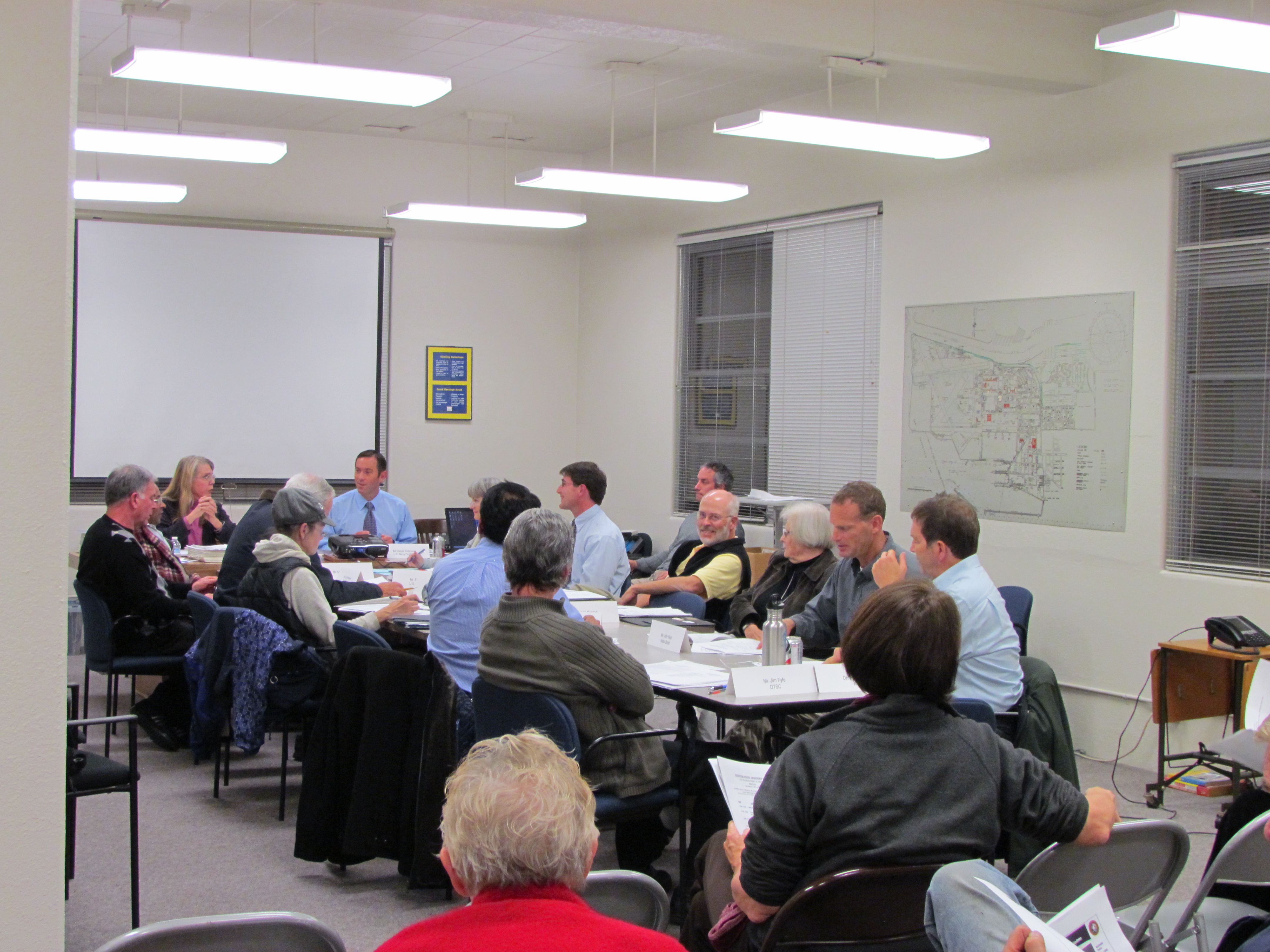
Restoration Advisory Board

Naval Air Station, Alameda (Alameda Point)

March 8, 2012       6:30 PM

Location: Alameda Point – 950 West Mall Square (Alameda City Hall West) Room 140 – Community Conference Room

Enter from West Midway Avenue at rear of building. 

 Agenda


6:30 – 6:35     Welcome and Introductions    

                              Community and RAB

6:35 – 6:45     Co-Chair Announcements     

                             Navy: Derek Robinson

                             Community: Dale Smith

6:45 – 7:05     Site 17 – Seaplane Lagoon     

                             Dredging Update

                             Navy Project Manager: Mary Parker

7:05 – 7:25     Site 24 – Pier 1 dock area     

                             Dredging Update

                             Navy Project Manager: Lora Battaglia

7:25 – 7:45     Operating Unit – 2B  near East Gate     

                             Underground vapor extraction using heat

                             Navy Project Manager: Curtis Moss

7:45 – 7:55     Update from regulatory agencies     

                             Pankaj Arora, US EPA

7:55 – 8:15     Community and RAB Comment Period

8:15 – 8:30     Approval of Minutes     Review Action Items

                             Dale Smith

8:30                 RAB Meeting Adjournment

Alameda Point Map

Restoration Advisory Board Responds to Navy’s Meeting Cutbacks

Alameda Point RAB meeting

At the October 2011 Alameda Point Restoration Advisory Board (RAB) meeting, the Navy announced that Alameda Point’s monthly RAB meetings would be reduced to quarterly meetings due to budget cutbacks.  The Navy said it would welcome a written response from the RAB on how the Navy might continue to carry out its responsibilities for community dialogue during difficult budgetary times.

On February 22, 2012, the RAB sent a letter to the Navy’s Environmental Coordinator for Alameda Point cleanup, Derek Robinson.  The letter cited the magnitude of the cleanup effort at Alameda Point – 25 percent of the Navy’s nationwide cleanup budget in Fiscal Year 2011 – as justification for having more than four meetings per year.  The RAB offered a reasonable compromise schedule that would add two meetings, bringing the total number of meetings this year to six.  The Navy has already indicated that it would continue to host its annual tour of cleanup sites at Alameda Point, which would be in addition to the six meetings being proposed by the RAB.

The RAB also suggested having more than one cleanup site presentation at a meeting in order to make more efficient use of the Navy’s time and money spent on hosting the meetings.  In past years, multiple presentations were made at meetings, but this practice ended because of the Navy’s concern that the meetings were too long and community members in attendance would leave before the end.

The complete letter is here.

Todd Shipyards copper cleanup

Todd Shipyards/Site 28. Dog Park to left of fence, Port of Oakland on right.

Right next to the Main Street Ferry Terminal, between the Oakland Estuary and the Dog Park, is the Navy’s cleanup Site 28, also known as the Todd Shipyards site.  The contamination at this site — copper and arsenic, and to a lesser extent lead and hydrocarbons — was not the result of Navy activities, even though the Navy owns the property.

Background

Filling in the land with estuary dredge soil contaminated with hydrocarbons from the coal gasification plant that once operated in Oakland was likely responsible for the petroleum-related hydrocarbons in the ground.  The Alameda Mole Railroad operated along this route from 1883 until 1939 and was also a possible contributor to the hydrocarbon residue in the soil.  Non-Navy shipbuilding and repair between 1941 and the 1980s was responsible for lead, arsenic, and copper contamination.

According to the Navy fact sheet, “The property was leased to various entities for non-Navy shipbuilding and repair between 1941 and 1970. The property was purchased from the Navy in 1970 by the Todd Shipyards Corporation, which used the land as an extension of its adjoining shipyard property until 1983, when the property was then sold to Alameda Gateway Limited.  The IR Site 28 portion of the former shipyard reverted to Navy ownership in 1995.”

Paint used on ships

The copper contamination came from paint used on the bottoms of ships.  The paint was an anti-fouling paint that served to prevent the growth of barnacles.  Copper in the paint acted as the biocide, which is why possible leaching into the estuary is a big concern.

Emerging cleanup technology

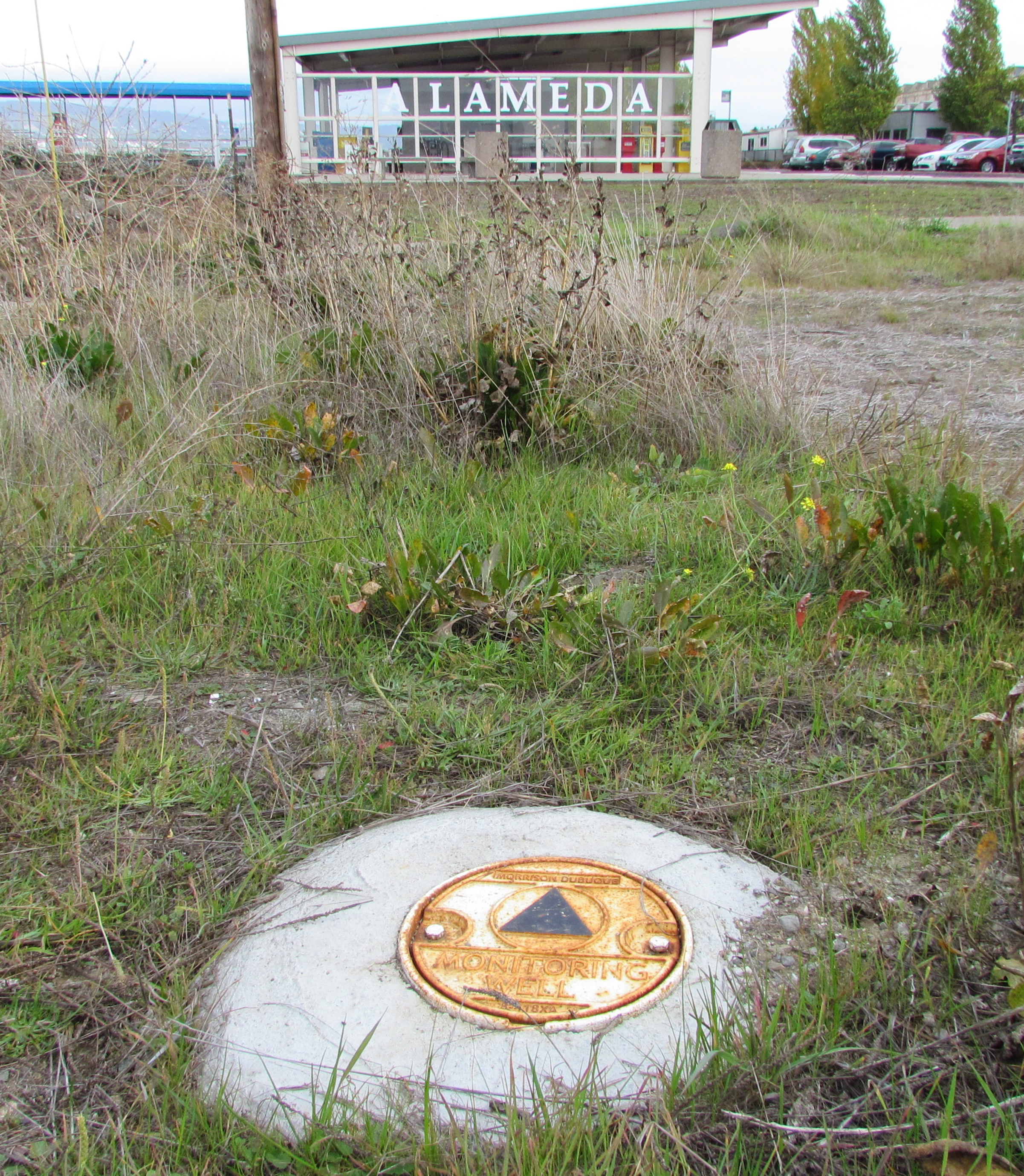
Todd Shipyard/Site 28 groundwater monitoring well. Alameda Main Street Ferry Terminal in background.

Even though the Navy did not cause the contamination, they are responsible for the cleanup, which it performed in 2010.  They are also responsible for monitoring the groundwater for 10 years to make sure their methods are permanent.  Some of the methods used here were straightforward:  Digging up soil and replacing with new soil.

The copper at groundwater level, however, is being dealt with by an emerging technology called metals immobilization.  In this process a proprietary non-toxic compound is injected into the ground to bind to the copper and cause it to be absorbed into soil particles, which will prevent it from leaching into the estuary and harming aquatic life.  Hence, the term immobilization – the copper is no longer mobile, or able to move.  Water and natural microbes in the ground are what activates this immobilization compound.  A helpful byproduct of this reaction is that food (carbon) for natural microbes is released, further enhancing the effectiveness of this process.

So-called emerging cleanup technologies are halfway between experimental and mainstream.  They have been proven effective in the short term, or in some locations, but have not been in widespread use long enough to be considered 100% effective in every soil type.  No one knows for certain if the binding effect will hold, but pilot lab tests were done on soil from Site 28, and the Navy and regulators fully expect it will work.  If groundwater monitoring indicates that it’s not working, the Navy will have to come up with another plan since there is no statute of limitations on their responsibility for cleanup.

This slideshow requires JavaScript.

Precision Dredging at the Pier Area – with video


Dredging at Pier 1 - Alameda Point

Designing the workplan for dredging toxic sediment next to Pier 1 at Alameda Point required precision so as not to undermine the stability of the concrete posts supporting the roadway that passes along the pier area.  The ground under the water slopes down nearly 40 feet from the cement parking slab adjacent to Wharf Road.  Six-foot sediment core samples were obtained during investigations.  The varying depths of contamination were charted and used to plot a computer program showing a slope profile that not only would accomplish cleanup, but also maintain the stability of Wharf Road.  This means that in some case they are dredging deeper than the contamination.

Dredging toxic mud at the pier area, in what is known as Site 24, got underway in early January 2012.  The Maritime Administration had to temporarily vacate this berth.  Prior Navy activities east of the pier area, which used solvents, paints, sandblasting materials, and hydrocarbons such as fuels and lubricants, led to contamination when waste products, including pesticides, were disposed of down three storm water drains.  The contamination chemicals of concern are cadmium, pesticides, lead, and PCBs.  The dredging process requires two methods – vacuuming mud from under the wharf road that is supported by concrete posts, and dredging with a clamshell scoop in the open water.

Vacuuming mud under roadway

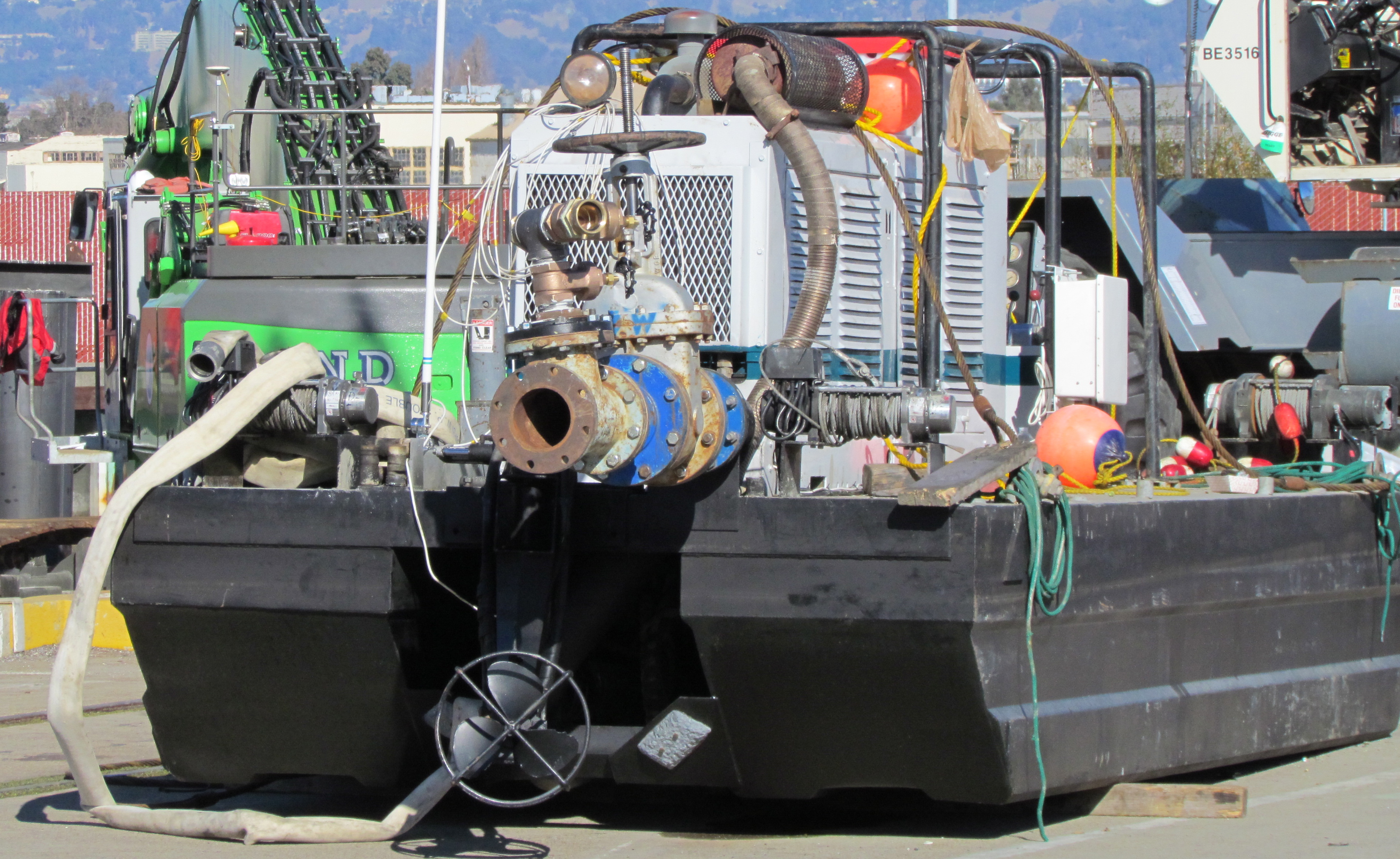
Raft with dredging pump. Hose connects to 4" valve at rear for vacuum dredging under wharf.

The first stage of work, now completed, was vacuuming mud from under the roadway. The specially built dredge pump, equipped with an agitator where the hose contacts the mud, was held in position by a barge-mounted crane that was custom built for this application.  The mud went through a large hose, across the roadway, into a drainage basin and into special geotextile tubes that retain the mud.

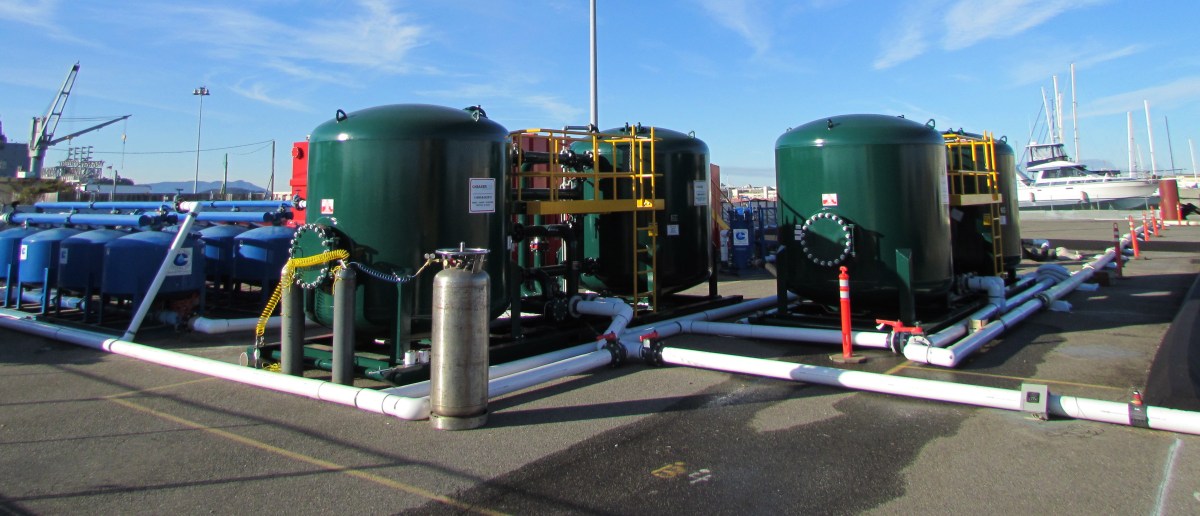
The water that drained off of the mud, however, was too muddy to immediately send to a filtration system.  It was first pumped into a large above ground pool of water in order to dilute it.  From there the water was pumped through a series of filtration tanks.  The water is being used for dust control and can also be pumped back into the harbor.

Open water precision dredging

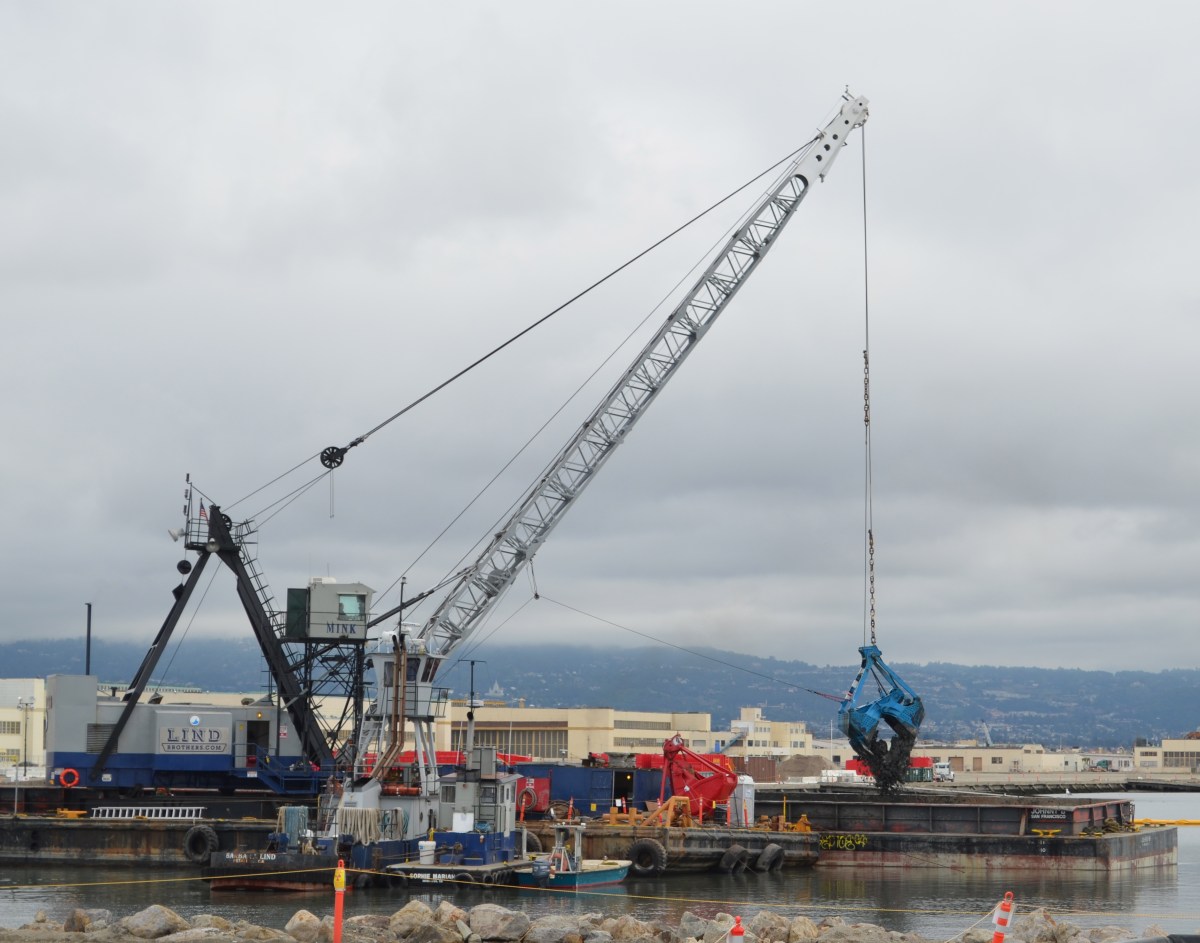
Open water dredging. Sediment deposited into dump truck.

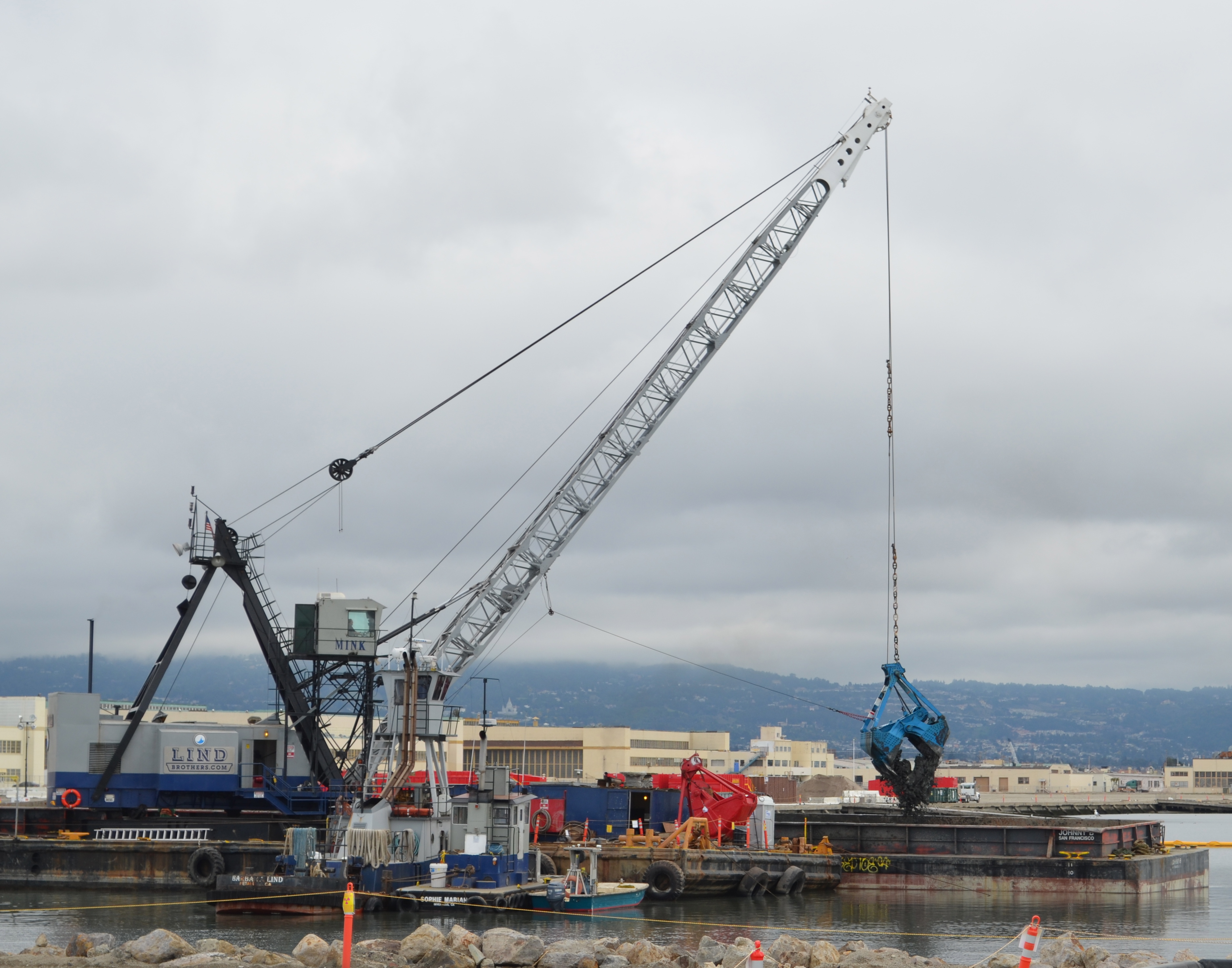
The open water dredging is conducted from a barge using a special clamshell scoop that allows virtually no mud to drip out of the jaws when hoisted out of the water.  This helps to minimize dispersing fine contaminated sediment in surrounding water, which could necessitate repeat dredging.  The scoops of mud are held in the air for about 30 seconds to drain the water before being hoisted over to a dump truck.  The trucks are driven a few hundred yards to a special drying pad to dump the mud.  As the dredge barge moves out of arms length of the wharf, it will have to deposit the mud in a hopper barge that will then be moved next to the wharf where the mud will be unloaded and put into the dump trucks.

Yellow boom holding turbidity curtain to contain disturbed mud, with raft containing turbidity sensors.

The operator of the dredging rig has a real time computer picture of the contour of the underwater ground surface.  The image is aided by positioning sensors on the scoop.  This allows the operator to follow precisely the slope design.  There is also a floating curtain to keep any disturbed contamination within the work area.  At the curtain boom and outside the work area are two floating rafts that detect turbidity, or muddiness, in the water.  These rafts send real time measurements to the dredge operator.  If the turbidity exceeds a certain limit, the dredging is temporarily halted.

Although the Navy periodically dredged the berthing areas for ship and submarine access when the base was open, their dredging was not able to get close to the wharf or under it, leaving the current legacy of contamination.   In the health risk assessment conducted by the Navy, they used the Least Tern as an indicator species since they are the most sensitive birds to forage here, and protecting them would therefore protect all other birds.  Fish consumption by humans was also used to determine that remediation was warranted.  The investigation process that led to this dredging project began with sediment core samples collected in 2005 and 2006.  About 4,000 cubic yards of mud will be dredged.


This slideshow requires JavaScript.

Where Alameda Point’s cleanup is at year’s end


This slideshow requires JavaScript.

The past year had some high points and low points in the cleanup process at Alameda Point.  Added delays, including a pile-driving surprise, were balanced out by steady progress.

The year saw, among other things, completion of a second Point-wide radiological survey of buildings and structures that identified two building interiors needing radium remediation, a new soil scan for radium on a section of the western runway area, replacement of a storm drain segment next to the Seaplane Lagoon, and preparation of the environmental document for the Berkeley Lab site, which will be useful whether we get the Lab or not.

Northwest Territories - Site 1 dump area, partly covered by runway

The contractor preparing to cover the old dump with rocks and soil at the northwest tip of Alameda Point delivered some embarrassing news to the Navy.  In the normal course of their duties, work-plan design testing revealed that the shape of part of the contamination did not match the official description.  You would think they could just process a work-order change.  But the Superfund law requires an additional two-year review process, which will push the completion of this open space opportunity to 2015.

At another cleanup project, the Navy drove over four dozen 30-foot steel electrodes into the ground to heat up the toxins and capture the vapor.  But before turning on the electricity, the contractor discovered they had hit a sewer line.  The project has since been idle for months awaiting a decision on how to proceed.

Seaplane Lagoon dredge dewatering pad - northwest corner

The big Seaplane Lagoon dredging project that began in January is certainly one of the most dramatic displays of cleanup.  Both the northeast and northwest corners of the lagoon were supposed to have been dredged by April and final soil disposal completed by year’s end.  But the contractor failed to meet the deadline and was let go.  A new contractor has been testing and removing existing soil, as well as doing extensive set-up over the past two months for the dredging of the northwest corner that will begin in January.

Another dredging project has just begun under the dock area next to the maritime ships.  They’re removing mud contaminated from two storm drain lines.  That project is on schedule.  It’s worth visiting the area to get a glimpse of the elaborate engineering needed to capture and clean water runoff from the mud.

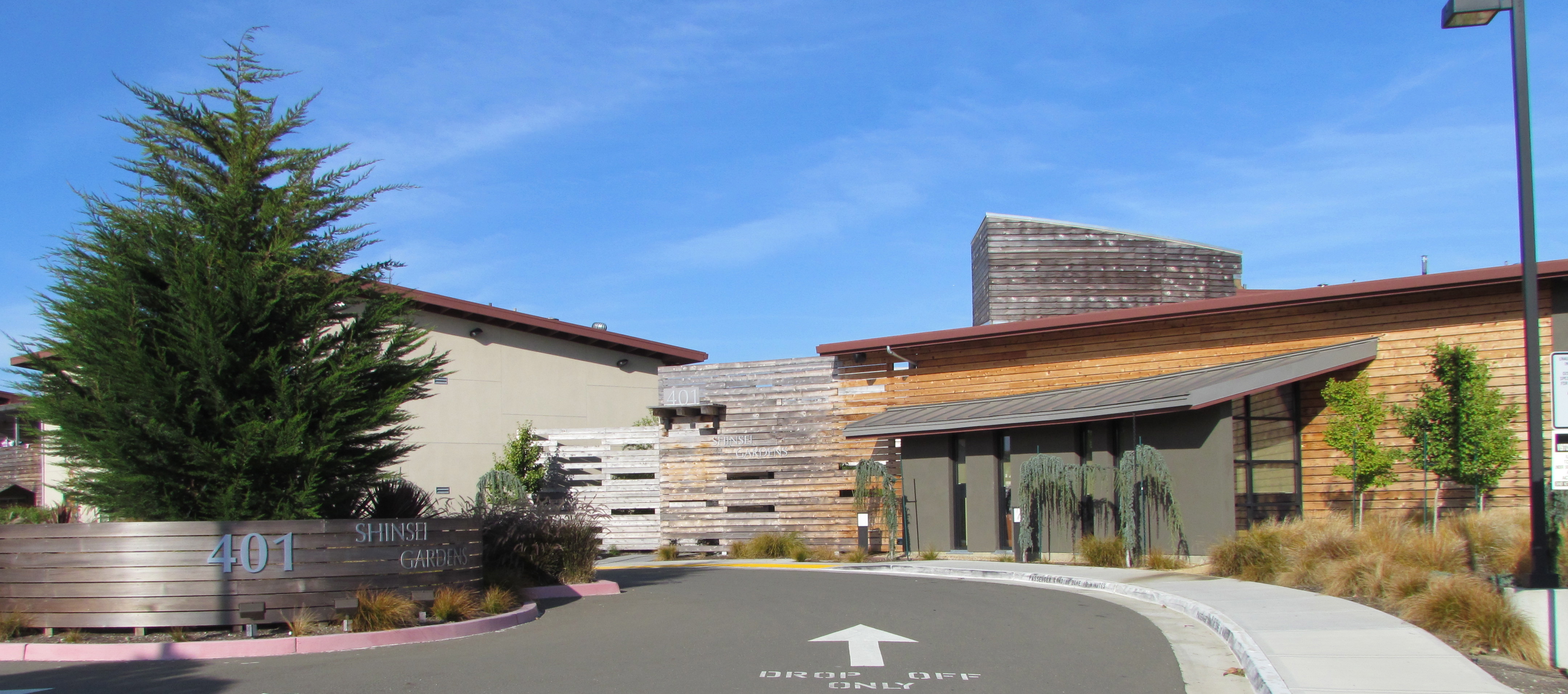
Shinsei Gardens low-income housing located above ongoing groundwater cleanup

Less dramatic and seldom seen work is always ongoing.  Groundwater is monitored at cleanup sites to ensure cleanup goals are being met.  One example is the monitoring of the removal of benzene and naphthalene under Shinsei Gardens and vicinity.

Evidence of the Petroleum Program is also seldom seen, other than some white PVC pipes in the ground.  But besides the big fuel extraction projects, there is ongoing testing of pipelines and oil/water separators in order to develop a remedial plan.

Finally, and perhaps most important, getting the first, very large, no-cost land conveyance from the Navy next year appears to be on schedule.  To help make it happen, the Navy and regulators are planning on modifying cleanup goals by enacting restrictions against future ground-floor residential development near the east entrance to Alameda Point.

Originally published in the Alameda Journal.