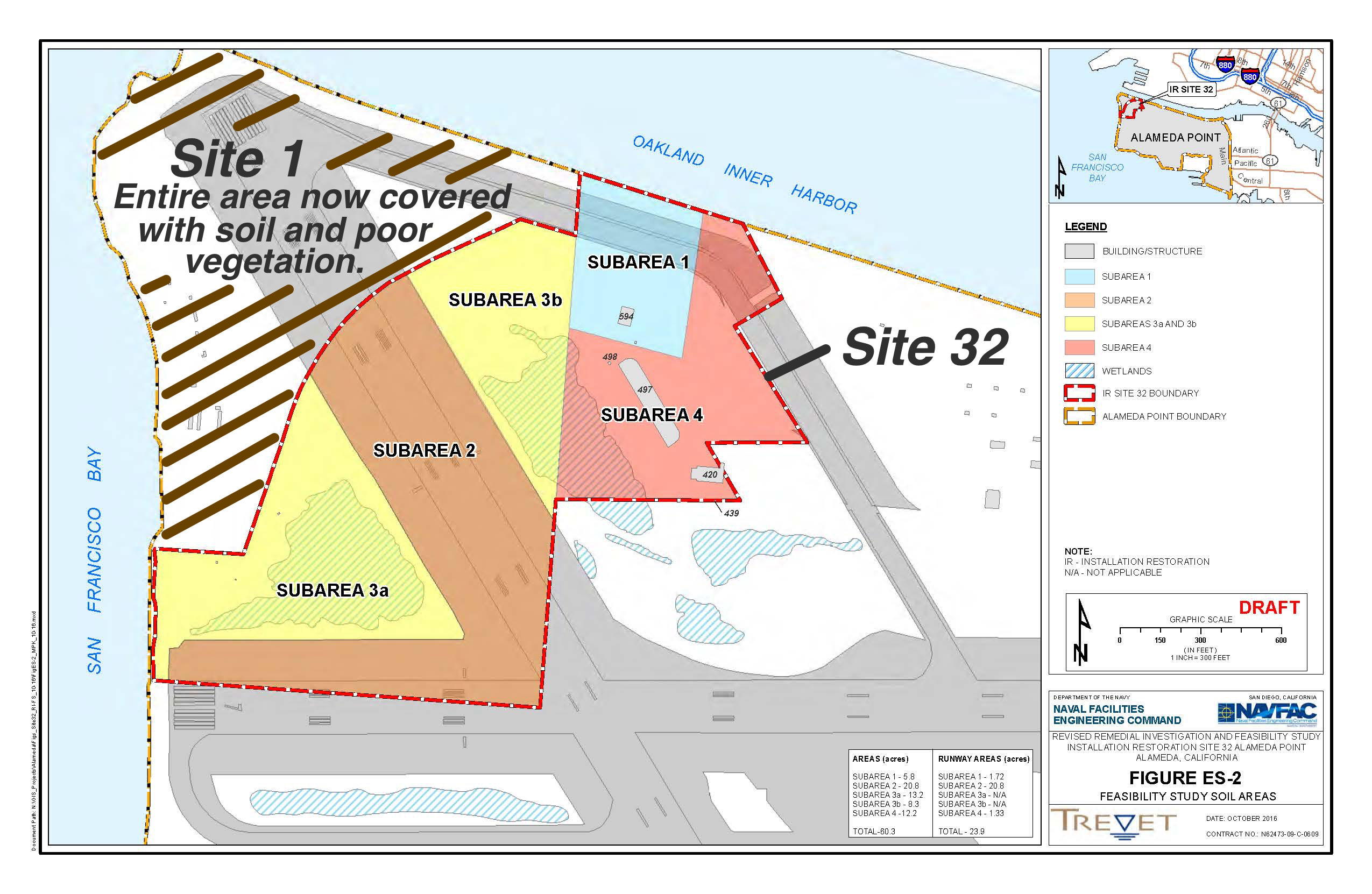
The Navy will present options on possible ways to clean up 60 acres at Alameda Point slated for a regional park on Thursday night. The draft cleanup options for Site 32 represent the culmination of 25 years of groundwater and soil studies that began before base closure was announced. Only five acres have been flagged for cleanup, but uncertainty about what lies beneath the pavement and structures requires a conservative approach.
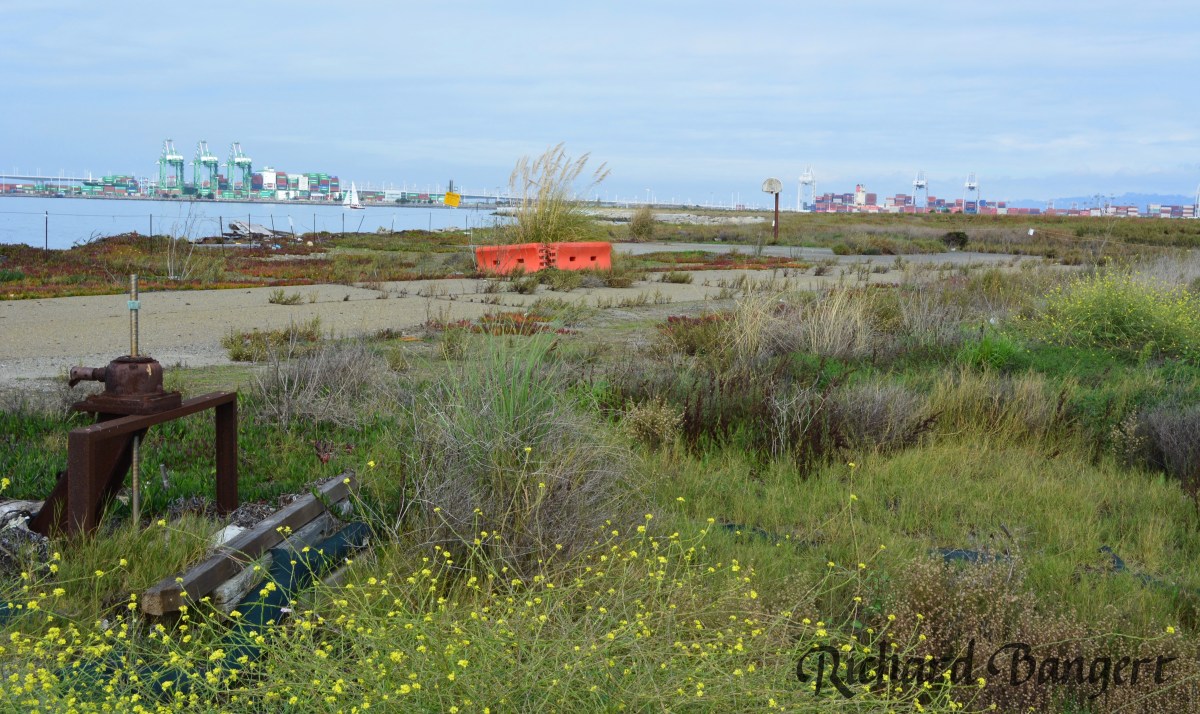
The site lies in the northwest portion of the old airfield along the Oakland Estuary and features open grassland, seasonal wetlands, runway, a large concrete bunker and two buildings. Input from the community and regulatory agencies on the cleanup plan will have a major impact on the design and use of the future park.Continue reading “Navy presents parkland cleanup plans”
The City of Alameda became the new owner of the Seaplane Lagoon at Alameda Point on April 13, 2016. It came from the Navy with a new condition that exceeds normal protocols for dredging in San Francisco Bay.
As with all cleanup sites, the Navy, city and regulators agreed to what areas needed to be cleaned up in the Seaplane Lagoon. The cleanup plan approved in 2006 was based on testing the sediment throughout the 110-acre lagoon. The problem areas were confined to about 10 acres at the northeast and northwest corners of the lagoon where storm sewers dumped contaminants prior to 1970s environmental laws. The agreed upon plan said that there would be no restrictions on the lagoon when cleanup was done.
Dredging the northwest corner of the Seaplane Lagoon in February 2012.
After cleanup was completed, two years of discussions between the Navy, state and federal regulators, and the city led to an amendment to the official cleanup decision to include a detailed management plan for any future dredging in the Seaplane Lagoon. The city led the effort to create a sediment management plan. It stipulates that all dredge sediment brought to the surface will have to be spread out six inches thick on a drying pad and scanned for radium-226 radiation at a cost borne by the city.Continue reading “Radium safety enhanced at Seaplane Lagoon”
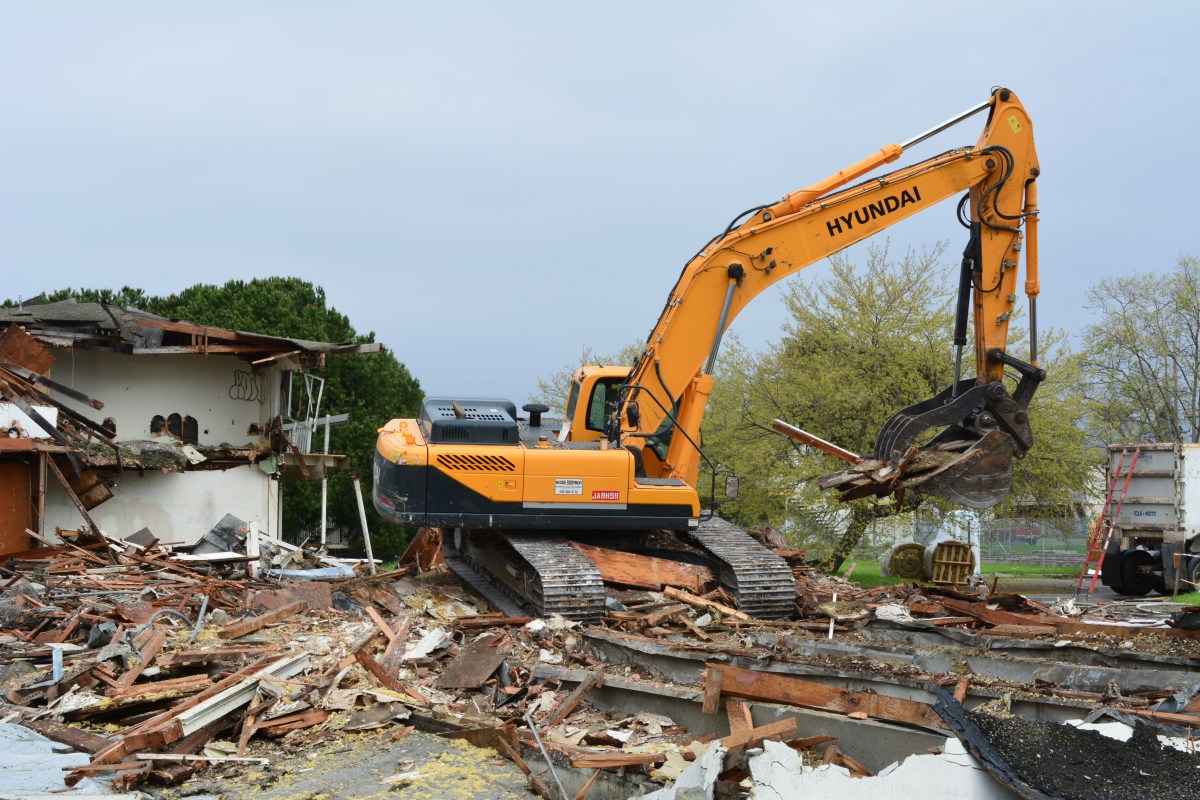
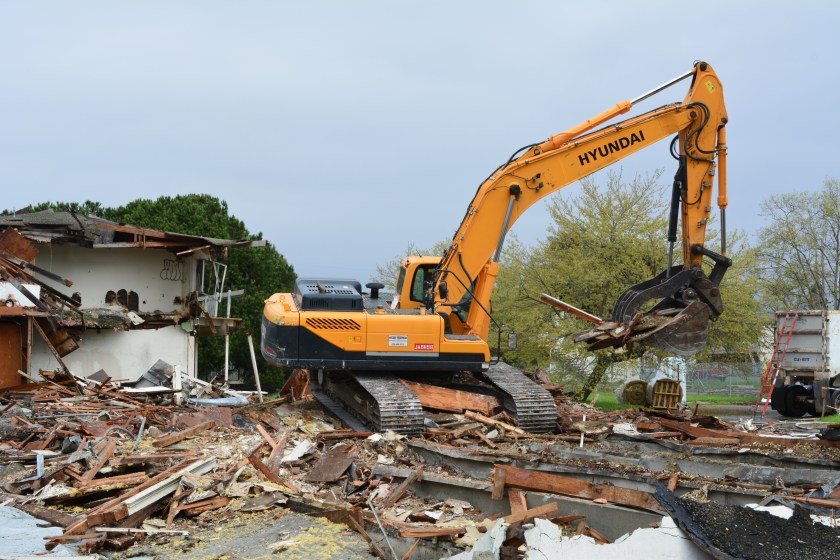
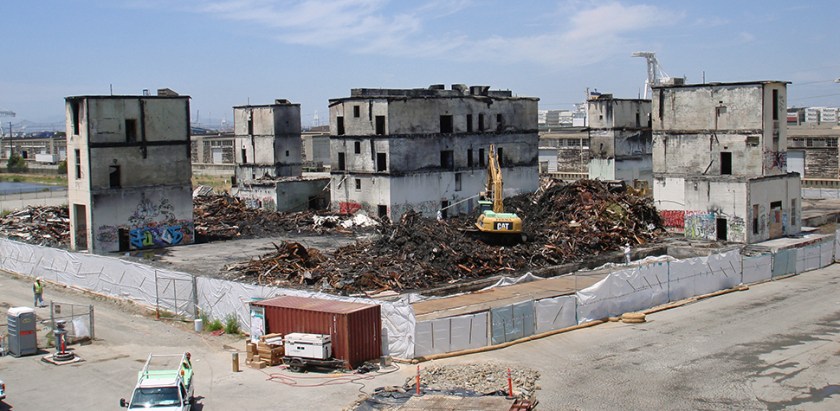
The demolition of 16 former Navy apartment buildings at Alameda Point has begun. On January 5, 2016, the City Council awarded a $547,000 contract to Asbestos Management Group of Oakland to perform the demolition.
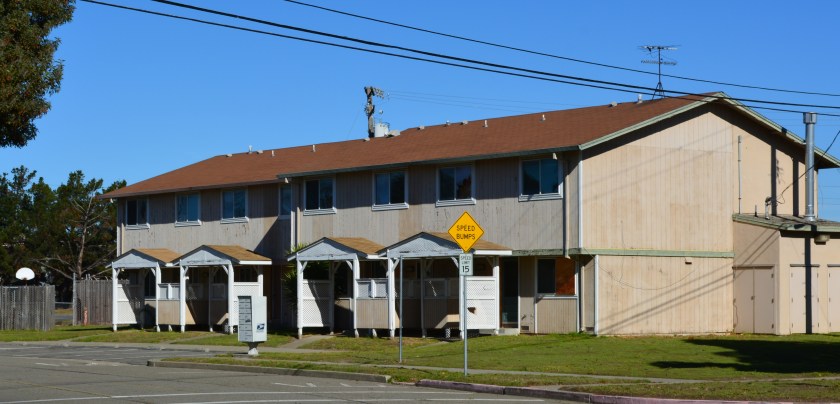
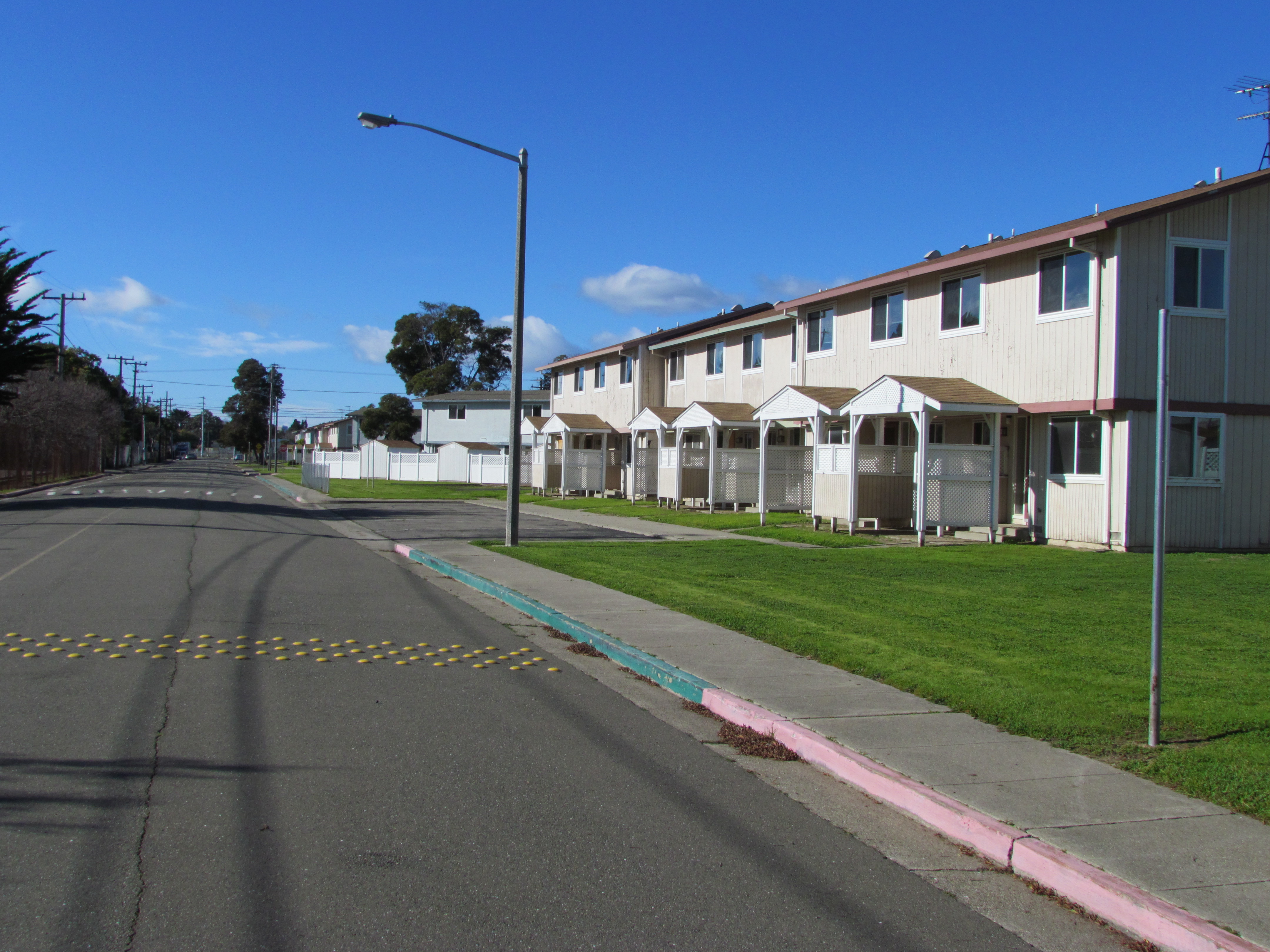
Demolition of Navy apartment buildings at West Tower Avenue and Orion Street, Alameda Point.
In April of 2015, the city council directed city staff to come up with a plan to address safety and blight issues after KTVU Channel 2 aired a story about unsafe conditions at the abandoned housing area.
The structures are located on Orion Street, West Tower Avenue, Stardust Place and Pearl Harbor Road. Demolition began during the second week of March and is expected to be completed within 60 days. The job is being paid for out of Alameda Point base reuse funds. Continue reading “Demolition of former Navy apartments begins”
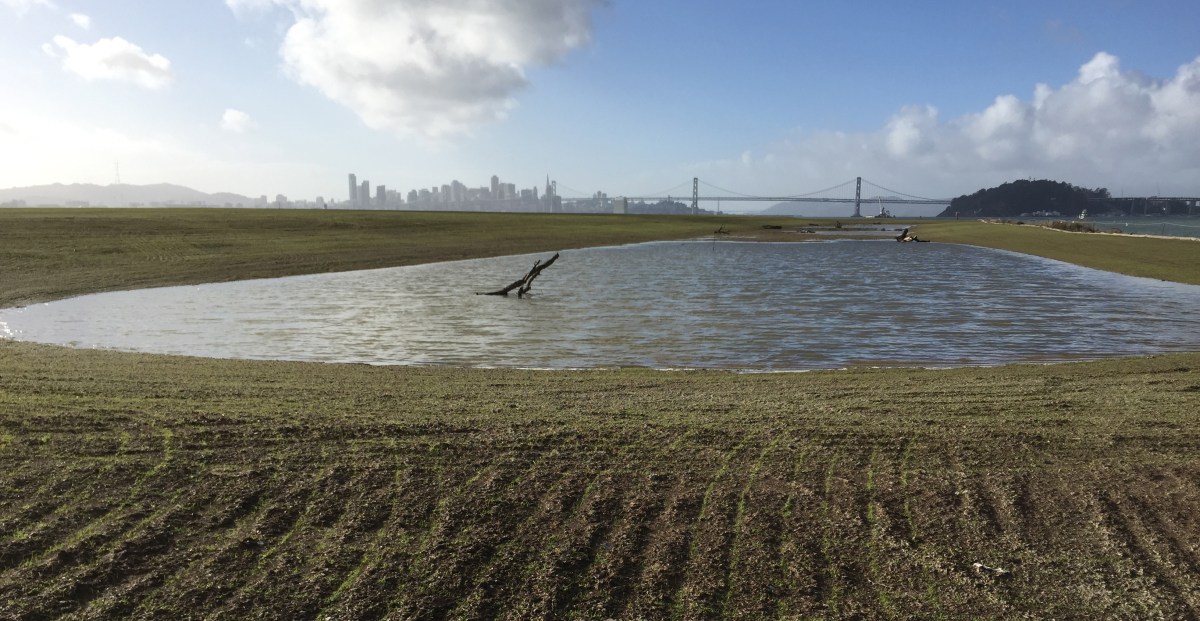
The Navy’s cleanup program has not only removed toxic substances from below ground, it has dramatically improved some of the above ground environment by creating new native grassland and wetlands. January rains filled the Navy’s new seasonal wetland on the northwest shoreline corner of Alameda Point and fostered growth of newly planted native grass seed on the surrounding soil.
New Site 1 wetland on January 13, 2016, with San Francisco in background. Rows in soil with emerging growth were created during sowing of seeds. Navy photo.
The 2.25-acre wetland lies within an approximately 37-acre shoreline cleanup area known as Site 1 at the confluence of the Oakland Estuary and San Francisco Bay. It is where the Navy buried its waste between 1943 and 1956. Most of the waste pits were covered by pavement in the mid-1950s when a new runway was added.Continue reading “Navy adds a wetland and grassland”
The city has received a prestigious award for its successful collaboration with a private developer on a brownfield redevelopment project—namely, Alameda Landing. The new retail and residential area is located near the Webster/Posey Tubes.
“The Landing is a complex project that lends itself to a public-private partnership,” said Debbie Potter, the city’s Community Development Director. Potter accepted the Phoenix Award on behalf of the city at the “Brownfields 2015” conference in Chicago. The award dovetailed with the conference theme of transforming blighted areas into productive sustainable development projects.
An old warehouse used for the Navy’s former Fleet Industrial Supply Center and a crane at the Port of Oakland provide a backdrop for condominiums nearing completion on Bette Street at Alameda Landing.
“Public-private partnership is pretty much the model at all former military bases. But it’s not a business model that every developer embraces,” said Potter. “Business is conducted in public.”
More business will be conducted in public early next year when Catellus is expected to approach the city council with revised plans for the last and final phase, which will include downsizing the previously approved office space and adding housing.
One project is selected from each of the 10 U.S. Environmental Protection Agency regions. Alameda Landing took home the award for Region 9, which covers California, Nevada, Arizona, Hawaii and Pacific Islands.
The city inherited a potentially valuable land asset from the Navy in 2000—a housing area that was to become Bayport, and an abandoned naval supply complex and hospital that was to become the Landing. Soon thereafter, the city selected Catellus as the developer.
Since then, challenges have been a frequent companion. The city and Catellus “had to work through infrastructure challenges, regulatory challenges, and financing challenges,” said Potter. “Virtually every aspect has required special attention, from soil conditions to retail makeup to the strength of the pier structure along the waterfront.”
As Bayport construction was underway, it became apparent that the initial proposed plan for 1.3 million square feet of research and development office space at the Landing was not viable. The time to adapt or die arrived early. “Being nimble throughout the process is key,” said Potter. “Without flexibility, you end up with no project.”
By early 2007, the city had decided to give Catellus wide latitude on what it was allowed by right to construct at Alameda Landing. Any configuration is allowed as long as the impacts, namely traffic, do not exceed the impacts identified in the environmental impact report.
The most significant changes were the slashing of office space to 400,000 square feet and the addition of up to 300 residential units at Alameda Landing.
In 2009, while the city and Catellus were waiting on the economy to rebound from the last recession, a fire of suspicious origin engulfed the abandoned hospital, which was still owned by the city. Lead and asbestos were incinerated in the fire. The added demolition and special cleanup costs amounted to several million dollars. The city will finally recoup all of its cleanup costs with a final payment from Catellus during the waterfront phase, according to Potter.
Wooden debris being cleaned up after a fire destroyed the abandoned Navy hospital in 2009. Location is about 100 feet west of Target at Alameda Landing. Looking northwest. Photo used by permission from City of Alameda.
Most of the Landing retail space is now filled, and the 284 residential units are nearing completion. “Tri Pointe is the first private multifamily housing constructed in Alameda since the charter amendment known as Measure A was enacted in 1973,” said Potter. “The Tri Pointe residential project was approved under provisions of the city’s Density Bonus Ordinance.”
Generous landscaping complements the loft-style condominiums at Alameda Landing near Target.
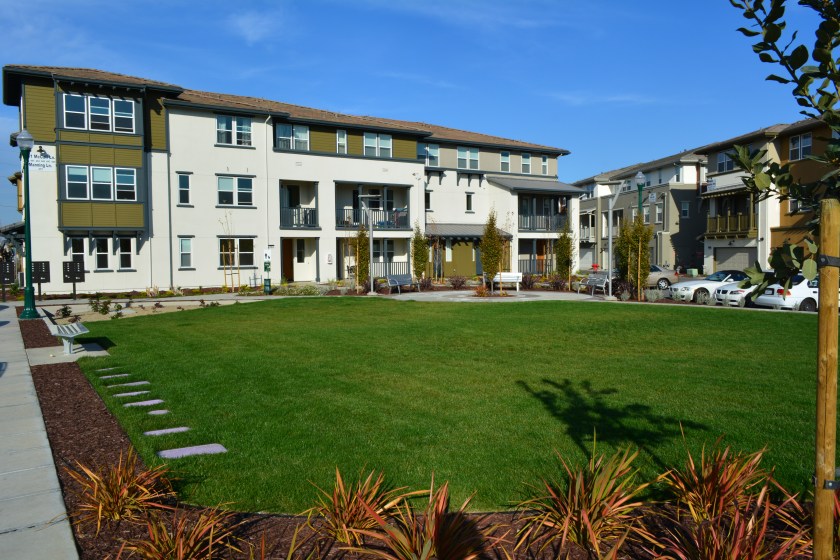
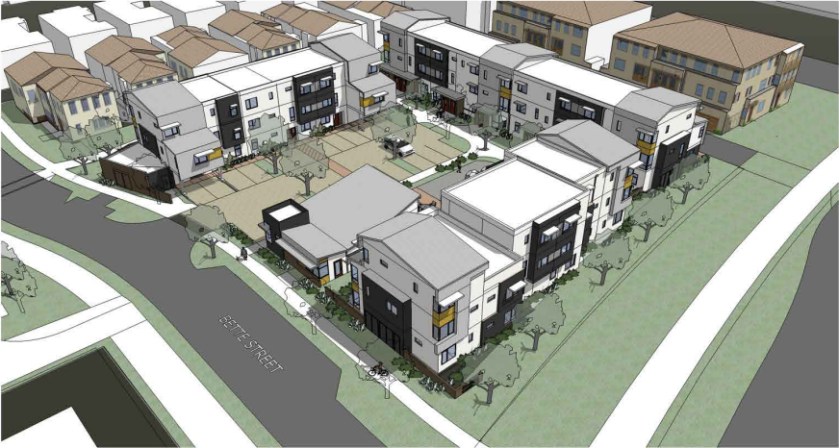
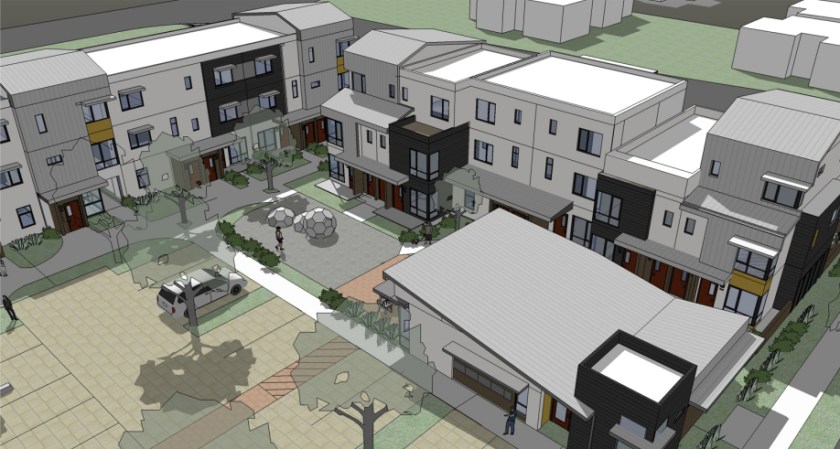
Construction is about to begin on Stargell Commons, 32 rental units for low- and very-low-income households, along with a community center. Catellus is bringing the infrastructure to the site and contributing $2 million for this project. The City of Alameda Housing Authority will own the land and lease the land to Resources for Community Development, which will build and manage the complex.
Stargell Commons, to be located at Bette Street and Stargell Avenue at Alameda Landing.
The final phase of the Landing—in the warehouse area between Mitchell Avenue and the Oakland Estuary that was originally slated for office space, a Miracle League baseball park, and a waterfront park and promenade—begins next year.
But first, the city council will be asked to approve a major revision that will include the addition of housing and the subtraction of office space due to weak demand. The Miracle League baseball park has been scratched because it’s now slated to become part of Estuary Park nearby, which Catellus contributed toward.
The authority for adding housing to the last phase of the Landing project originated in 2012, when the former city council updated the General Plan Housing Element, creating a Multifamily Overlay zoning designation. These special overlay zones, or sites, provide the rights for multifamily housing on specific sites. It designated 10 acres at 30 units per acre on the land north of Mitchell Avenue.
“It gives Catellus zoning rights to residential if they want to pursue residential,” said Potter. “No amendment to the development agreement or master plan is needed,” explained Potter. “But keep in mind that the zoning designation—multifamily overlay—is constrained by the requirement that any revised uses must fit within the environmental impact report and not generate additional impacts.”
The city currently owns the warehouse area north of Mitchell and collects about $800,000 a year in rent from two tenants. The land will be sold to Catellus upon approval of the revised plan.
The Phoenix Awards Institute, Inc., a nonprofit, administers the awards. The U.S. Environmental Protection Agency and the International City/County Management Association organized the national conference in Chicago.
Brownfield definition: “A brownfield is a property, the expansion, redevelopment, or reuse of which may be complicated by the presence or potential presence of a hazardous substance, pollutant, or contaminant.” Source: U.S. Environmental Protection Agency.
Additional info: California State Water Resources Control Board Brownfields Program.
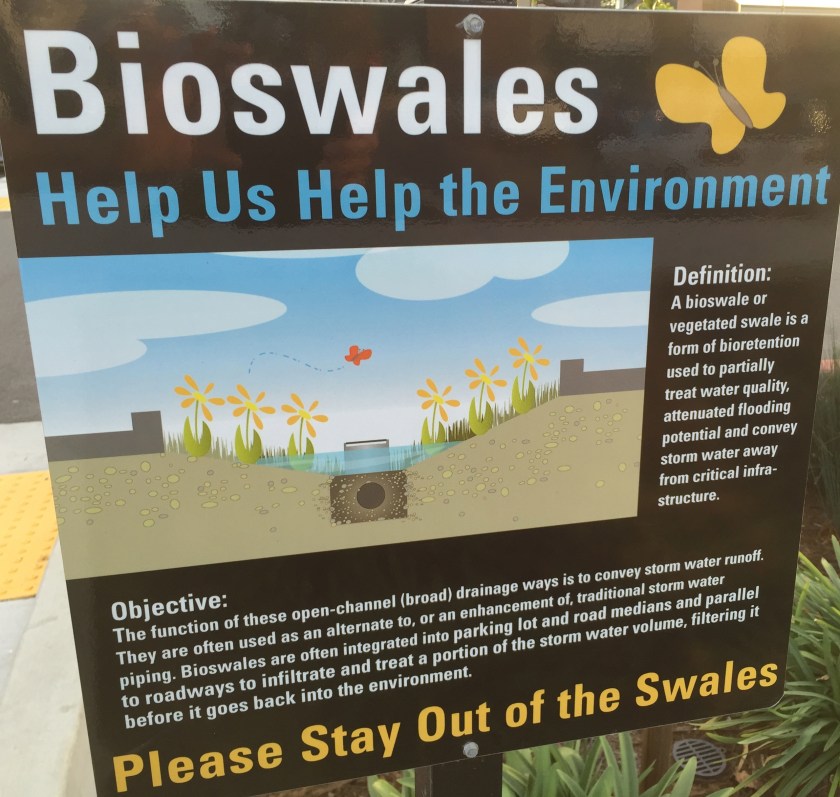
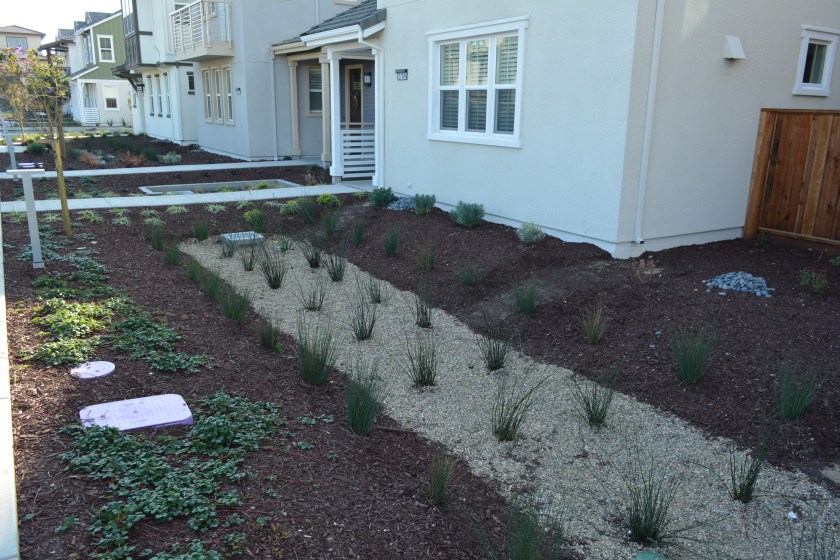
Stargell Commons courtyard close-up.Bioswale water filtration in the parking lot of Alameda Landing retail area.Description of “bioswales” in Alameda Landing parking lot.Bioswale natural filtration for water runoff in residential area of Alameda Landing.
The vacated residential area known as North Housing—located between Alameda Point and Alameda Landing—has been deemed environmentally safe for transfer out of Navy hands. The approval comes after a four-year effort to clean up groundwater to drinking water standards was declared unnecessary and terminated.
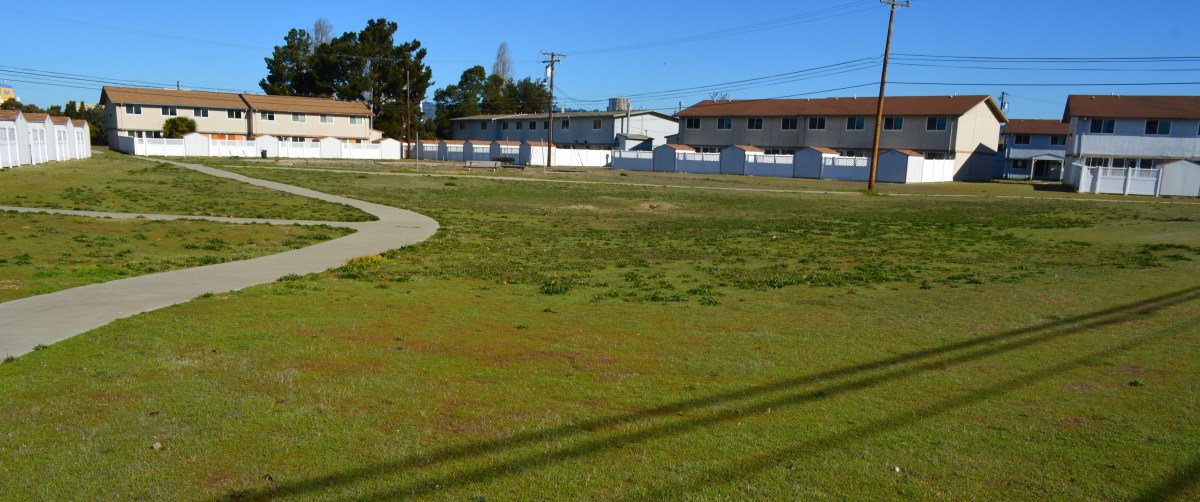
Center courtyard in former Navy housing area called North Housing. Looking north/northeast.
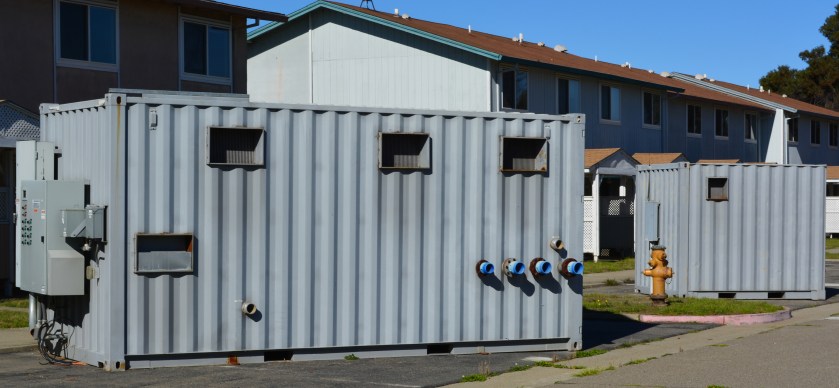
The original overly cautious risk assumption in the 2007 cleanup plan—that humans might somehow ingest the salty groundwater 10 to 20 feet below the surface—is now seen as implausible. The vapor extraction system covering a six-acre area of benzene and naphthalene-contaminated groundwater was dismantled in 2014 after a new round of tests showed that there is no evidence of harmful vapors rising to the surface.
The land was originally slated for transfer to the Coast Guard. But the Coast Guard decided in 2008 that it no longer wanted the property. The Navy and the city then worked out a plan that incorporates a federal requirement for homeless accommodation and a for-profit development.
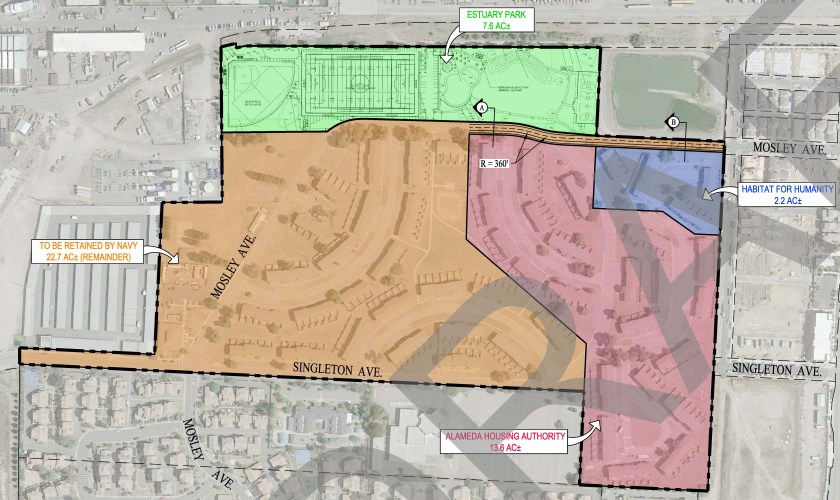
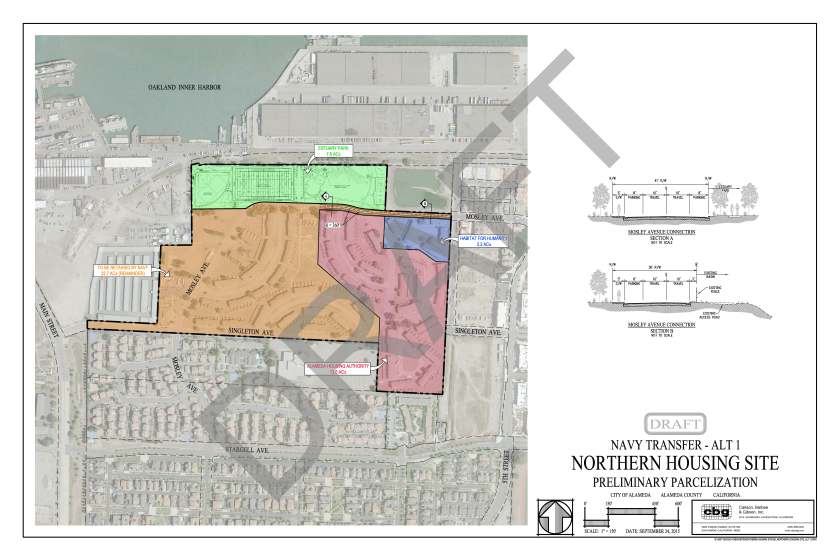
The 22.7 acres slated for auction to a private developer will be tagged with utility infrastructure costs—streets, drainage, utilities—on all of the North Housing area, except for the Housing Authority’s 13.6 acres and Habitat for Humanity’s 2.2 acres. The Housing Authority and Habitat for Humanity will be responsible for bringing new utility services from the nearest street to their housing units.
Draft map prepared by the city of Alameda showing proposed Housing Authority, Habitat for Humanity, and private developer parcels. Pending final approval. Dusty rose area going to Housing Authority, blue to Habitat for Humanity, tan to private developer. Click on map to enlarge.
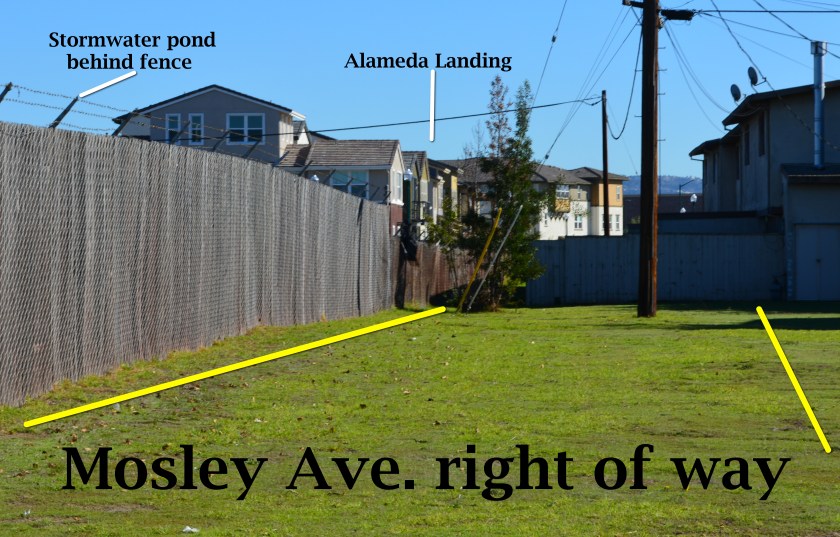
Mosley Avenue will be connected between Alameda Landing and North Housing with 360 feet of new roadway.
In 2013, the Navy turned off its air pump and carbon filter vacuum cleanup system to see if it made any difference in the concentrations or movement of contaminants. It didn’t.
But before the U.S. Environmental Protection Agency (EPA) would sign off on a permanent shutdown of the cleanup system, it wanted a new set of tests at ground level to ensure there is no risk of harmful vapors. The Navy conducted tests inside the vacant housing, in the crawl spaces, and under the parking lot and basketball courts at the former Island High School property. The negative results satisfied the EPA.
In April the Navy officially amended its original 2007 Record of Decision cleanup plan, with regulatory agency concurrence, citing new evidence. It also cited city, county, and state regulations that prohibit intrusive activities and specifically prohibit well installation in the shallow groundwater where the contamination is located. The cleanup plan amendment said that results of the evaluations of extensive data for this cleanup area “show that there is no unacceptable risk for current residential and school uses and any potential future land uses.”
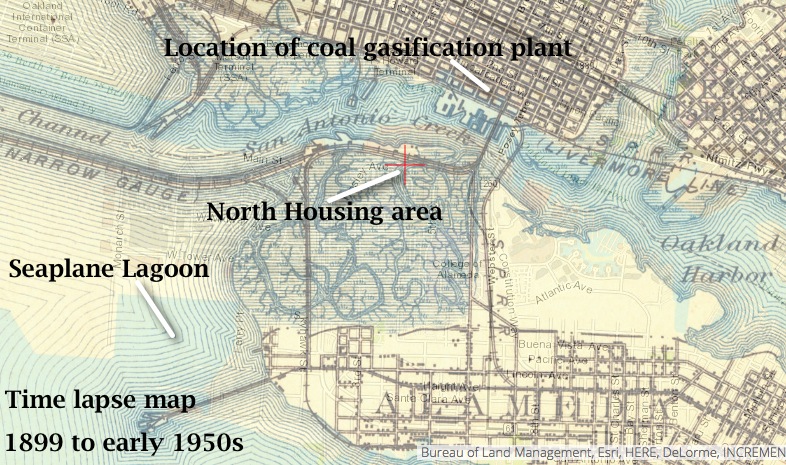
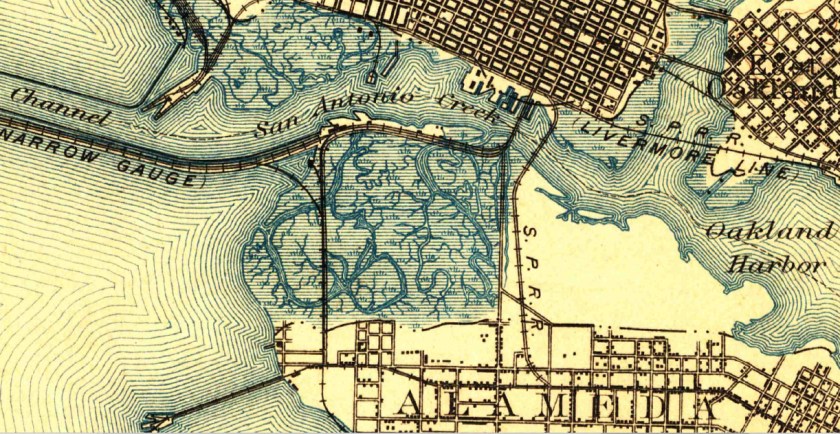
The amended plan also cited new evidence that suggested the contaminants were part of what is called the Marsh Crust at around 20 feet below ground and essentially stuck there. The Marsh Crust is a layer of “hydrocarbon gunk” that Oakland Gas Light Company’s coal gasification plant discharged from about 1880 to 1910. The waste discharges went into what was then San Antonio Creek, and much of it settled on the nearby marshland where North Housing now sits.
Time lapse map showing former marshland where North Housing is now located. Source: US Geological Survey Historical Topographic Map Explorer.
The land was never cleaned up before being filled in for use as San Francisco Bay Aerodrome—hangars and two runways—from 1930 to 1941. The Marsh Crust extends from the Oakland Estuary to Bayport and over to central Alameda Point. A city ordinance requires a permit before digging into the Marsh Crust to ensure safe handling.
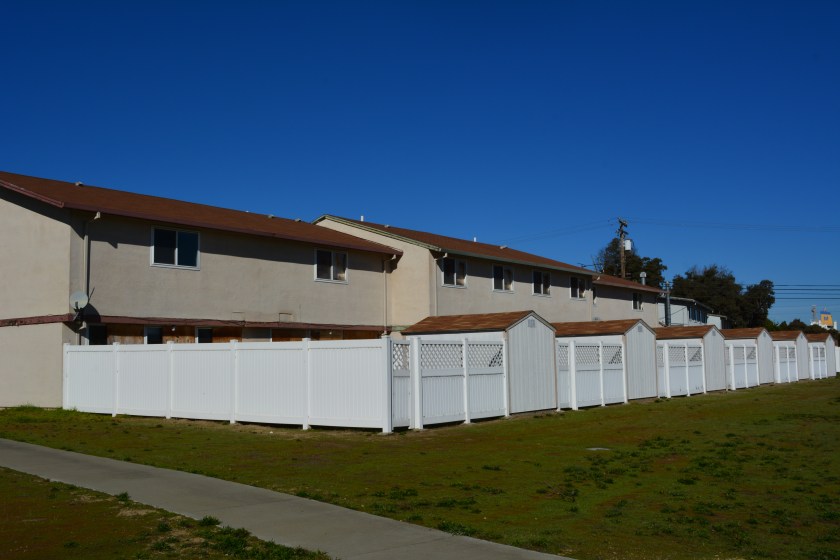
The 37-acre North Housing area lies adjacent to the new Alameda Landing residential neighborhood. The site currently contains 51 residential structures with 282 three- and four-bedroom units constructed in 1969. With the possible exception of the two acres going to Habitat for Humanity, all of the units will be demolished to make way for new construction.
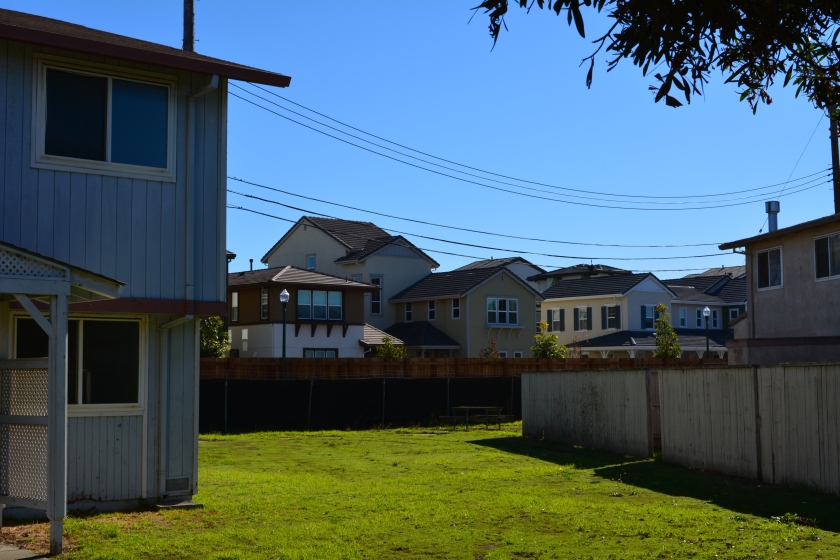
Future Housing Authority property, with new Alameda Landing houses in the background.
The Housing Authority will build 90 units of supportive housing that will include a community center.
It is not yet determined what Habitat for Humanity will do with its parcel. The private developer area is currently zoned for 315 units of multifamily residential housing and may exceed that number if the density bonus is applied for.
The transfer of properties is expected in 2016. The auctioning of the for-profit North Housing Navy property will follow, but no firm timeline has been announced.
Edited version of article first appearing in the Alameda Sun.
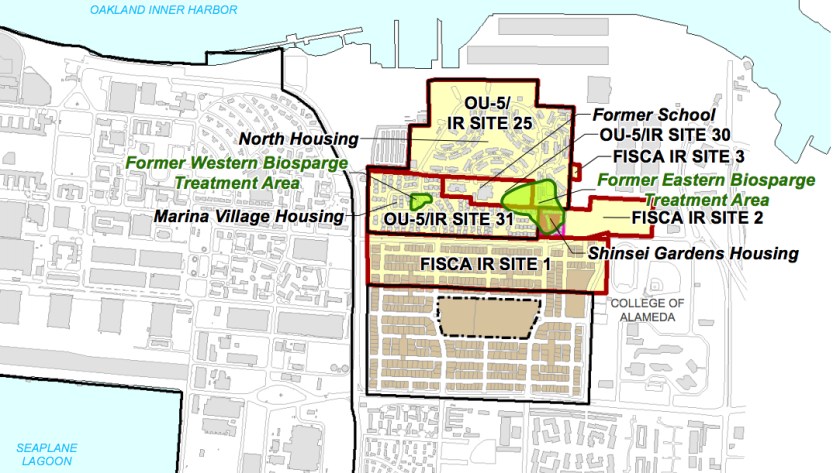
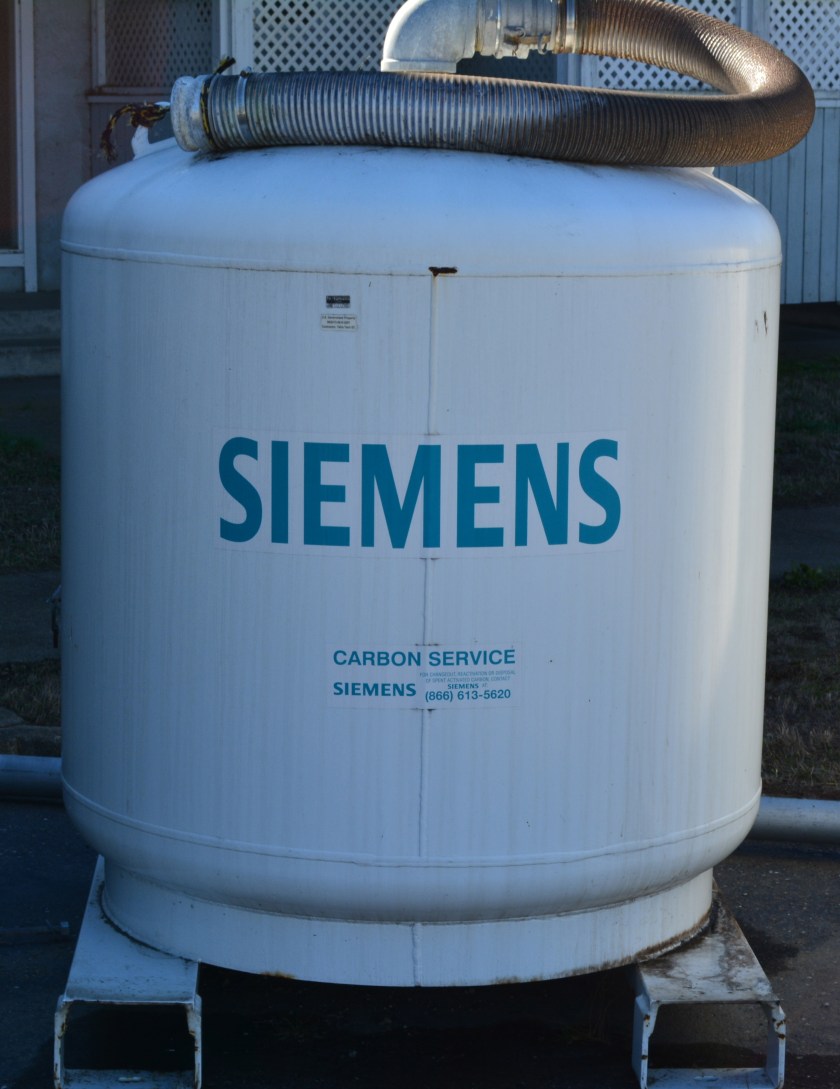
Map showing two groundwater cleanup areas in OU-5.Control module with pumps for groundwater cleanup system waiting to be hauled away from North Housing.Charcoal filter tank to remove benzene and naphthalene from groundwater vapors, waiting to be hauled away.
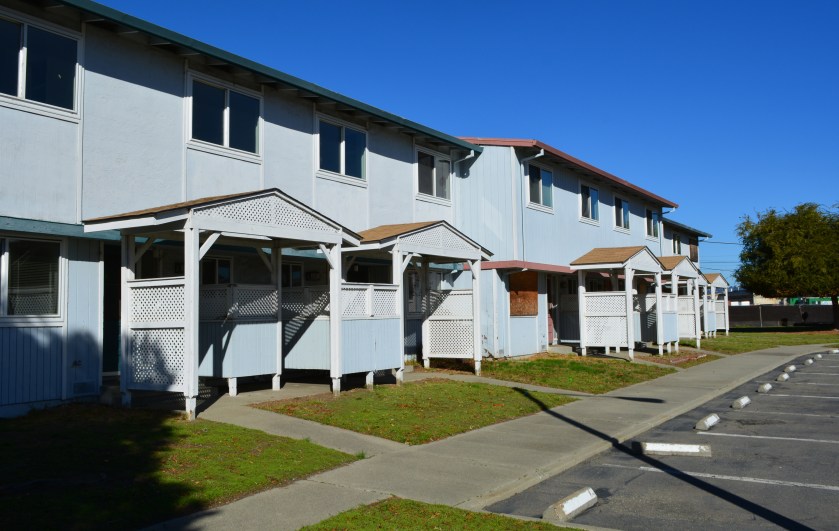
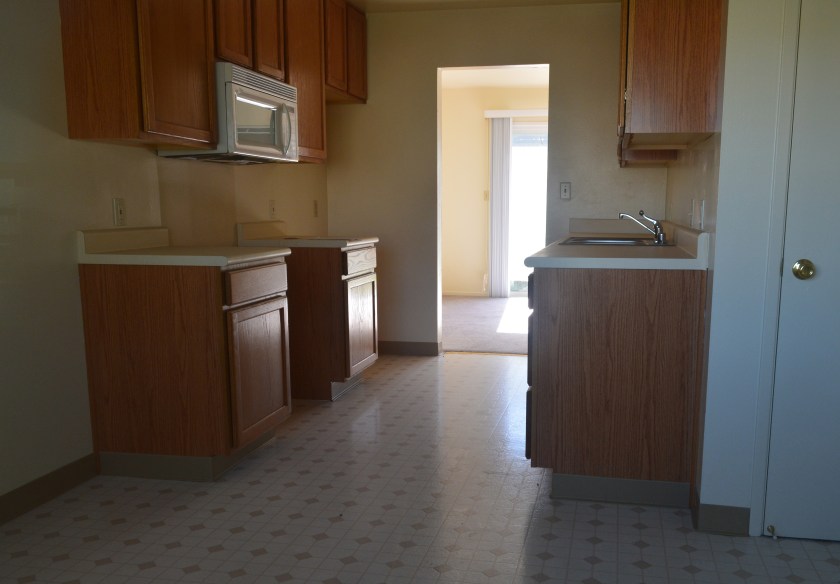
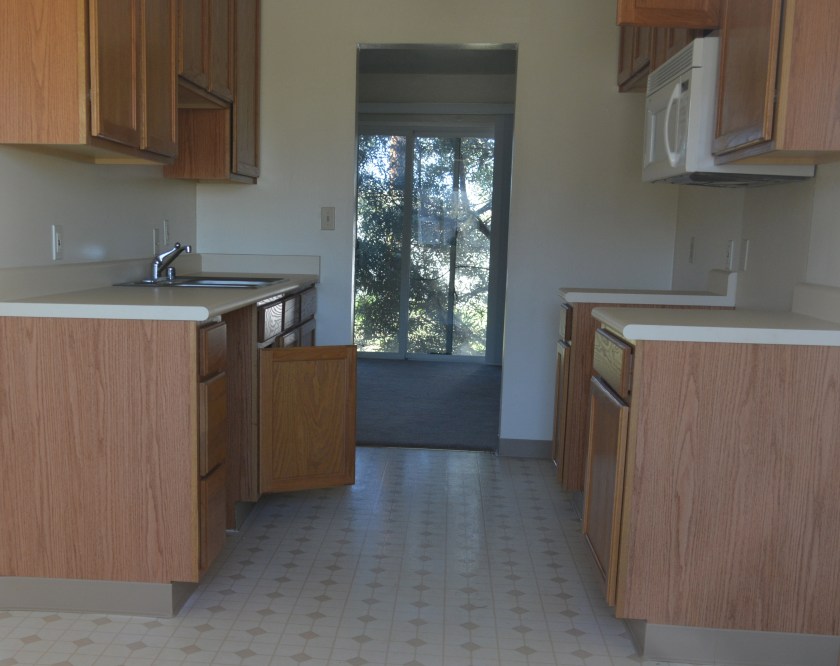
Typical current condition of North Housing interiors.Typical current condition of North Housing interiors. Photo date: November 19, 2015.
Draft North Housing site map, with Mosley Avenue connection details. Click on map to enlarge.1899 topographical map of western Alameda showing marshland. Source: US Geological Survey Historical Topographic Map Explorer.
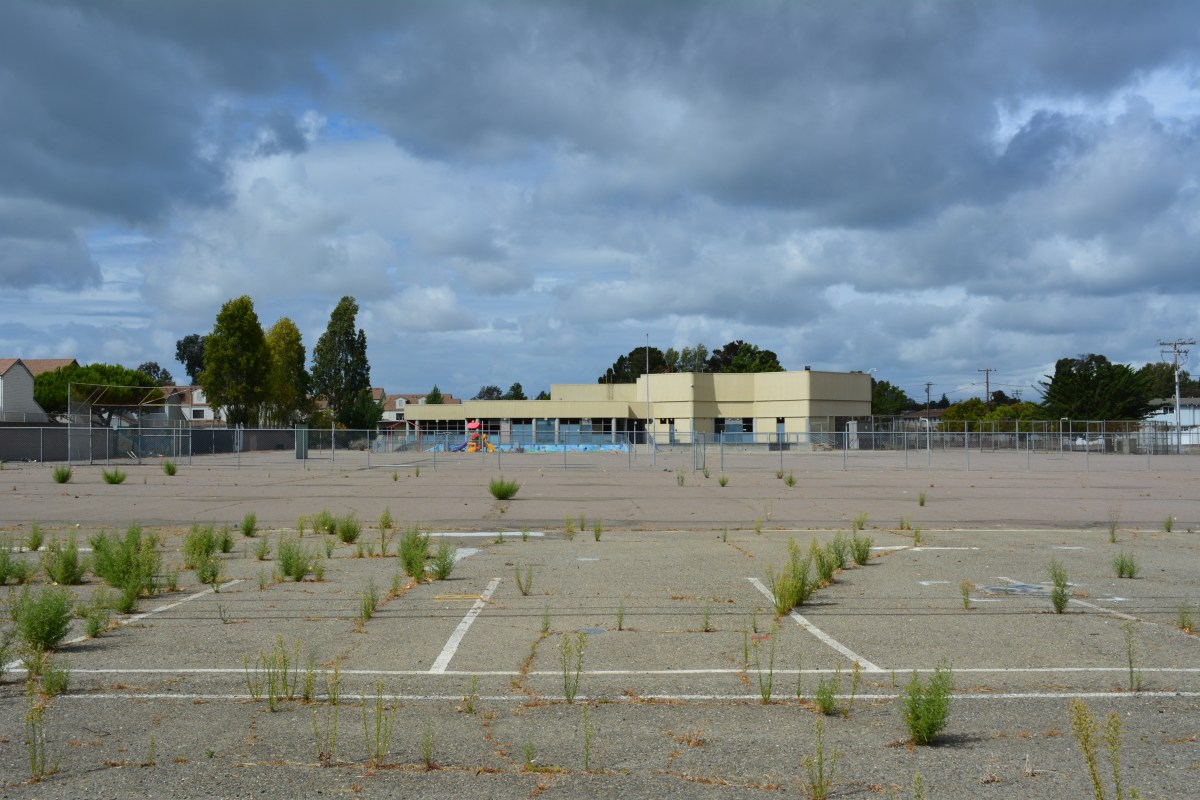
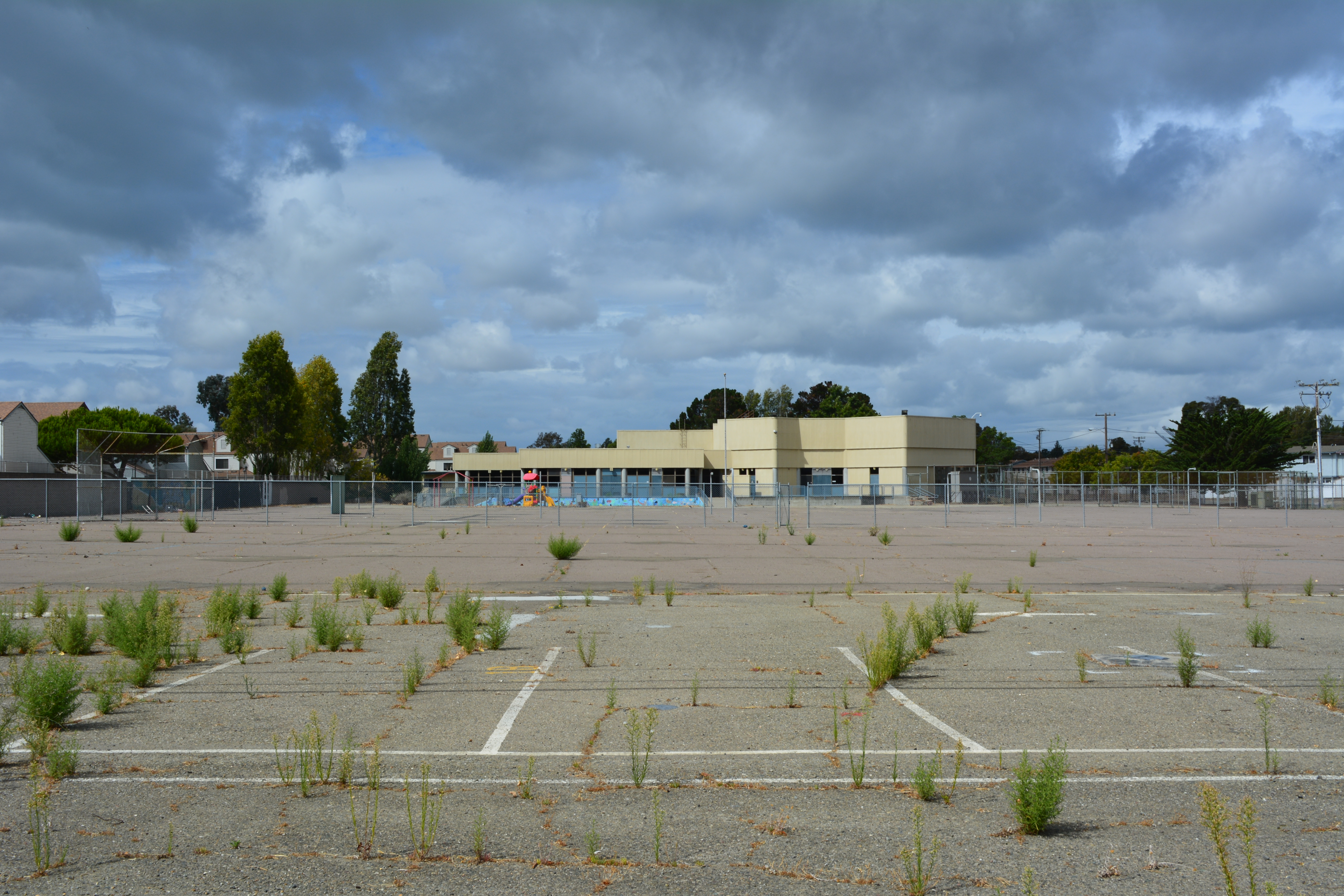
Newly available funds from the 2014 Measure I school bond, as well as the expected growth in student enrollment, prompted Alameda Unified School District (AUSD) to submit a request to the Navy in April to acquire the vacant Island High School and Woodstock Child Development Center parcel on Singleton Avenue on the city’s West End. The Navy responded favorably.
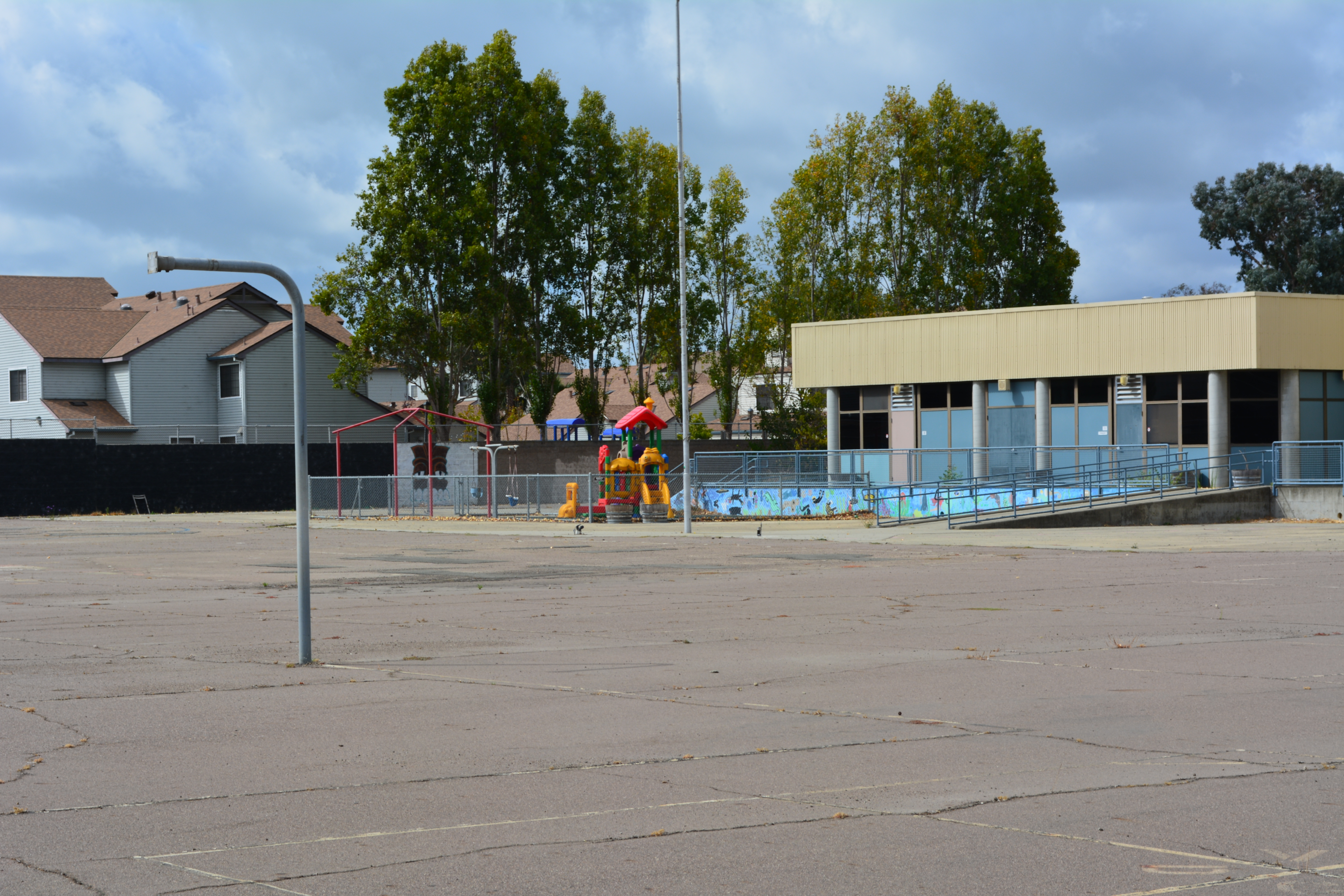
Vacant Island High School site on Singleton Avenue. Coast Guard housing is to the left. Singleton Avenue and vacant North Housing area is to the right. Woodstock Child Development Center is on the far side of the high school.
The school district previously leased the 5.9-acre parcel from the Navy at no cost. AUSD was slated to receive the two sites from the Navy under a previous application for a Public Benefit Acquisition. However, AUSD vacated the sites in 2010 and 2011 and withdrew their application due to the estimated hundreds of thousands of dollars required for upgrades to the sewer and water lines.
The school district has been resorting to creative desk shuffling in recent years to cope with a shortage of adequate space and lack of funds. One example given by School Superintendent Sean McPhetridge in the application to the Navy states, “One school has gone so far as to relocate a classroom computer lab into a former student toilet room to accommodate the growth of enrollment.”
Currently, the Woodstock Child Development Center and Island High School jointly operate on the site of the former Longfellow Elementary School. The acquisition of the property will allow the district to relocate those two programs back to Singleton Avenue where they previously operated.
Children’s playground equipment is from when the school housed Miller Elementary School prior to becoming a high school.
In the application, Superintendent McPhetridge describes a veritable ripple effect of efficiencies that would ensue as a result of the acquisition. It would “open the former Longfellow Elementary School site and allow the transfer of other programs from other elementary schools currently in operation, and in turn, it would open classroom space at many existing elementary schools,” stated McPhetridge. “The transfer of programs from existing elementary schools to the former Longfellow Elementary School site would provide for the growth of students at their neighborhood schools.”
A 2014 demographic study projects that the school district will add approximately 1,000 students over the next 10 years, the majority of them on the west side of Alameda. Redeveloped Alameda Point and Alameda Landing are projected to produce approximately 600 students.
“The District has not committed to a full modernization of the buildings at this time, but is planning on committing the funds necessary to open both campuses and provide safe and updated facilities,” stated McPhetridge in the application.
The property transfer process for public benefit conveyances involves sending the parcel from the Navy via another federal agency, in this case, the Department of Education. “The U.S. Dept. of Education approved this transfer and is now waiting to get the title from the Navy,” said Susan E. Davis, Senior Manager of Community Affairs at AUSD. “Once that happens, the Department of Education will give the title to us.”
“We’re hoping that the campus will be open sometime in the 2017-18 school year,” said Davis. “Designing, getting state approval, and doing the construction on school buildings can take some time.”
Singleton Avenue with vacant North Housing on the right. School parcel is on the left.
The Singleton Avenue school sites are located next to the Coast Guard housing to the south. Across the street and to the north of the school parcel is the vacant North Housing site, which is still owned by the Navy and zoned for a new residential neighborhood.






 Alameda Point Environmental Report