The groundwater remediation project between two buildings near the East Gate entrance, in the area known as Operating Unit 2B, finally got underway after a long delay in startup since last spring.
During set up, one of the 30-foot-long steel electrodes driven into the ground to generate heat struck a plastic sewer line. The sewer line was not on any maps and was undetectable through scanning since it is not iron. Operation of the system began last month after a sewer line bypass was installed, and it will continue through May.
Heating and extraction of solvents in groundwater between East Gate entrance and Seaplane Lagoon.
The contamination is from nearby aircraft maintenance operations that resulted in chlorinated solvents, used in cleaning aircraft parts, ending up deep underground in the groundwater. Of the three most common methods for cleaning up groundwater contaminated with solvents and fuels – pumping in neutralizing chemicals, heating up the ground to vaporize and extract the contamination, and bioremediation using microbes – the heat treatment method was chosen for this site because it is the fastest.
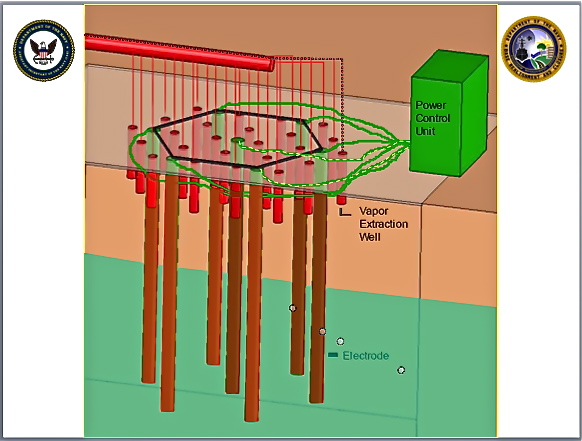
Graphic illustration of heat treatment system. Brown electrodes are heated with electricity, which heats the soil and groundwater, creating steam and toxic vapors that are sucked out into red pipe. Navy graphic.
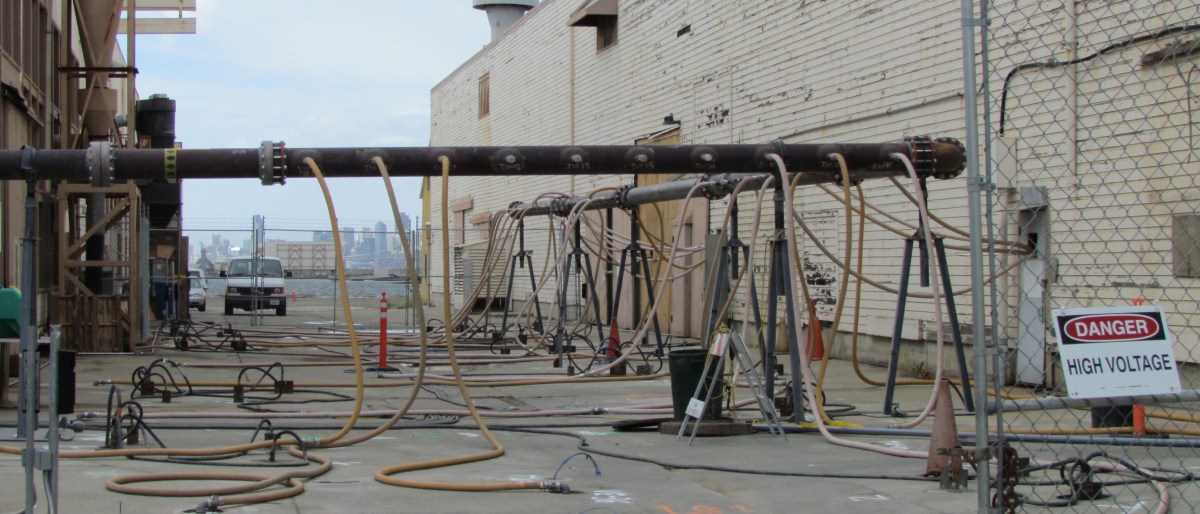
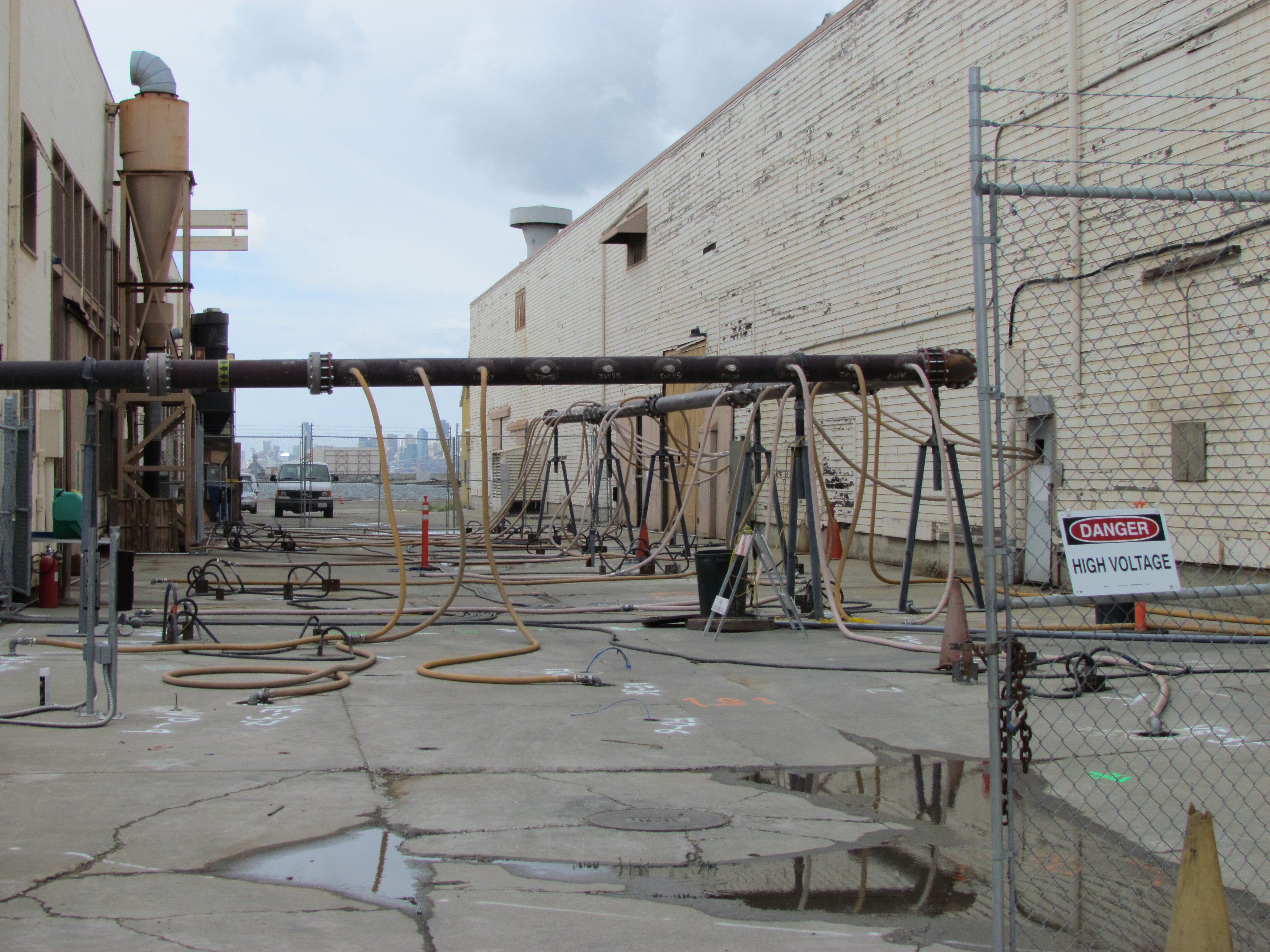
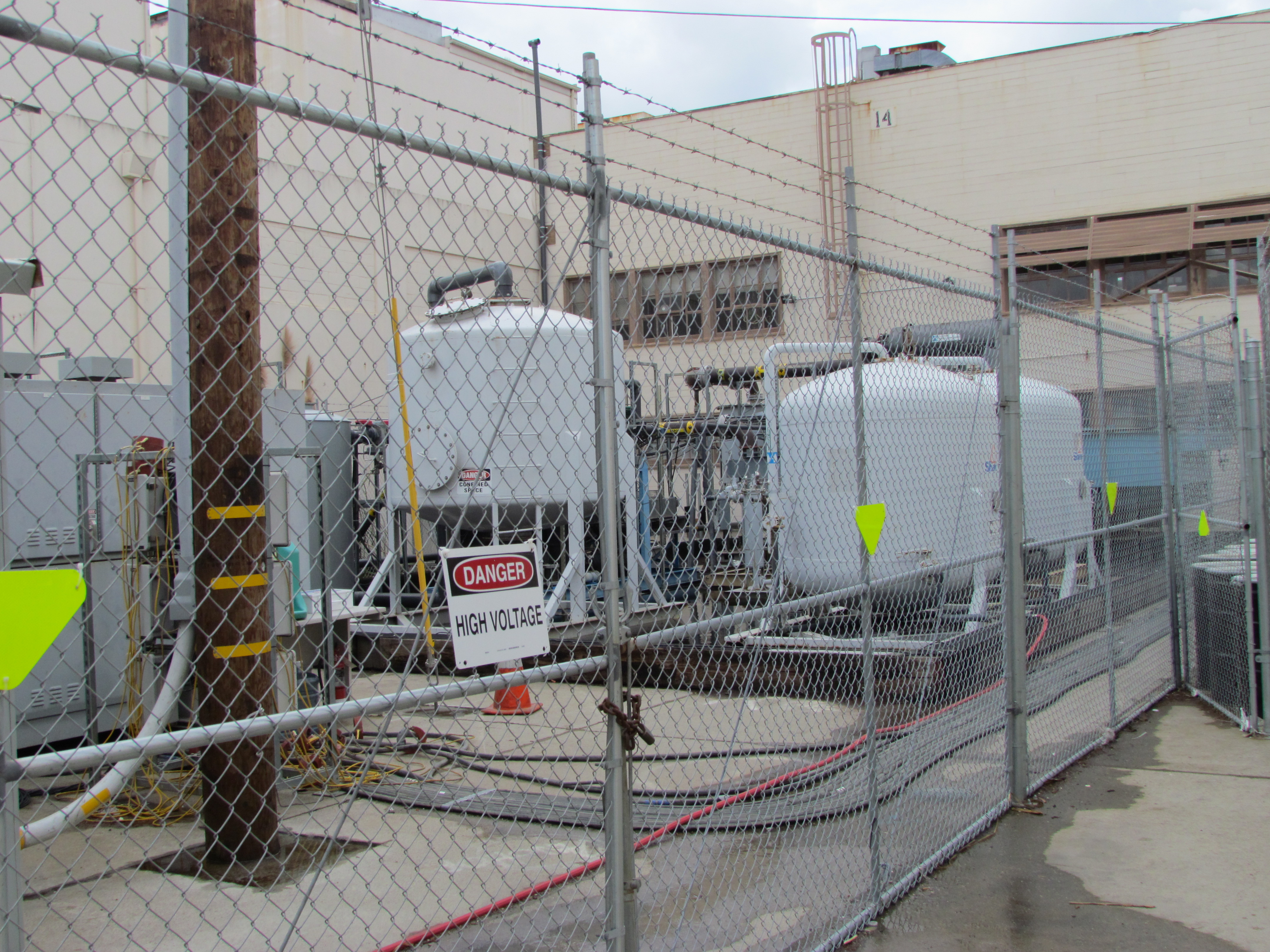
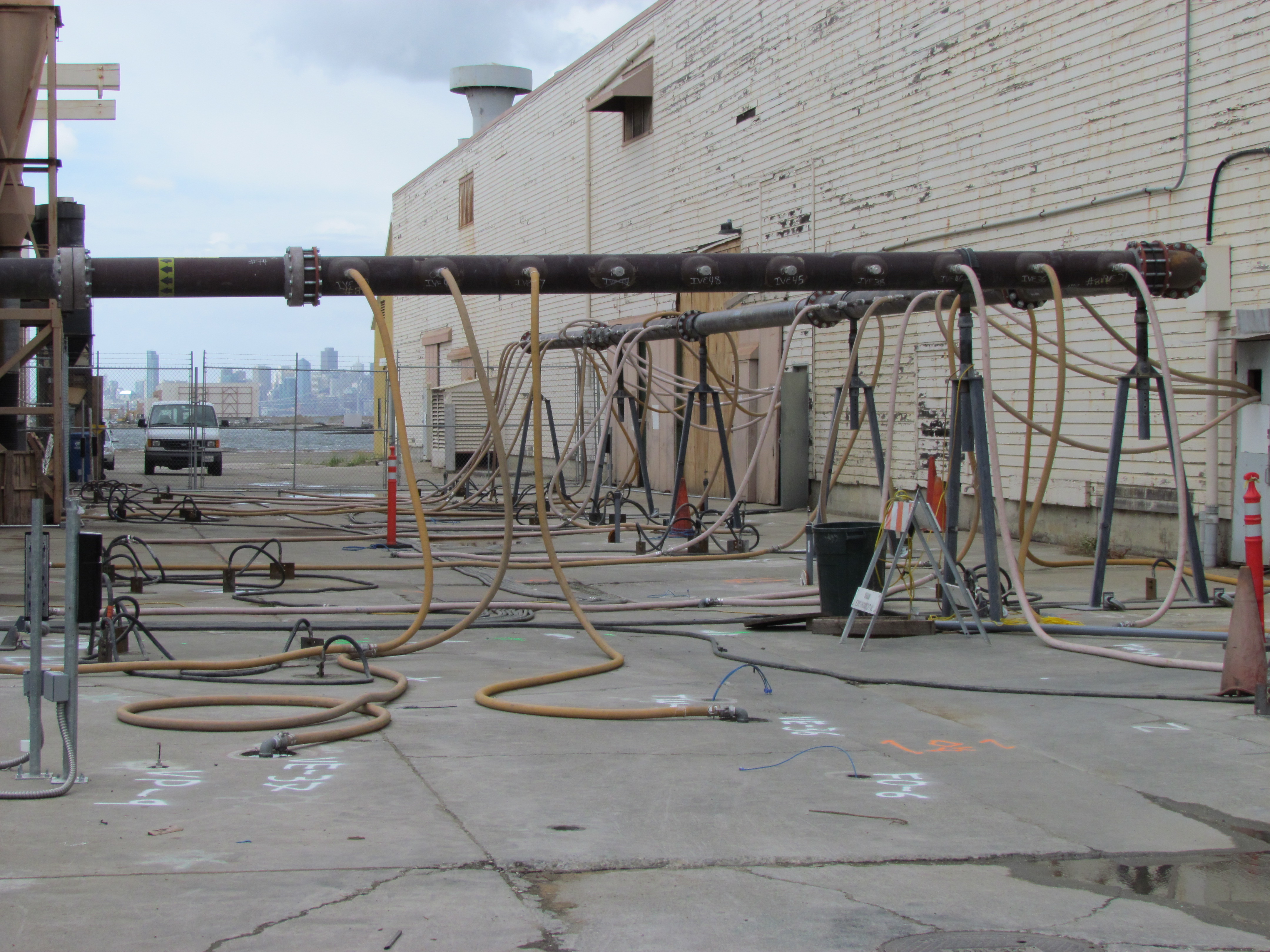
It takes weeks for the ground to get to the target temperature of 194 degrees, which is the temperature at which the solvent boils and turns to vapor. Pipes at ground level suck the vapor out of the ground and channel it through a large pipe to the granulated activated carbon filter system.
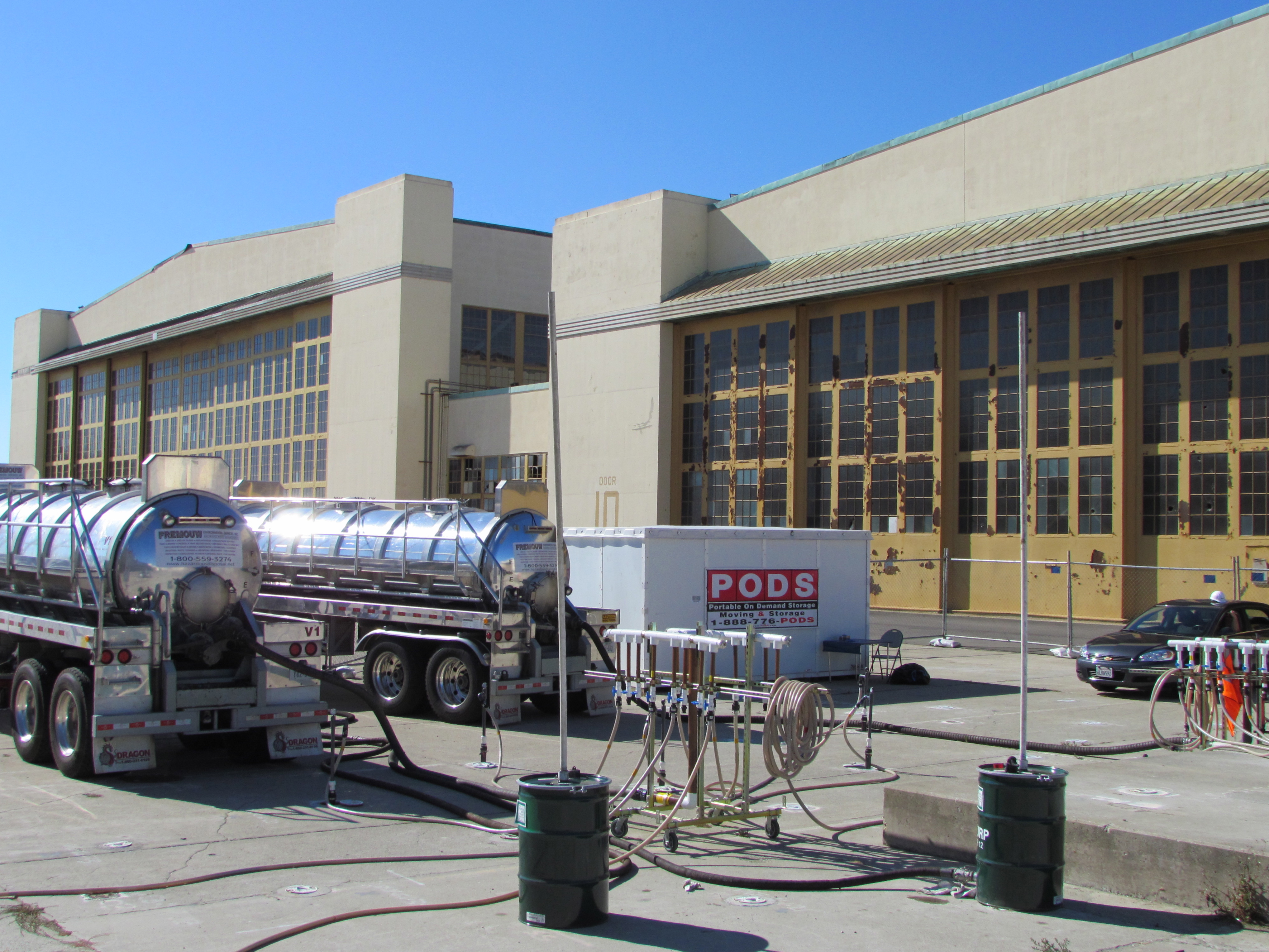
Granulated activated carbon filter system in tanks. Water vapor and toxic vapors are captured and separated.
Other groundwater contamination nearby will be treated by a different method not yet announced. The Alameda Point electrical substation is near the other treatment area, and underground electrical lines leading every which way preclude the use of electrodes to heat the groundwater.
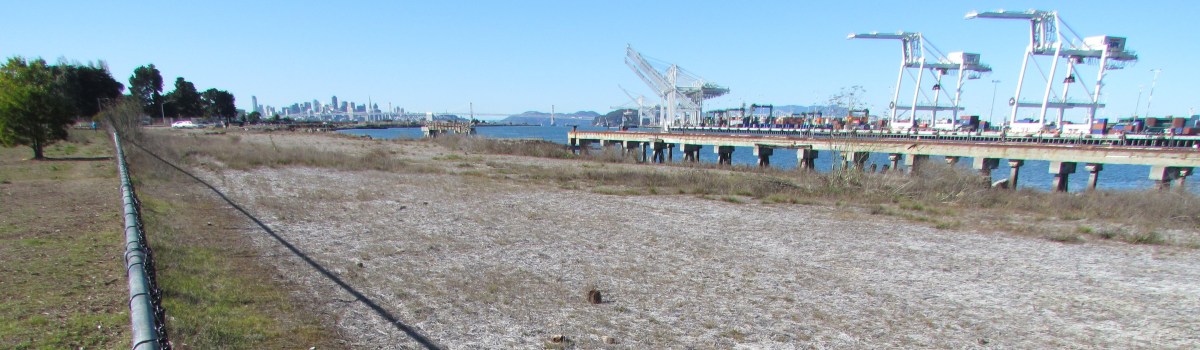
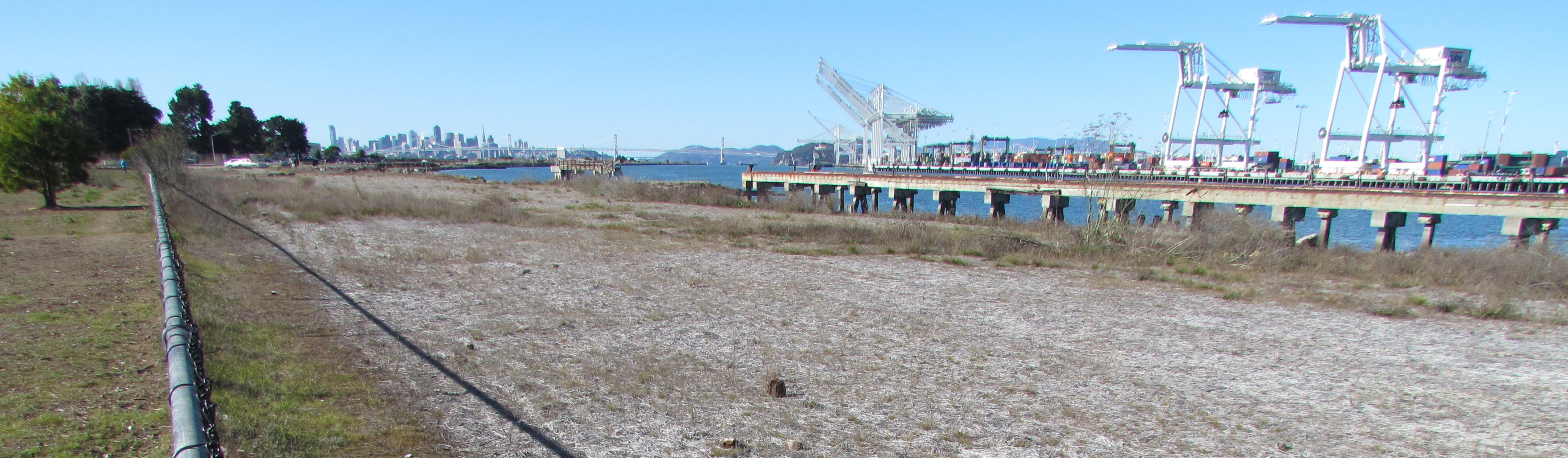
Todd Shipyards/Site 28. Dog Park to left of fence, Port of Oakland on right.
Right next to the Main Street Ferry Terminal, between the Oakland Estuary and the Dog Park, is the Navy’s cleanup Site 28, also known as the Todd Shipyards site. The contamination at this site — copper and arsenic, and to a lesser extent lead and hydrocarbons — was not the result of Navy activities, even though the Navy owns the property.
Background
Filling in the land with estuary dredge soil contaminated with hydrocarbons from the coal gasification plant that once operated in Oakland was likely responsible for the petroleum-related hydrocarbons in the ground. The Alameda Mole Railroad operated along this route from 1883 until 1939 and was also a possible contributor to the hydrocarbon residue in the soil. Non-Navy shipbuilding and repair between 1941 and the 1980s was responsible for lead, arsenic, and copper contamination.
According to the Navy fact sheet, “The property was leased to various entities for non-Navy shipbuilding and repair between 1941 and 1970. The property was purchased from the Navy in 1970 by the Todd Shipyards Corporation, which used the land as an extension of its adjoining shipyard property until 1983, when the property was then sold to Alameda Gateway Limited. The IR Site 28 portion of the former shipyard reverted to Navy ownership in 1995.”
Paint used on ships
The copper contamination came from paint used on the bottoms of ships. The paint was an anti-fouling paint that served to prevent the growth of barnacles. Copper in the paint acted as the biocide, which is why possible leaching into the estuary is a big concern.
Emerging cleanup technology
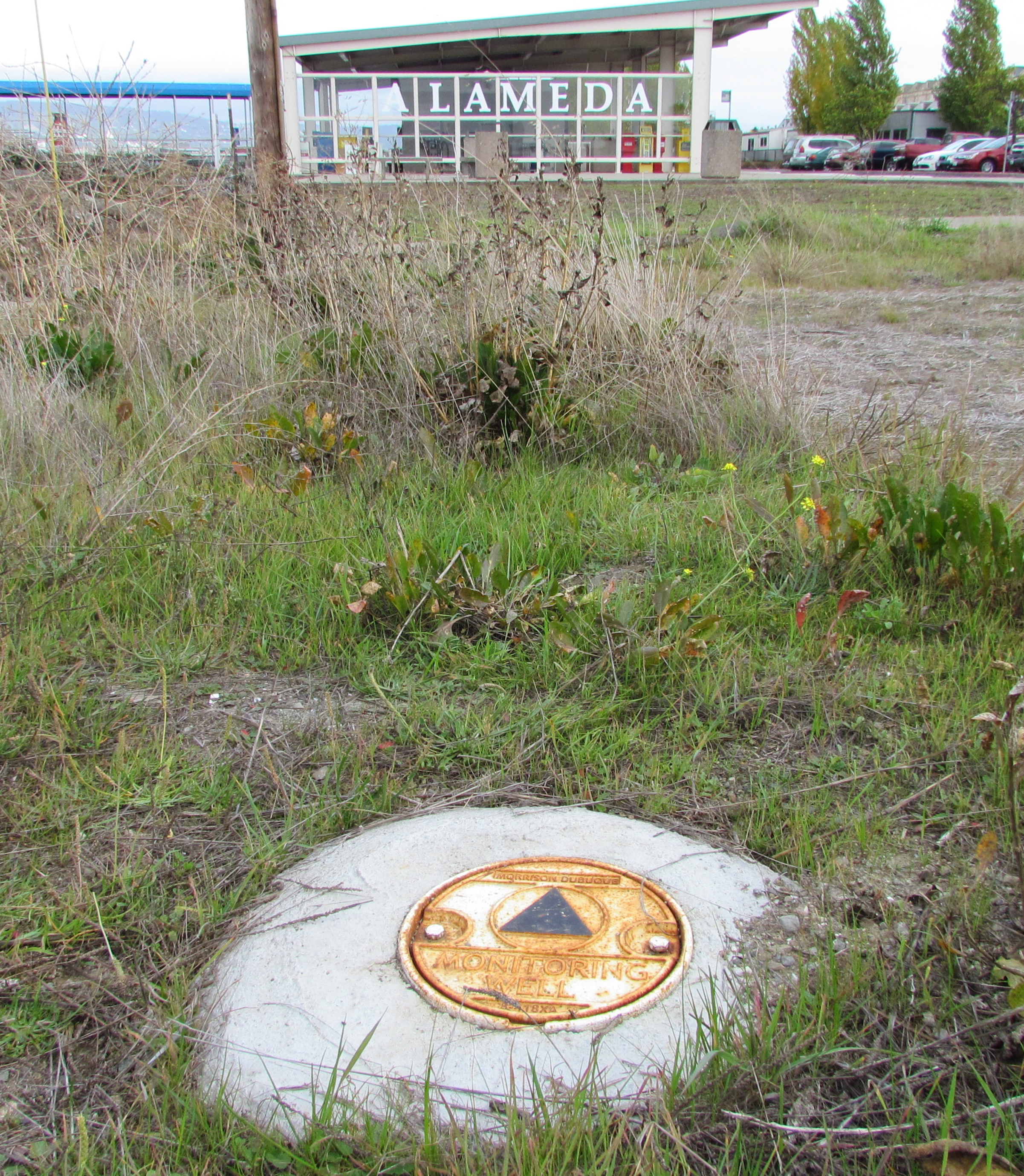
Todd Shipyard/Site 28 groundwater monitoring well. Alameda Main Street Ferry Terminal in background.
Even though the Navy did not cause the contamination, they are responsible for the cleanup, which it performed in 2010. They are also responsible for monitoring the groundwater for 10 years to make sure their methods are permanent. Some of the methods used here were straightforward: Digging up soil and replacing with new soil.
The copper at groundwater level, however, is being dealt with by an emerging technology called metals immobilization. In this process a proprietary non-toxic compound is injected into the ground to bind to the copper and cause it to be absorbed into soil particles, which will prevent it from leaching into the estuary and harming aquatic life. Hence, the term immobilization – the copper is no longer mobile, or able to move. Water and natural microbes in the ground are what activates this immobilization compound. A helpful byproduct of this reaction is that food (carbon) for natural microbes is released, further enhancing the effectiveness of this process.
So-called emerging cleanup technologies are halfway between experimental and mainstream. They have been proven effective in the short term, or in some locations, but have not been in widespread use long enough to be considered 100% effective in every soil type. No one knows for certain if the binding effect will hold, but pilot lab tests were done on soil from Site 28, and the Navy and regulators fully expect it will work. If groundwater monitoring indicates that it’s not working, the Navy will have to come up with another plan since there is no statute of limitations on their responsibility for cleanup.
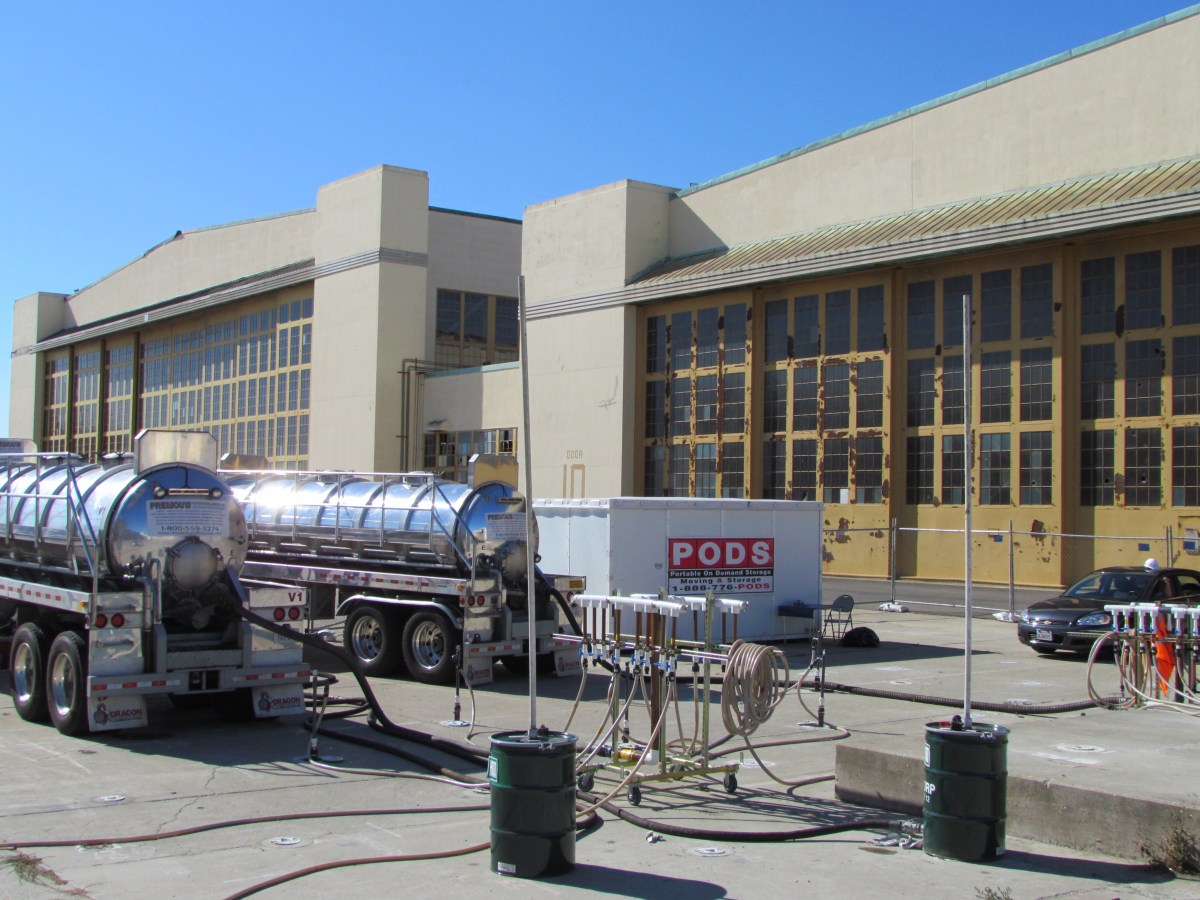
Tanker trucks sucking jet fuel out of the ground next to Building 5. Looking northwest.
Background
The Navy has three cleanup programs at Alameda Point: Superfund, Petroleum, and Radiological. The Petroleum Program takes care of underground concentrations of petroleum, mostly jet fuel, and is organized by corrective action areas. One such area outside Building 5 made it onto the calendar this year.
Dumping jet fuel – Building 5, the largest hangar at the Point, was a busy aircraft maintenance facility. Petroleum products like jet fuel were often disposed of down a drain, which in this case would have gone to an underground oil/water separator. A Navy contractor concluded that jet fuel detected in test wells outside of Building 5 on the south side could have leaked either from the oil/water separator, or the drain line, or both. The area has been designated Corrective Action Area 5B (CAA 5B). Continue reading “Cleaning Up Jet Fuel at Building 5”
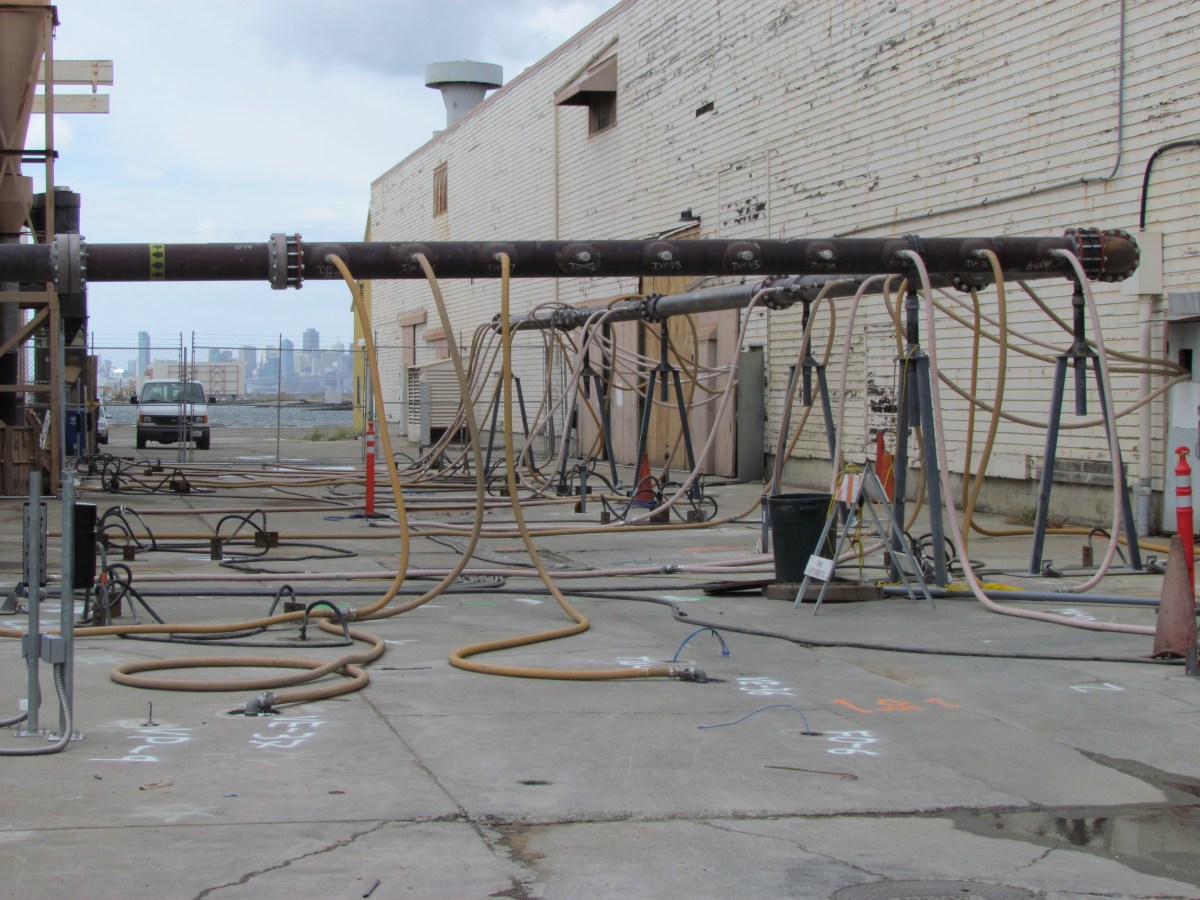
Hoses carry vapors to large pipe that leads to filter system. Vapors are created using high-temp electrodes that extend 30 feet into the ground. Seaplane Lagoon and San Francisco are in background.
There are various methods to clean up groundwater contaminated with solvents and petroleum products. Beneficial chemicals can be injected to neutralize the toxic chemicals. Sometimes bacteria, either those naturally present or some that have been added, can do the job. In some cases at Alameda Point the Navy inserts steel beams called electrodes into the ground that are hooked up to their own power line. They dial up the power to 1,100 amps (a household electric stove is around 40 amps), and let the heat turn the chemicals into vapor. This is the method the Navy is using in a limited application just east of the Seaplane Lagoon. Continue reading “Cleaning up a toxic groundwater plume using heat”
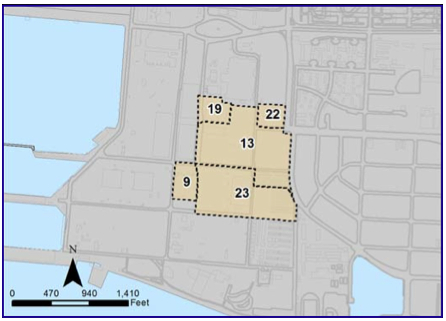
OU-2A cleanup area - Seaplane Lagoon and USS Hornet are to the left - numbered areas are individual site #s
After years of investigation, the Navy, along with the federal and state regulators, has come up with a remediation plan for 39 acres, encompassing five sites, called Operating Unit 2A. On Wednesday, August 31, the Navy will spell out its plan for remediation and solicit comments. The meeting will be at City Hall West at Alameda Point, 950 West Mall Square, Room 201 from 6:30 pm to 8:00 pm.
Operating Unit 2A is roughly one block away from the soccer fields on the south side of Alameda Point and one block away from the USS Hornet. The Unit has contamination issues that date back to 1879 when the Pacific Coast Oil Works Company began operating an oil refinery near Main Street.
The main two highlights up for discussion are:
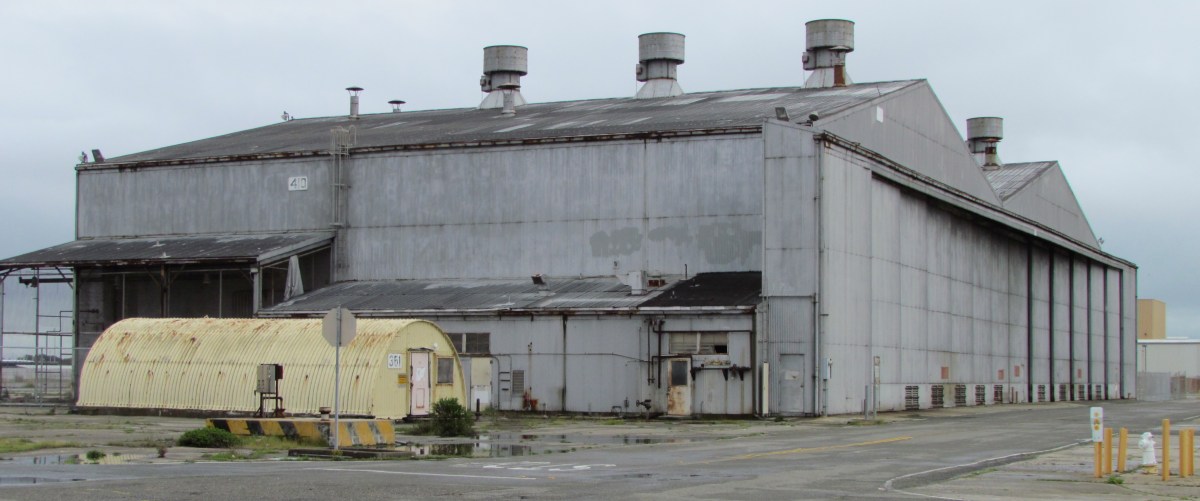
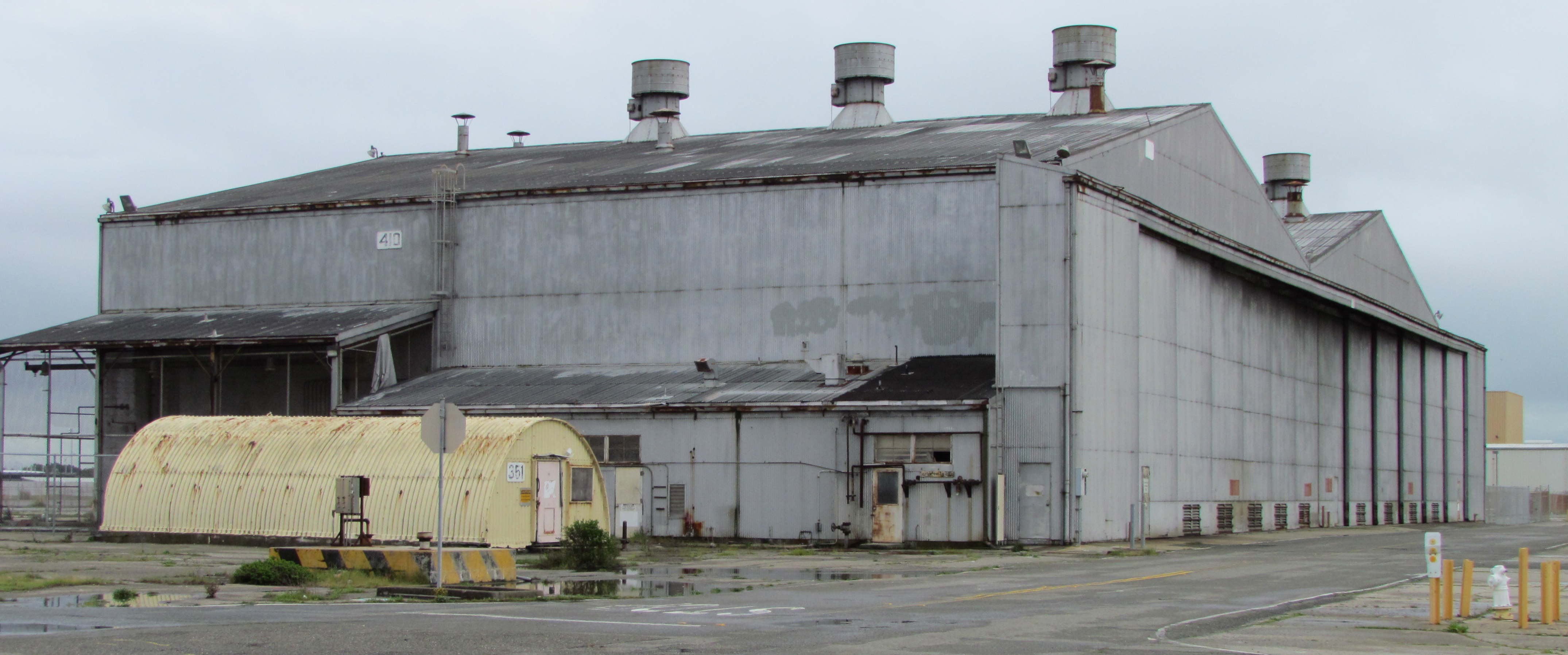
Building 410
Building 410 is where the Navy operated an aircraft paint stripping facility. The soil was found to be clean, but toxic chemicals seeped into the groundwater. The conclusion reached by the Navy and regulators is that no active remediation efforts need to be conducted. Instead, they will rely on “natural attenuation,” which means to let nature take its course through dilution, dispersion, and biodegradation of the contaminants.
Building 410 - former paint stripping building
Their rationale for not undertaking a vigorous program to clean the groundwater to drinking water safety levels is that no one will ever be using it for drinking water, especially because of high salt content. No wells are permitted and, even if a well was desired for drinking water, there is pure water at the much deeper 100-foot depth. They also claim that vapors will not intrude into structures because it is in the second water-bearing zone and, therefore, the water zone above will act as a barrier. Continue reading “Navy Announces Cleanup Plans – Public Meeting August 31, 2011”
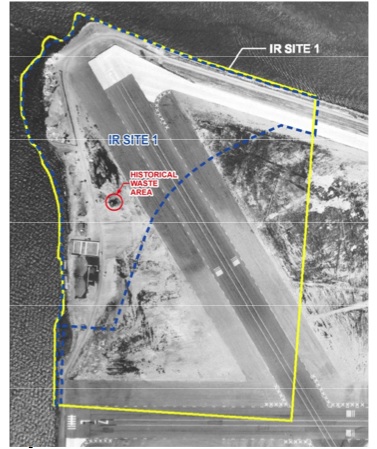
Site 1 indicated by blue line. Yellow line indicates entire area used by Navy as a disposal area from 1943 to 1956. Red indicates waste pit that caused groundwater contamination. Navy photo and overlay.
Groundwater
The Navy is proceeding with plans to remediate contaminated groundwater at the old disposal site at the northwest tip of Alameda Point. The contaminated groundwater is within the area known as Site 1, which encompasses over half of the old dump. In one particular area of the dump, the Navy routinely dumped liquid waste material. No one knows for sure how much of it was in drums that may still be rusting away, and how much was just poured into the pit.
Some current and former members of the Restoration Advisory Board (RAB) have long been concerned as to whether the size of the plume has been adequately characterized, meaning how wide and how deep. The main issue is its proximity to the Bay and whether remediation measures will prevent any of the hazardous compounds from entering Bay water. Continue reading “Environmental Cleanup – Update on Site 1”

 Alameda Point Environmental Report