Two possibilities for Alameda Point VA property following veterans project cancellation

Alameda could find itself back at square one, or at least close to it.

In September 2025, Representative Lateefah Simon informed city officials that the U.S. Department of Veterans Affairs (VA) had decided to cancel plans for a clinic and columbarium cemetery at Alameda Point.  The news became public when a letter to the VA from Congresswomen Lateefah Simon and Nancy Pelosi and Senators Adam Schiff and Alex Padilla was released on December 12, 2025. 

The congressional delegation urged the VA to reconsider its decision to terminate the project.  On December 15, 2025, public officials and representatives of veterans organizations made a similar plea on the steps of Alameda’s Veterans Memorial Building. 

If the VA sticks to its decision to terminate the project, it is unclear what will happen next. But two land-disposal processes are on the table.

The delegation’s letter to the VA questioned why the agency plans to turn over the land to the federal General Services Administration (GSA), which handles disposing of real estate.  The congressional delegation pointed out that the land could go back to the Navy, according to the VA/Navy land transfer agreement.  The letter explained that the “VA and the Navy have a binding agreement that requires VA to notify the Navy of its decision to terminate the project within 30 days of its determination, and permits the Navy to receive the property if VA makes such a decision within fifteen years of this 2014 agreement.” 

This means either the GSA or the Navy will dispose of the federal land.  History and current events will likely play a role in both scenarios.

Continue reading “Two possibilities for Alameda Point VA property following veterans project cancellation”

Caspian and Elegant Terns join Least Terns to nest at Alameda Point

Naval Air Station-Alameda gained notoriety as a refuge for the endangered California Least Tern when the base closed in 1997.  Over 500 acres were dedicated to protecting the terns’ adopted nesting site next to a runway formerly used by jet aircraft. 

This unlikely bird habitat for the Least Terns some 400 miles north of their historic breeding grounds along the southern California coast offered the birds something they had lost, which drove them to the brink of extinction – nesting sites free of human disturbance near a source of small fish to feed their chicks. 

Surprisingly, two other tern species have recently begun nesting in the vicinity.  Elegant and Caspian Terns seem to be thriving there, while the endangered Least Terns are struggling.

Continue reading “Caspian and Elegant Terns join Least Terns to nest at Alameda Point”

Guns and Traps Used to Protect Least Terns at Alameda Point

The endangered California least terns that nest on the old airfield at Alameda Point are well protected during their April to August nesting season.  Fencing keeps people away from the 10-acre sandy nesting site, but it won’t stop other birds and mammals from getting to the eggs and the helpless chicks.  Only a well-armed and outfitted predator management officer can effectively deter other animals.

Every year, the U.S. Fish and Wildlife Service hires a wildlife biologist from Wildlife Services, a division of the U.S. Department of Agriculture.  Typically used for protecting crops and livestock, the agency is also hired to protect dozens of endangered species every year.  The most recent field report available for Alameda Point is for 2019, obtained through the Freedom of Information Act.

The report describes a variety of methods used to deter or eliminate threats to the nesting terns.  First, loud noises and bright flashes of light are fired from a gun to frighten away an avian predator, called hazing.  Second, the wildlife biologist drives a vehicle toward an avian predator, another form of hazing.  Third, predators are trapped.  And fourth, as a last resort, the biologist is left with no other choice than shooting the predator with a shotgun or rifle or euthanizing. 

Continue reading “Guns and Traps Used to Protect Least Terns at Alameda Point”

Wetland contract awarded for Alameda Point

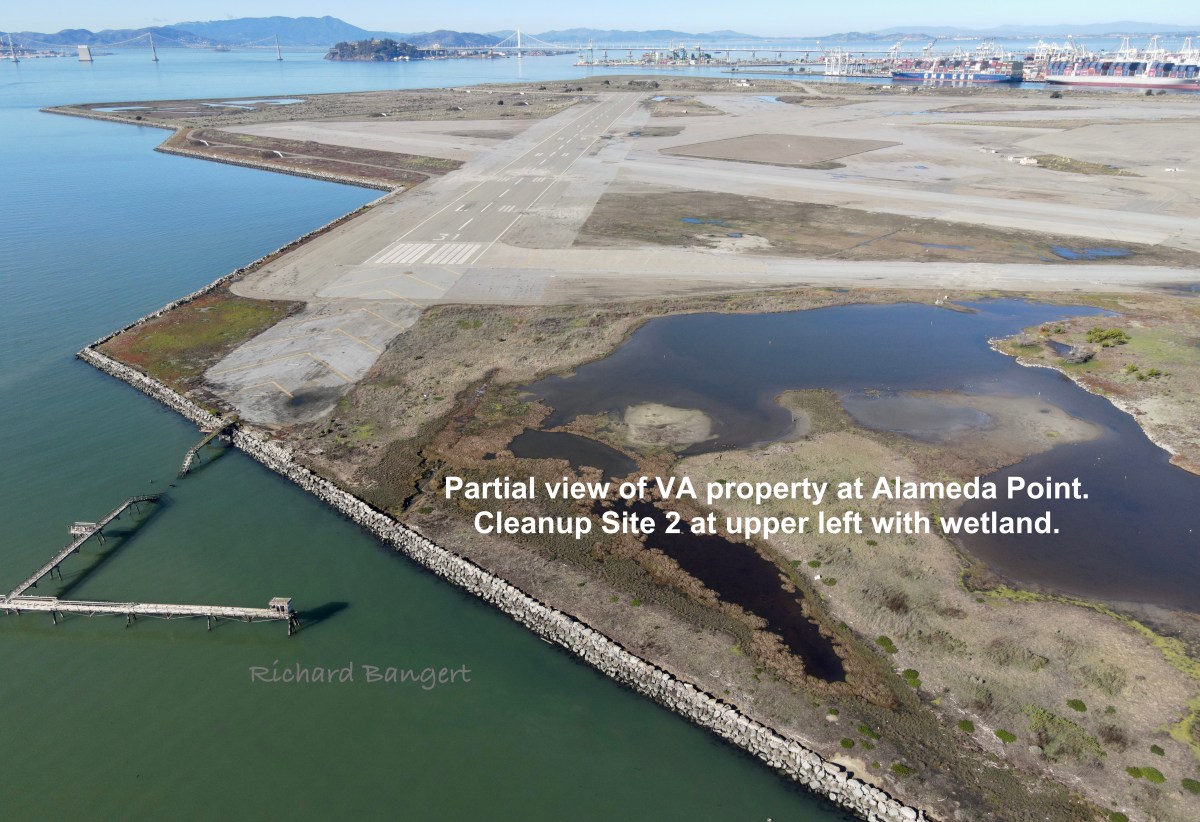
On August 7, the U.S. Army Corps of Engineers awarded a services contract to Adanta, Inc. of Napa to expand and enhance an existing wetland on the Veterans Affairs (VA) property at Alameda Point.  The wetland project is being implemented to offset impacts to wetland areas elsewhere on the VA property where a health clinic, offices and a columbarium cemetery will be built.

“The four-year services contract, valued at up to $2,373,044, includes development, seed collection, propagation, restoration, and enhancement to ensure the wetland is completely established as a self-sustaining tidal marsh at the VA Alameda Point site,” states the Corps of Engineers August 14 news release.  “In total, 8 acres of new tidal marsh will be installed and established, as will 3.3 acres of tidal transitional habitat; and 14.8 acres of existing tidal wetland will be enhanced.”  Seed collection and preparation is scheduled to start this summer.  The work is expected to be completed in 2025.

One-third of the wetland impacts of the VA project will not be offset at Alameda Point.  The Corps of Engineers will purchase credits in the San Francisco Bay Wetland Mitigation Bank for 3.6 acres of impacts.  The mitigation bank manages a wetland restoration project in Redwood City funded by Bay Area projects that impact wetlands.  The credit purchase detail is not mentioned in the news release. Continue reading “Wetland contract awarded for Alameda Point”

New generation of Great Blue Herons born in cypress rookery

The cypress trees in the wetland near the proposed DePave Park at Alameda Point have served as a safe and secure nesting site for Great Blue Herons for many years.  This year is no exception, despite the trees having died and barely standing.  On May 7, Audubon Society bird observer Dawn Lemoine counted 13 juveniles in the nests.

The wetland around the cypress trees provides the ideal landing spot for the young herons’ first flight and subsequent adaptation to life outside the nest.  They can be seen for the first week or so after leaving the nest hanging out in the wetland preening and sunning themselves. Continue reading “New generation of Great Blue Herons born in cypress rookery”

Urban Shield conducts hostage rescue training on Nature Reserve

On Sept. 9, the tranquility of the remote shoreline on the federal property at Alameda Point was interrupted by participants firing blanks as an Urban Shield police tactical team staged a mock hostage rescue.  The gunfire was part of the emergency preparedness training that was performed in an area the U.S. Department of Veterans Affairs (VA) agreed not to use for this purpose. 

Continue reading “Urban Shield conducts hostage rescue training on Nature Reserve”

VA project adds to legacy of letdowns on airfield

A legacy of disappointment continues on the aircraft runway area at Alameda Point.  In the nearly 20 years since the Navy ended operations there, the community has lost 74 acres of open space that was once slated to become city property.  The community has also lost the possibility for a 550-acre national wildlife refuge and a state-of-the-art community hospital to be run jointly with Alameda Healthcare District to serve veterans and non-veterans. 

There is still no groundbreaking scheduled for the veterans’ clinic and columbarium.

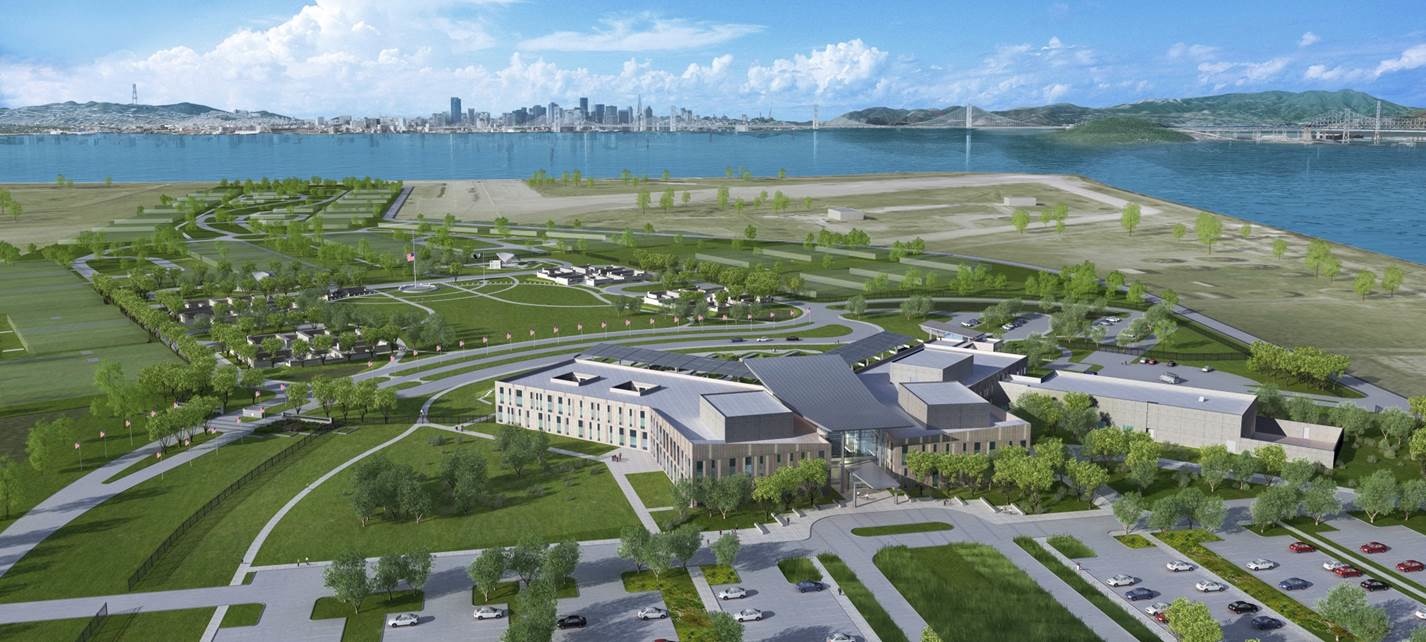
U.S. Department of Veterans Affairs (VA) plans for outpatient clinic, medical and benefits offices, and a national cemetery at Alameda Point. San Francisco in background.

The only recent expenditures on the 624 acres of federal property, now owned by the Department of Veterans Affairs (VA), have been to fund landscaping over an underground dump and the management of the endangered least terns that nest on 10 acres, which includes the widespread application of herbicides and vegetation removal on 300 acres of pavement at the direction of the U.S. Fish and Wildlife Service. 

Mitigating the loss of wetlands appears to be the only planning underway. Continue reading “VA project adds to legacy of letdowns on airfield”