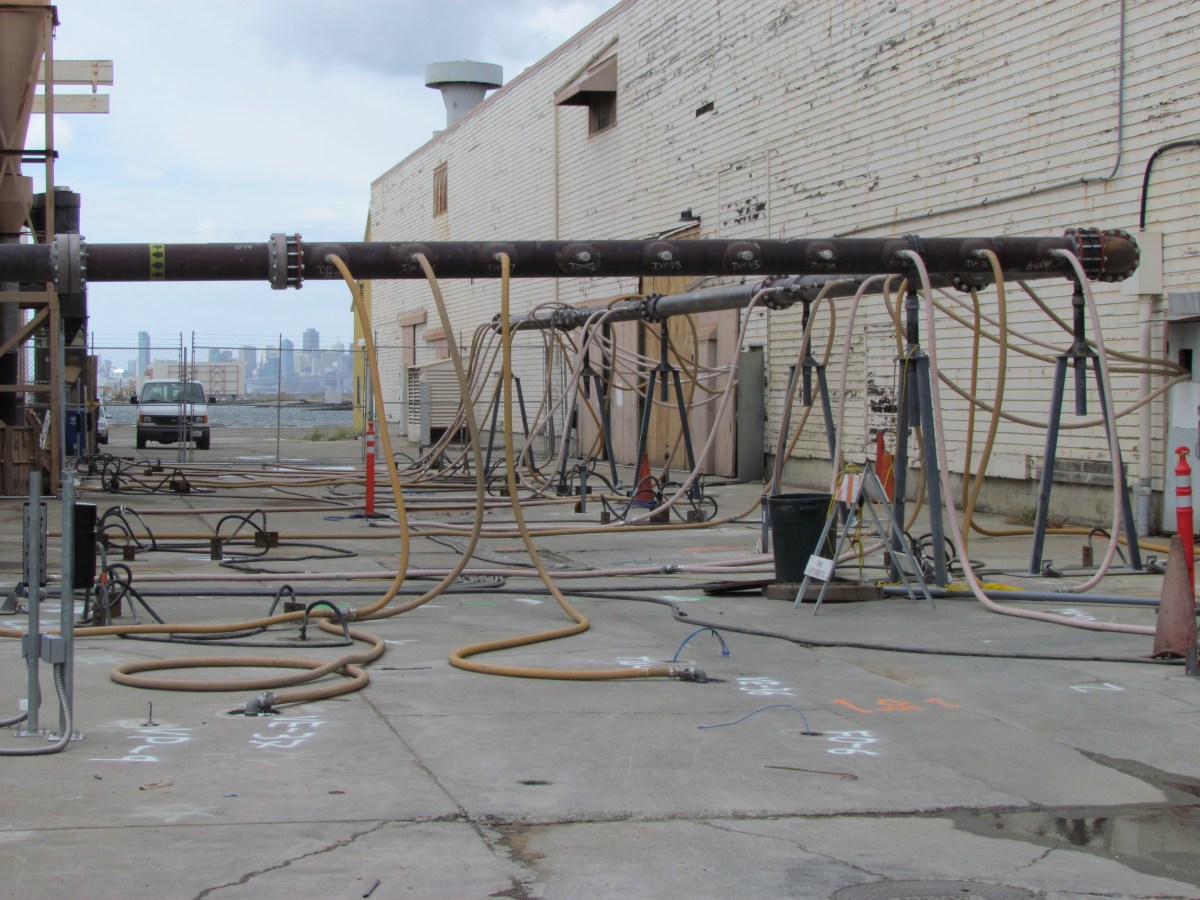
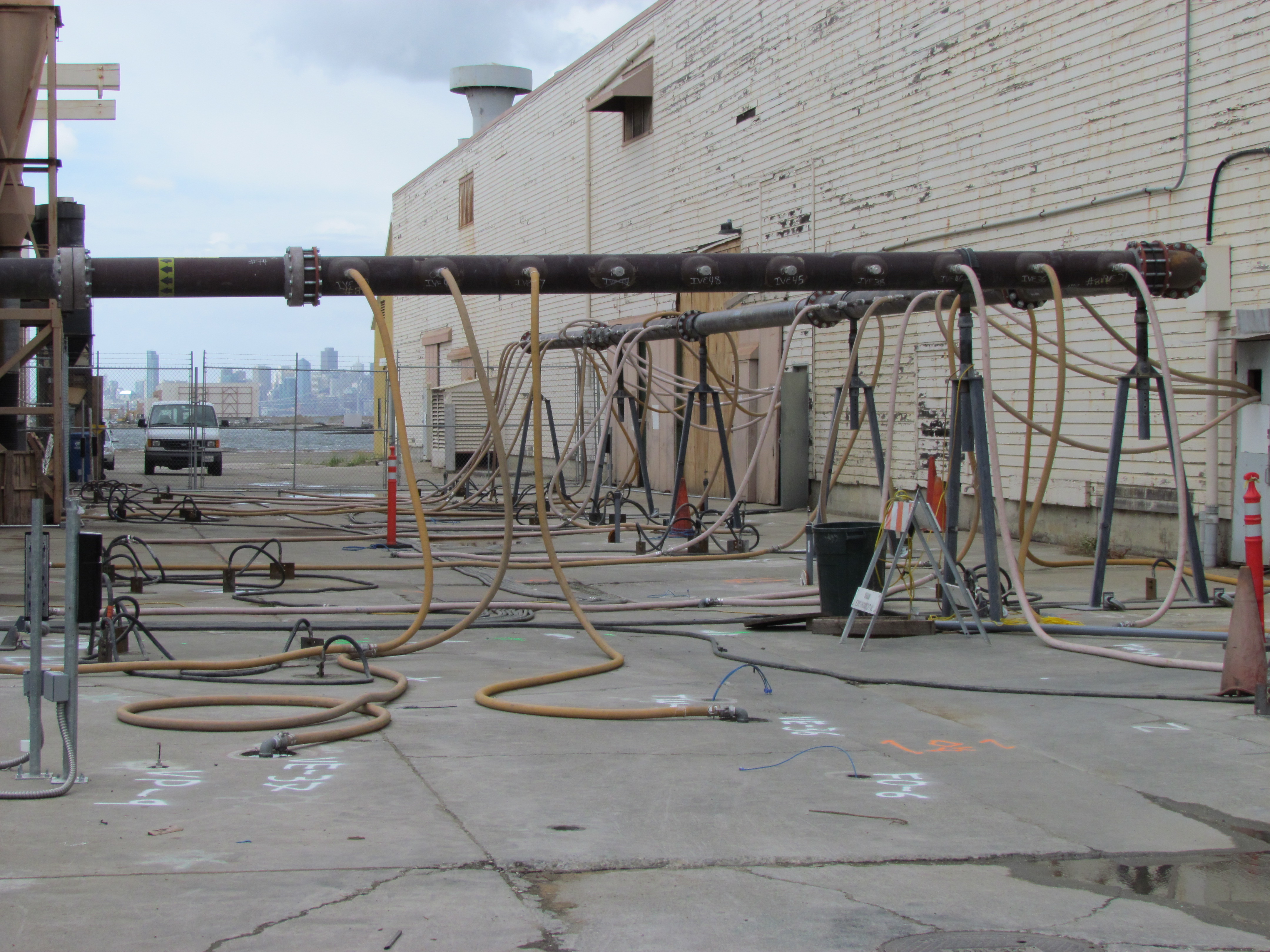
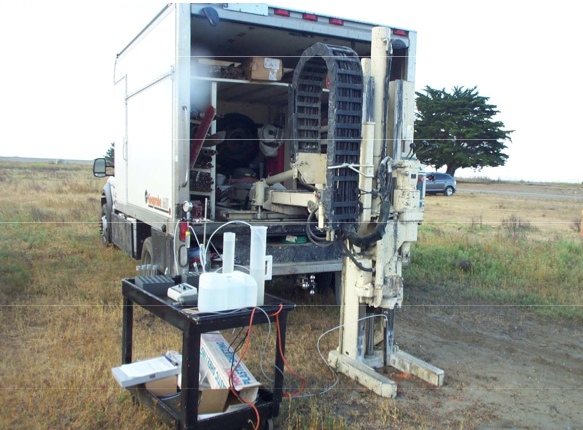
Hoses carry vapors to large pipe that leads to filter system. Vapors are created using high-temp electrodes that extend 30 feet into the ground. Seaplane Lagoon and San Francisco are in background.
There are various methods to clean up groundwater contaminated with solvents and petroleum products. Beneficial chemicals can be injected to neutralize the toxic chemicals. Sometimes bacteria, either those naturally present or some that have been added, can do the job. In some cases at Alameda Point the Navy inserts steel beams called electrodes into the ground that are hooked up to their own power line. They dial up the power to 1,100 amps (a household electric stove is around 40 amps), and let the heat turn the chemicals into vapor. This is the method the Navy is using in a limited application just east of the Seaplane Lagoon. Continue reading “Cleaning up a toxic groundwater plume using heat”
Up until passage of the Clean Water Act in 1972, it was common practice to dispose of chemicals by dumping them down sewer and storm drain lines that drained into the nearest surface water. Many people did this in their homes.
At Alameda’s former Naval Air Station the worst legacy of this practice was in the drain lines leading out of the massive Building 5 and nearby Building 400. Building 5 is where the radioactive paint with radium-226 was used to paint aircraft dials and markers.
2009/2010 Drain Removal Action – In 2010, the Navy completed the removal and replacement
of thousands of feet of the most seriously contaminated lines leading to the Seaplane Lagoon. But questions remained for Restoration Advisory Board (RAB) members about drain lines leading north to the Oakland Estuary and also the Industrial Waste Line that was installed after passage of the Clean Water Act.
Remaining drain lines – September RAB Presentation
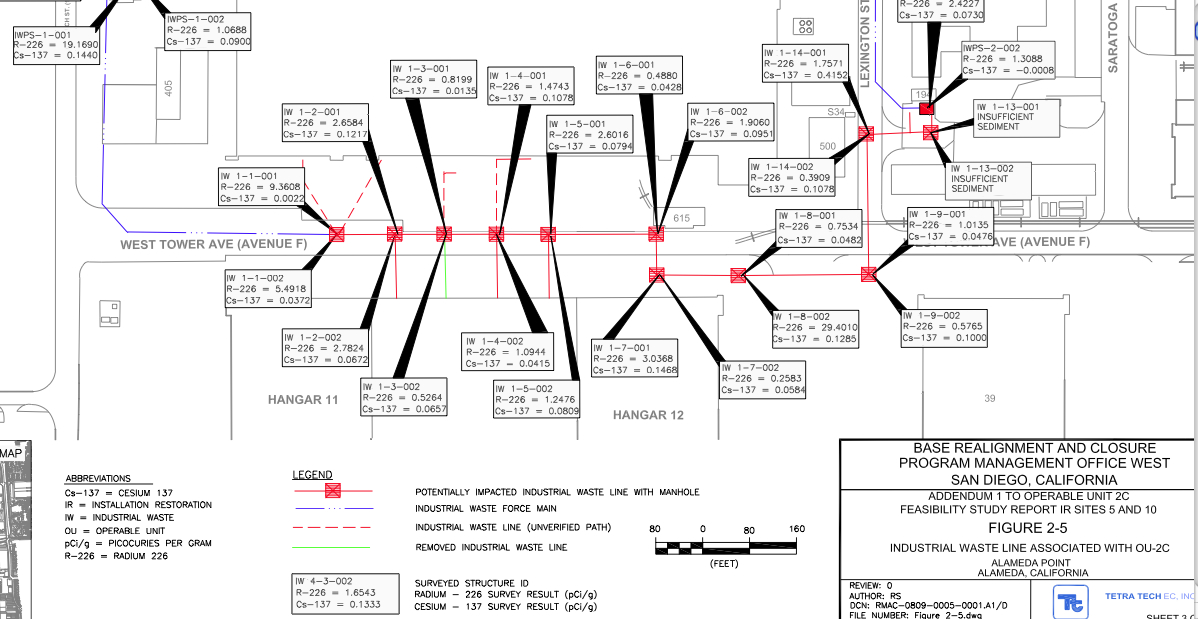
The RAB heard a presentation at the September meeting about the Navy’s recent examination of all the remaining drain lines using cameras and sampling equipment. The drain lines lead out of Building 5 and are part of the cleanup area known as Operating Unit-2C. Three of the storm drains and the industrial waste line were found to have areas of elevated radium, although nothing close to the levels found in the lagoon drains that were removed last year. Six alternatives for dealing with the problem, from no action to complete removal ($58 million), were presented. Two hundred ninety-seven samples were collected.
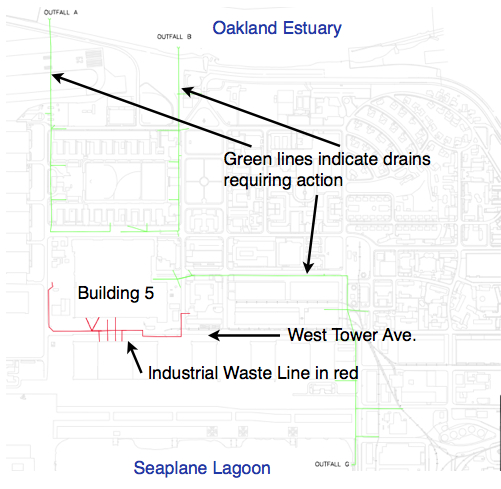
Drain lines requiring remedial action - OU-2C
Industrial Waste Line Should Not Be Left in Place – The majority of the RAB favored the option that prescribed hydro-jet cleaning, limited excavation and disposal of storm drain lines, and complete removal of the Industrial Waste Line. Concern was raised about two alternatives that allowed the Industrial Waste Line to remain in place under West Tower Ave, the main thoroughfare between the hangars, and have so-called institutional controls. Institutional controls can have a way of being forgotten as the decades roll on, which could lead to workers being being exposed to radium during infrastructure upgrades. The forgotten lines could also lead to unexpected expenses for the city and to the posting of alarming radiation warning signs long after everyone thought the problem had been dealt with. Update – October 13 – Another reason to remove the old Industrial Waste Line: The August 8, 2011 Navy feasibility report cited in this post stated, “The industrial waste line is not considered a candidate for hydro-jetting due to the deteriorated condition of the line.” Better to remove it than have toxic residue leaking out into the water table.
Industrial Waste Line survey results (click on image to enlarge)
RAB co-chair Dale Smith said it was premature to vote on alternatives. The regulatory agencies still have to review the report.
Nuclear Fallout Residue Also Surveyed – The Navy’s contractor also gathered data on the presence of Cesium-137 and Strontium-90. The presence of these two radioactive isotopes in drain lines was expected due to worldwide data showing that nuclear weapons testing and nuclear accidents such as Chernobyl have caused widespread dispersal. There are also records indicating that some observation planes that flew through nuclear fallout during nuclear weapons testing were dismantled and decontaminated at Alameda Point as part of the weapons testing studies.
The main reason for concentrations in drain lines at Alameda Point is because of all the concrete pavement that sends high volumes of water runoff into drains. The levels of Cesium and Strontium concentrations in the investigative samples were within the range that could be expected from worldwide fallout of nuclear weapons testing.
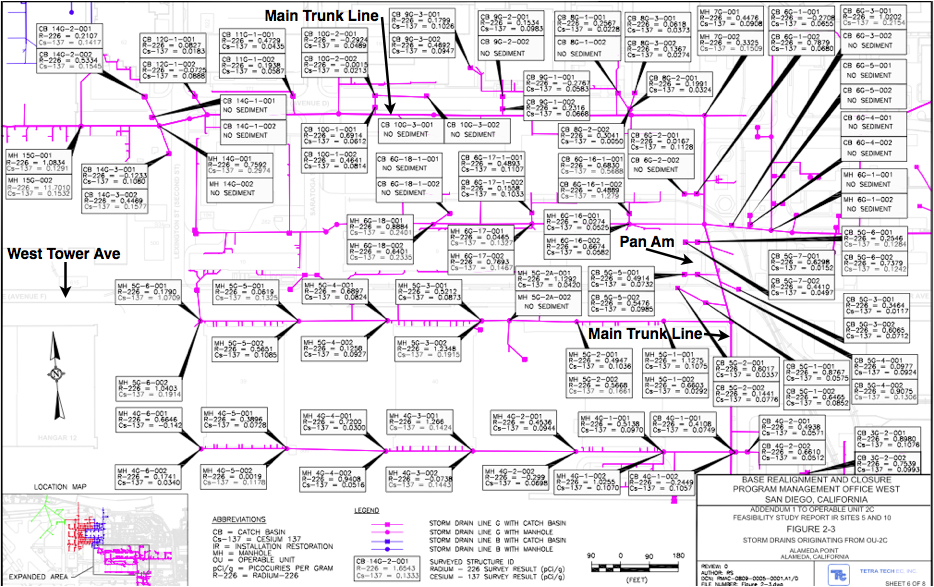
Updated October 12, 2011, in response to inquiry from reader – Below is a map and nine pages of test results for Storm Drain Line G, which partly runs along Pan Am Way. Also indicated is the Main Trunk of this storm drain, which runs from Building 5 on the left of the map to the Seaplane Lagoon on the lower part. The three horizontal storm drain lines shown below the Main Trunk are called laterals. Only the Main Trunk portion is singled out for remediation work.
The likely alternative that will be chosen will not be complete removal. Instead, it will (hopefully) be limited removal and replacement in the few areas that show elevated readings for radium. One alternative is to not do anything, but rather leave the lines in place with “Institutional Controls,” which means a big hassle if anyone ever wants to do infrastructure work.
The remediation goal for radium 226 is nothing greater than 1.56 pico curies per liter. It’s based on a background level of 0.56 that would be randomly found in Alameda. This background standard was established by agreement between the Navy and US EPA in prior years. The remediation goal set by the Navy is nothing in excess of 1.0 above background, or 1.56. The Navy’s “1-above-background” standard is more stringent than the norm for US EPA.
In looking at the readings in the boxes and on the test result tables, there are only a few locations where radium was found to be a problem. “MH” in the box means it is manhole that was tested. “CB” is a catch basin. One reason for the low readings could be because in 2009/10 when the most seriously contaminated lines – F and FF – were being replaced due to radium contamination, the Navy had Storm Drain Line G power flushed to clean it out. The contaminated water was properly disposed of.
Another possible reason for the low radium readings is that the point from which it leaves Building 5 (where the radium paint was once used) could have been the least used for disposing of radium paint waste. This would correspond with the actual results of testing before and after the recent dredging operation on the northeast corner of the Seaplane Lagoon where line G ends. Other than a few solid objects containing radium, none of the dredged material from the northeast corner required disposal at a nuclear waste facility. The upcoming dredging of the northwest corner, however, will likely yield elevated radium in dredged sediment.
The Navy’s top cleanup person for Alameda Point, Derek Robinson, began the September 2011 Restoration Advisory Board (RAB) meeting by asking members to consider cutting back on the frequency of its monthly meetings. He cited budget pressure. The meetings cost the Navy $10,000 per meeting. The purpose of the RAB is to review, comment, and makes suggestions to the Navy and regulatory agencies regarding cleanup of toxic substances at Alameda Point, and also to serve as a vehicle for the Navy to communicate with the community.
Sampling contents of old disposal site called Site 2 on Wildlife Refuge. Cleanup plans here are the subject of controversy. (Navy photo)
Three longtime RAB members said they were open to the idea of meeting reductions. One cited the small number of areas left for review. Two suggested that conference calls in lieu of meeting in person would be acceptable as an alternative. The RAB’s community co-chair Dale Smith, however, opposed any meeting reductions until work phase planning is completed on the remaining cleanup areas. She said there is still too much going on.
The guidelines for establishing local environmental cleanup advisory groups were established in 1994. Details on the number of members and meeting frequency were left to the local areas. The Alameda Point RAB adopted a new set of rules on May 7, 2009, which stated that meetings would be monthly, and that schedule changes must be placed on the agenda and passed by a majority vote of RAB Community members, the Navy, City representatives, and the Regulators. The rules were signed by the Navy, the community co-chair, and three regulators.
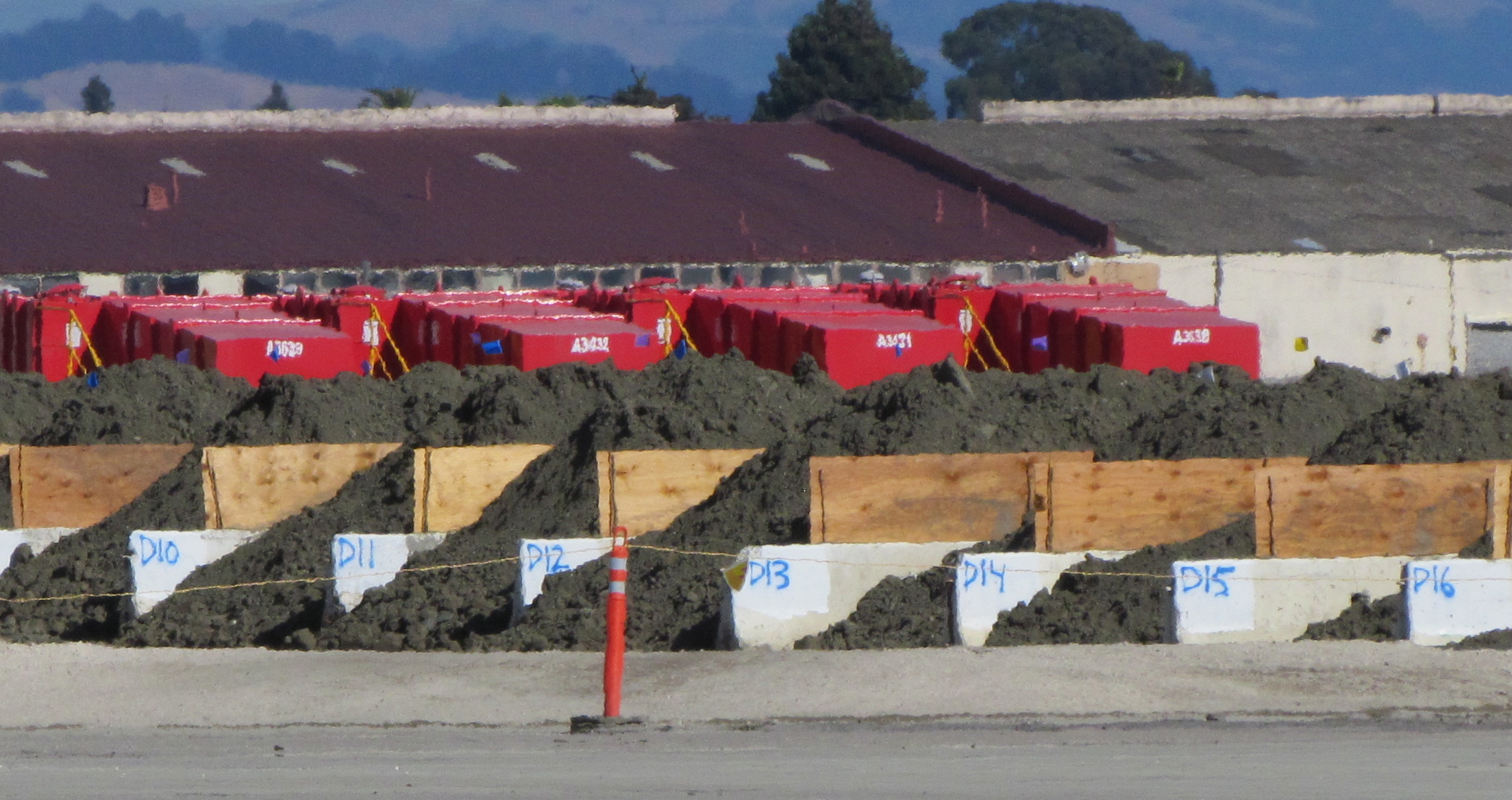
Radioactive radium waste not an issue The massive pile of dredge mud that has been sitting between the Seaplane Lagoon and the hangars is now dry enough to be tested to determine the exact contaminant profile and hauled away.
dredge soil awaiting testing and hauling away
The contaminant of greatest concern to community has been radium-226, the radioactive ingredient once used to make aircraft dials glow in the dark. Testing revealed that the sediment did not contain elevated radium levels and therefore would not need to be disposed of at a special radioactive waste site. There were several solid objects, referred to as “buttons,” that were found which contained elevated radium. Those objects and the surrounding soil were removed for special disposal.
The piles of dredge soil neatly arranged and numbered next to the old Control Tower are waiting to be hauled away to a hazardous waste disposal site.
Wildlife Refuge Truck Route
In addition to trucking dredge soil to a hazardous waste site, there is a large mound of asphalt that is being trucked onto the wildlife refuge and out to an area where clean soil and fill material is being stored for future use. This asphalt is from a temporary pad that the Navy laid down in the dredge soil dewatering area. It was covered with plastic and not contaminated, and now it is no longer needed.
PCB hotspot
Early this year the Navy began its dredging project to remove contaminated sediment from the northeast and northwest corners of the Seaplane Lagoon. The Seaplane Lagoon ranked as one of the worst PCB sites in the Bay Area according to a regional Water Board study. Continue reading “Seaplane Lagoon Dredging Update”
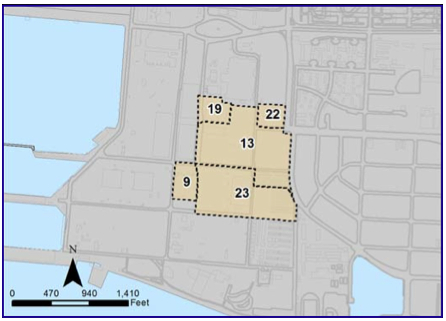
OU-2A cleanup area - Seaplane Lagoon and USS Hornet are to the left - numbered areas are individual site #s
After years of investigation, the Navy, along with the federal and state regulators, has come up with a remediation plan for 39 acres, encompassing five sites, called Operating Unit 2A. On Wednesday, August 31, the Navy will spell out its plan for remediation and solicit comments. The meeting will be at City Hall West at Alameda Point, 950 West Mall Square, Room 201 from 6:30 pm to 8:00 pm.
Operating Unit 2A is roughly one block away from the soccer fields on the south side of Alameda Point and one block away from the USS Hornet. The Unit has contamination issues that date back to 1879 when the Pacific Coast Oil Works Company began operating an oil refinery near Main Street.
The main two highlights up for discussion are:
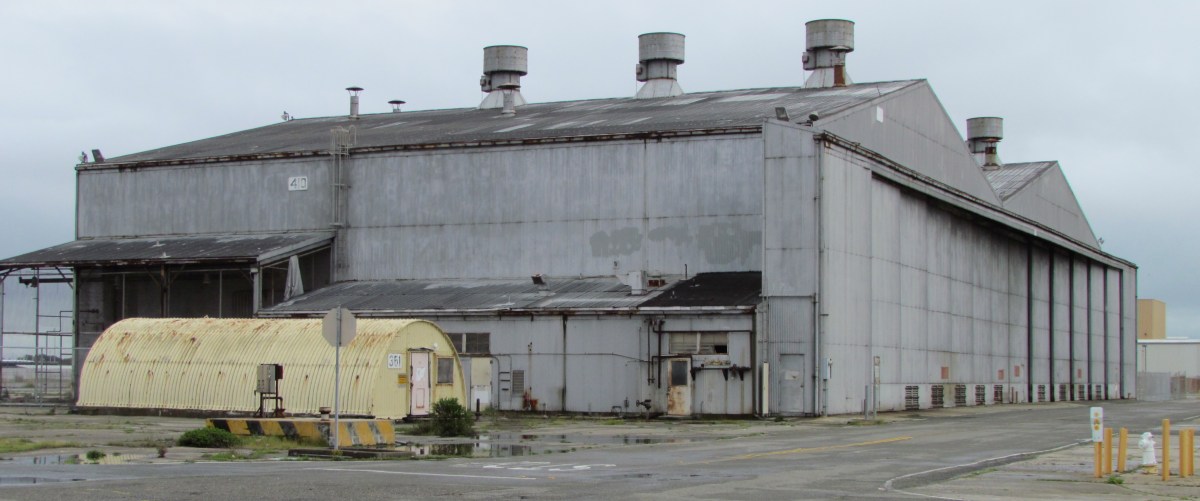
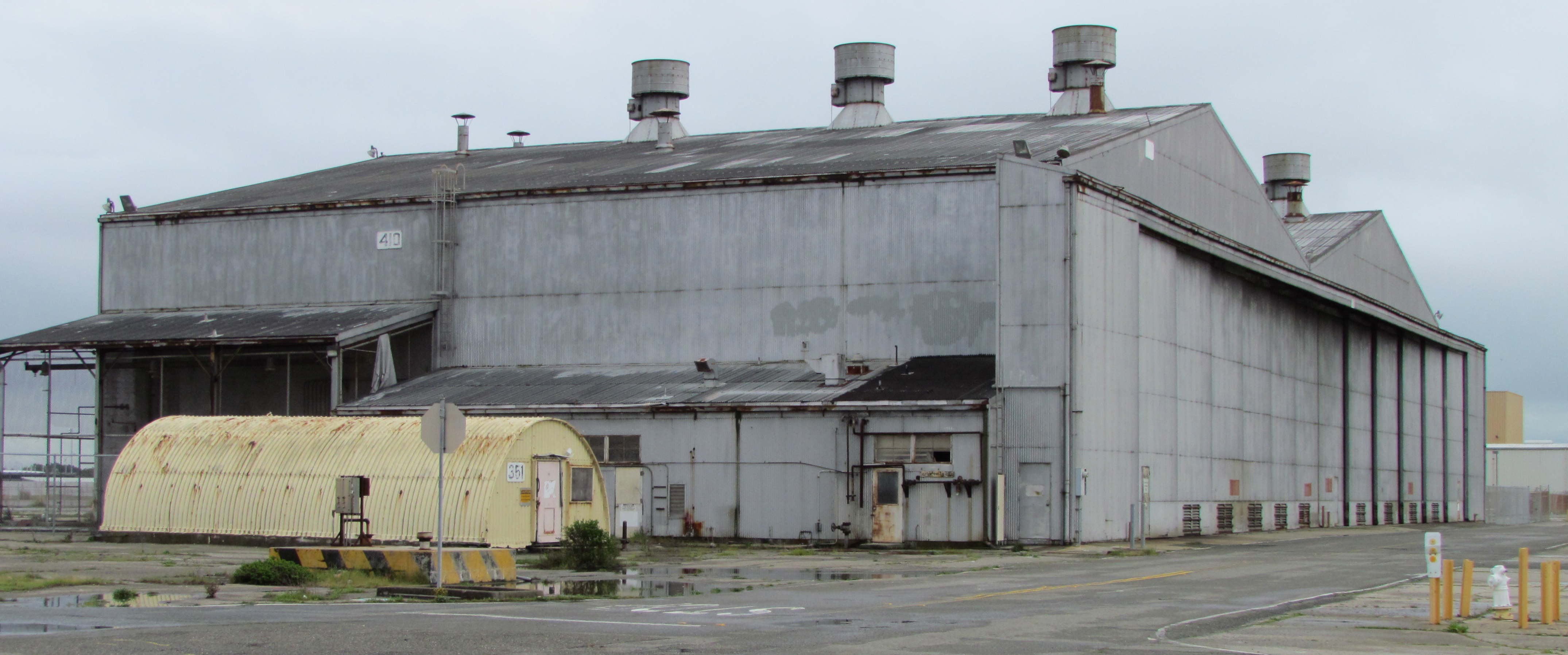
Building 410
Building 410 is where the Navy operated an aircraft paint stripping facility. The soil was found to be clean, but toxic chemicals seeped into the groundwater. The conclusion reached by the Navy and regulators is that no active remediation efforts need to be conducted. Instead, they will rely on “natural attenuation,” which means to let nature take its course through dilution, dispersion, and biodegradation of the contaminants.
Building 410 - former paint stripping building
Their rationale for not undertaking a vigorous program to clean the groundwater to drinking water safety levels is that no one will ever be using it for drinking water, especially because of high salt content. No wells are permitted and, even if a well was desired for drinking water, there is pure water at the much deeper 100-foot depth. They also claim that vapors will not intrude into structures because it is in the second water-bearing zone and, therefore, the water zone above will act as a barrier. Continue reading “Navy Announces Cleanup Plans – Public Meeting August 31, 2011”
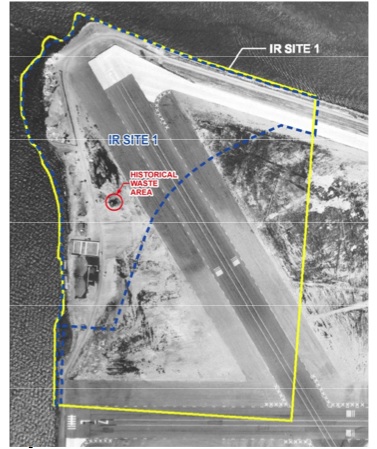
Site 1 indicated by blue line. Yellow line indicates entire area used by Navy as a disposal area from 1943 to 1956. Red indicates waste pit that caused groundwater contamination. Navy photo and overlay.
Groundwater
The Navy is proceeding with plans to remediate contaminated groundwater at the old disposal site at the northwest tip of Alameda Point. The contaminated groundwater is within the area known as Site 1, which encompasses over half of the old dump. In one particular area of the dump, the Navy routinely dumped liquid waste material. No one knows for sure how much of it was in drums that may still be rusting away, and how much was just poured into the pit.
Some current and former members of the Restoration Advisory Board (RAB) have long been concerned as to whether the size of the plume has been adequately characterized, meaning how wide and how deep. The main issue is its proximity to the Bay and whether remediation measures will prevent any of the hazardous compounds from entering Bay water. Continue reading “Environmental Cleanup – Update on Site 1”
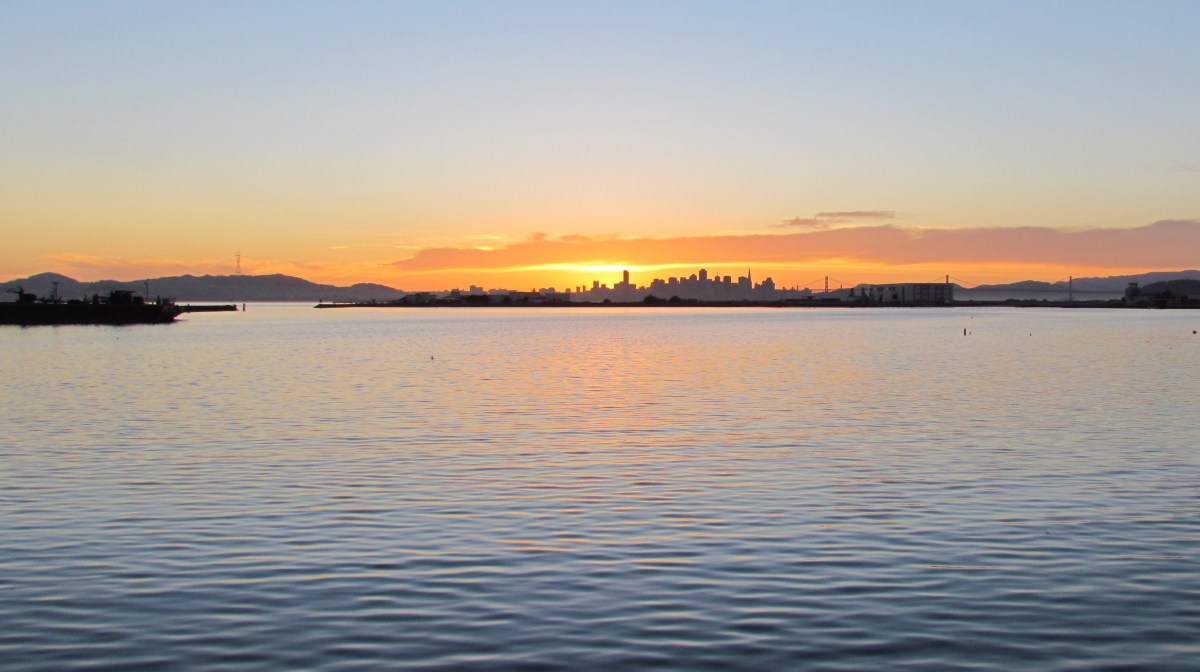
Sun sets on dredging project for this year - to resume in 2012. Fence is down on east side of lagoon, which will allow sunset viewing and bird watching throughout the remainder of the year.
Seaplane Lagoon dredging contractor fails to meet deadline
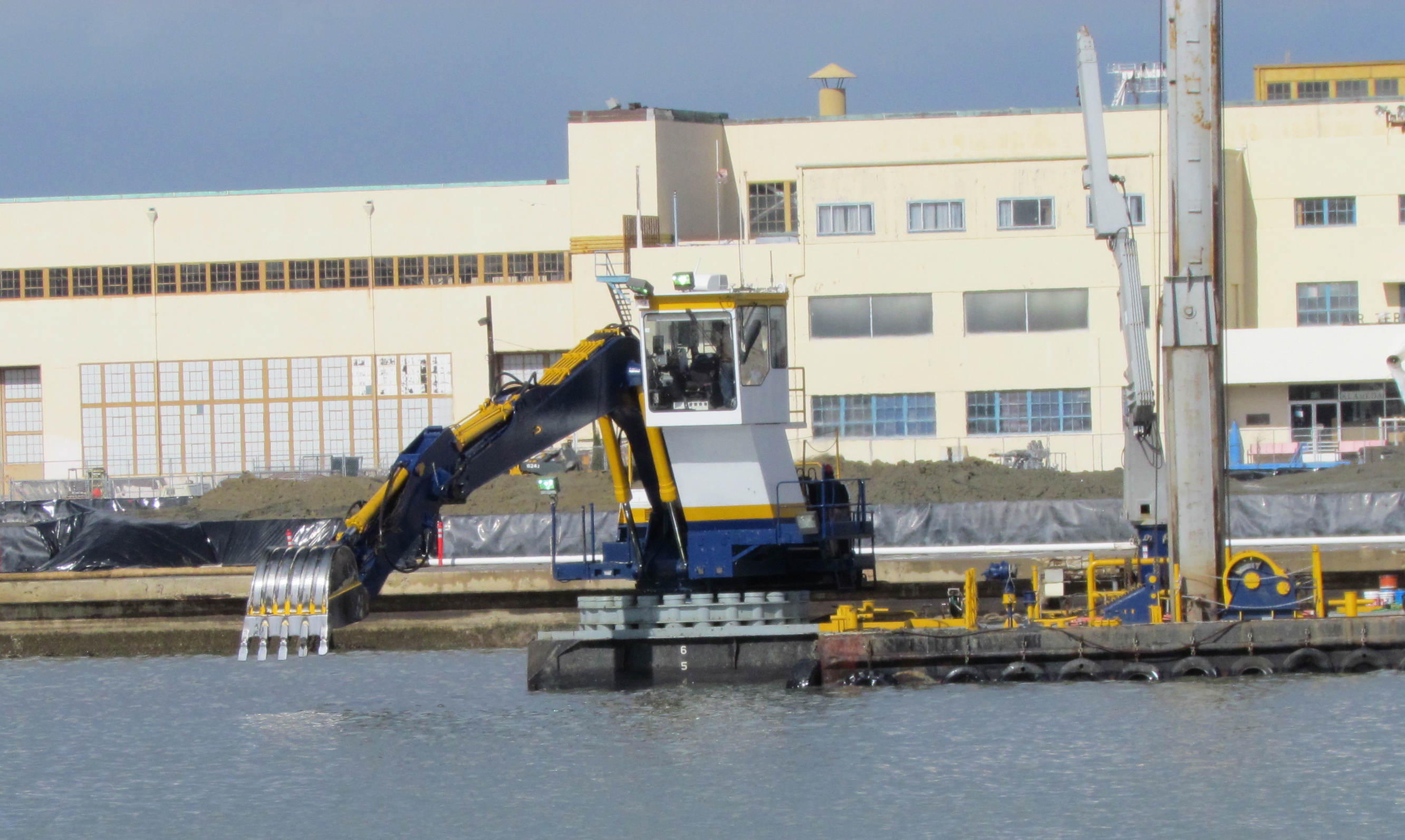
Seaplane Lagoon dredging barge is gone, not having completed the job on time.
The Navy was expecting the contractor to complete the dredging of both the northeast corner and the northwest corner of the Seaplane Lagoon by mid-April prior to the arrival of the endangered California Least Terns. The terns nest on the Wildlife Refuge and feed in the Seaplane Lagoon and nearby waters. It is illegal to disturb them while feeding and nesting. The contractor completed the northeast corner, but work was halted before starting on the northwest corner due to the arrival of the Least Terns.
The dredging will resume in early 2012 and be completed by mid-year. It is unclear at this point whether the Navy will incur an additional expense for the dredging operation, since it was not completed by the deadline, and the dredging equipment had to be demobilized.
In response to a question about whether the Seaplane Lagoon dredging contractor is expected to complete the project within the budget allocated for this project, the Navy’s Environmental Coordinator for Alameda Point, Derek Robinson, said, “The Navy is optimistic the project will be completed within the allocated budget. The Navy and its current contractor are presently negotiating a change to scope to allow the future dredging of the northwest corner of the Seaplane Lagoon to be performed under a new contract.” In response to a question about whether the demobilization of the dredging operation until 2012 is going to lead to a cost overrun, or will the contractor absorb the cost, Derek Robinson reiterated the above statement and went on to say, “Until the negotiations with the current contractor are complete and the new project is awarded, the total project cost will not be known.”
The existing piles of dredge soil on the tarmac near the Air Museum and Bladium will be hauled away this summer. They will be tested for radium-226 and other contaminants in order to determine where they will be disposed of. The fencing along the eastern side of the lagoon has been removed, and the dredging barge is gone.
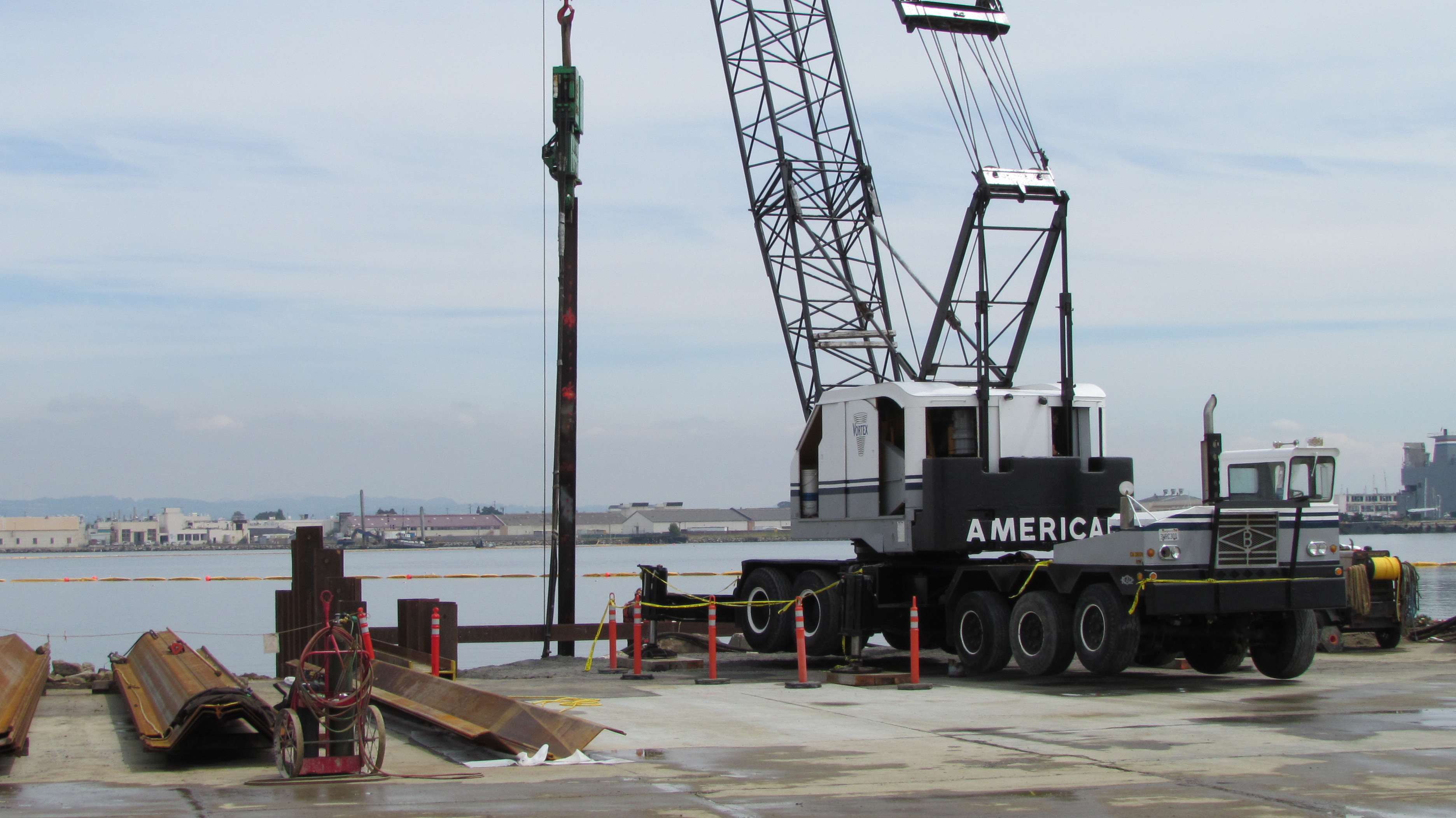
Installing steel sheet pilings in lagoon prior to removing drain pipe, soil, and concrete
A separate project on the western side of the lagoon is continuing. It involves removing the last leg of the old sewer drain line that was removed due to radium-226 contamination. A steel barrier has been constructed in the lagoon to prevent contaminants from entering the water during the project.



 Alameda Point Environmental Report