News About Cleanup, Sustainability, Parks, Open Space, and Wildlife at Alameda Point, Alameda, CA
Author: richard94501
My blog is Alameda Point Environmental Report covering parks and open space, environmental cleanup, wildlife, and sustainability at the former Navy base in Alameda now called Alameda Point.
Articles on my blog are frequently posted on the Alameda Post news site.
I also host a Flickr photo site, which is accessible via the sidebar wildlife photo gallery.
I hope you find my stories and photos of interest.
Richard Bangert
Alameda, California
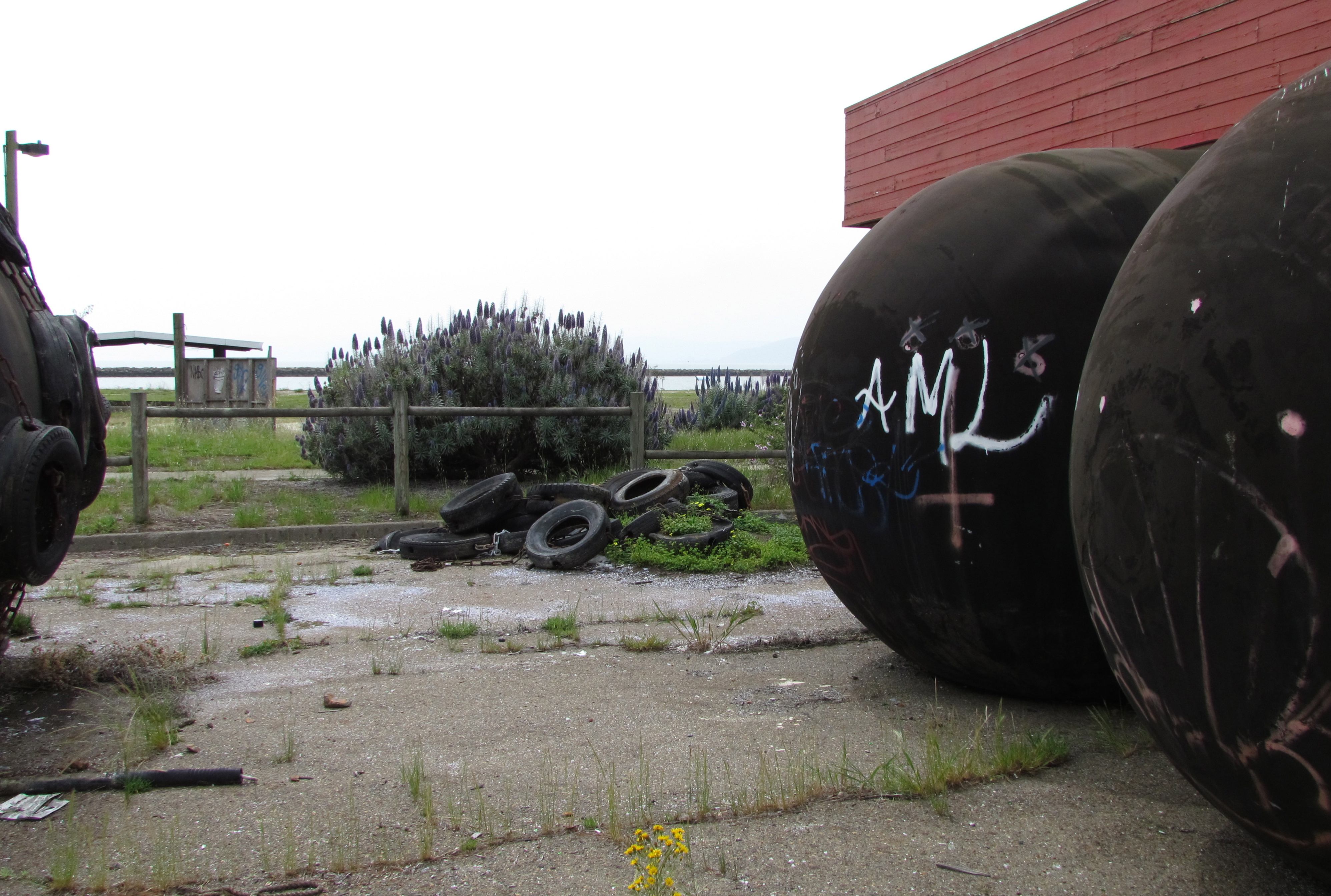
Lizards go rogue on city’s adaptive reuse plans, setting up multi-family housing complex outside of the adaptive reuse area.
The lizards hope that a tire pile discarded in the last century will be grandfathered into reuse plans because of their low-impact, eco sustainable practices. Capturing rainwater, reducing global warming with plants, and keeping carbon-based tires out of the waste stream are cited as benefits.
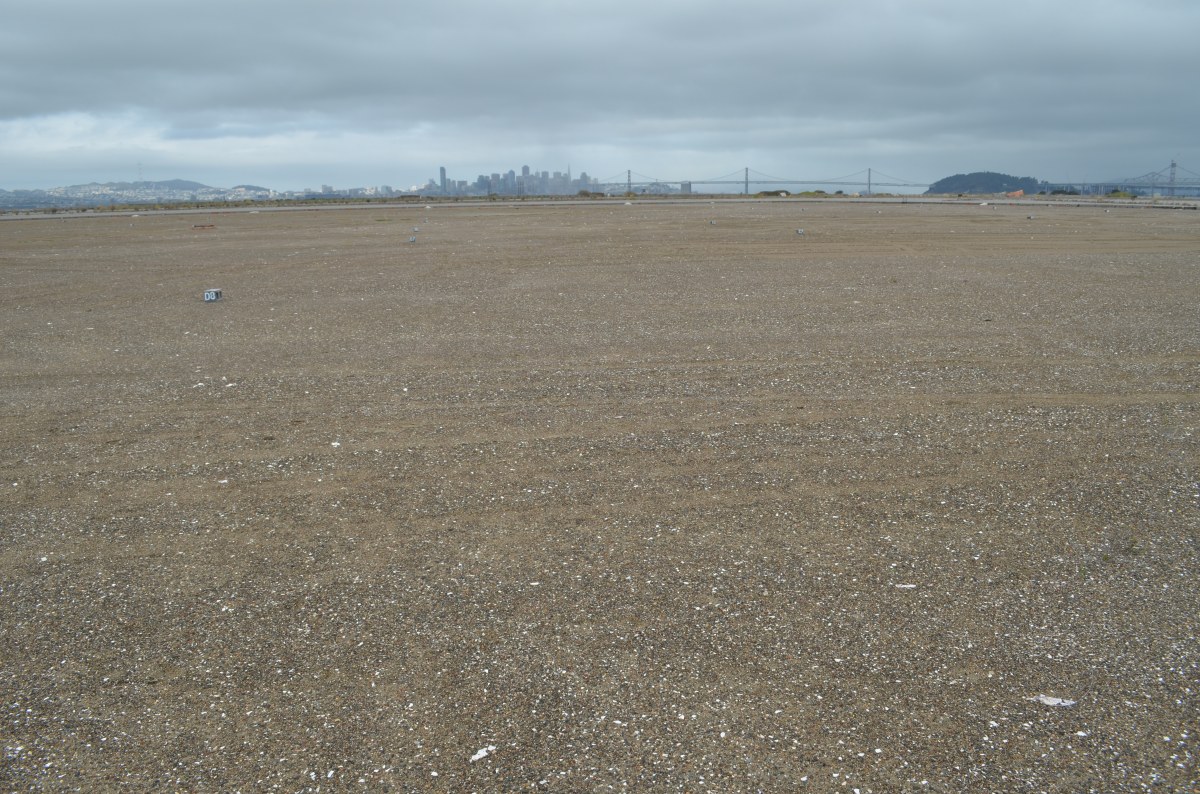
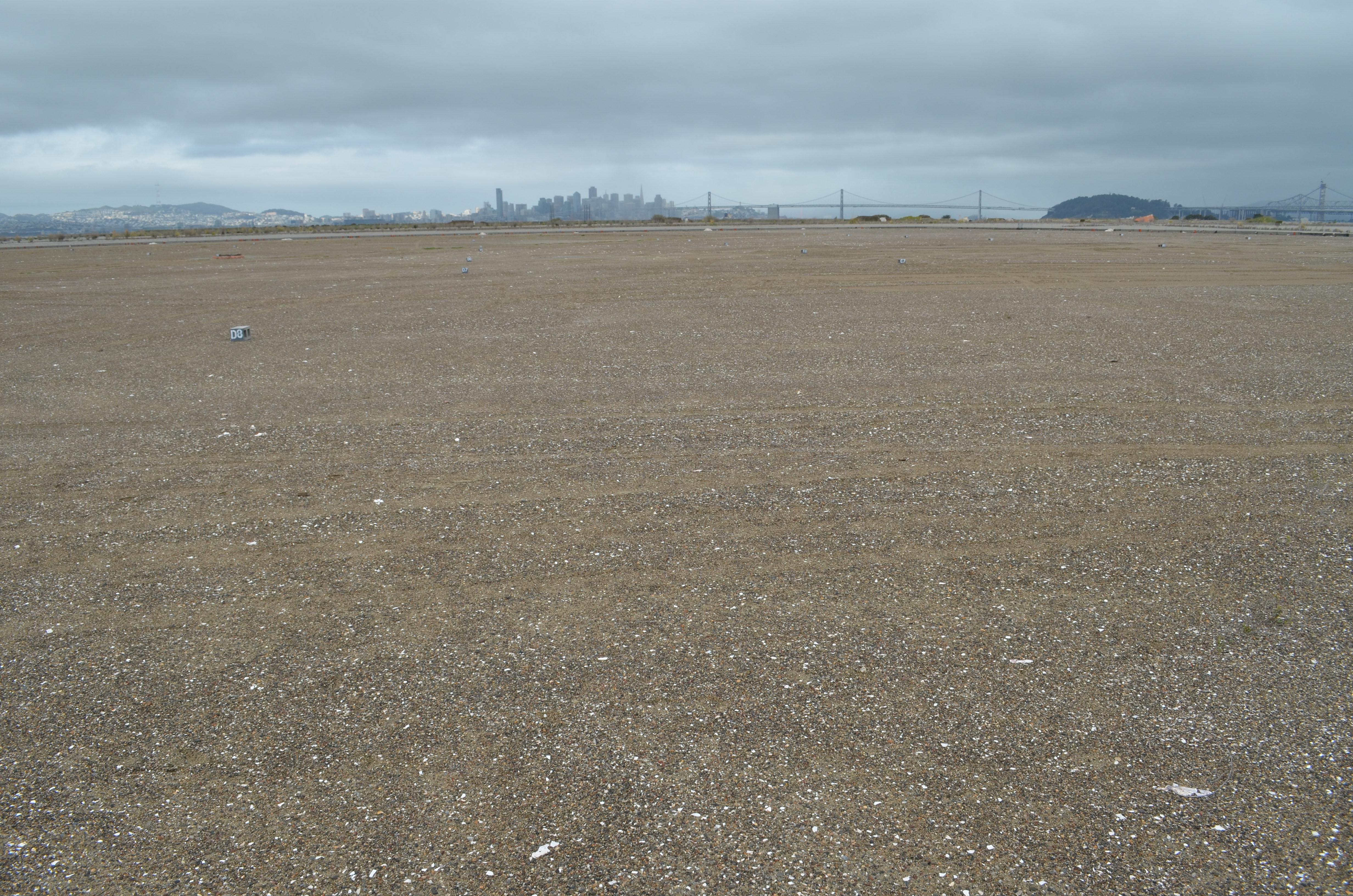
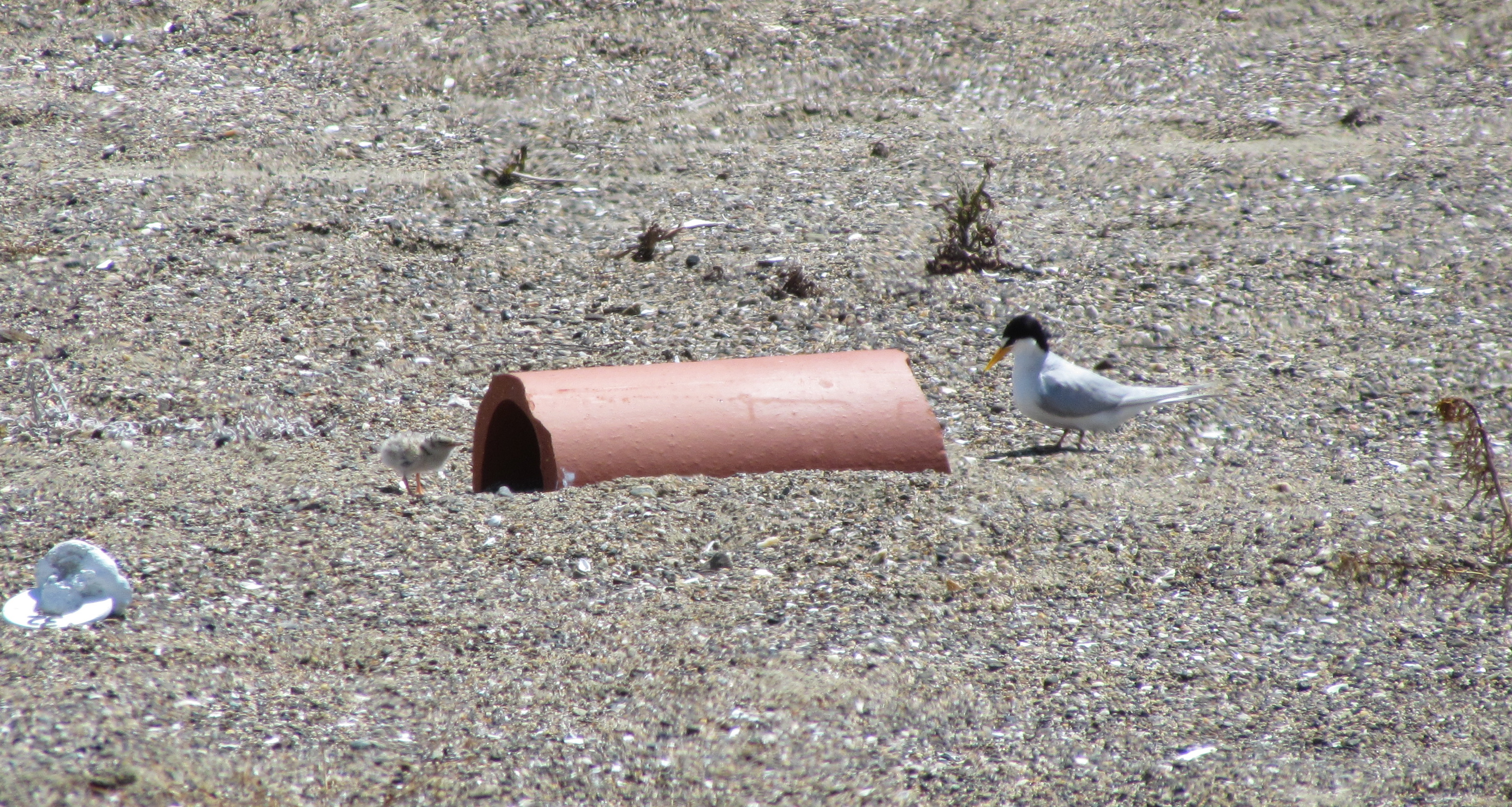
CA Least Tern nesting site at Alameda Point Wildlife Refuge
The following was prepared by Leora Feeney, co-chair of “Friends of the Alameda Wildlife Refuge,” a committee of the Golden Gate Audubon Society.
Delivered to the Alameda City Council on Monday, March 19, 2012, regarding the city-VA-park district proposal being considered for Alameda Point.
Alameda Point Collaboration
on
Veterans Health and Memorial Facilities
CA Least Tern Colony
Nature and Wildlife
Passive Open Space
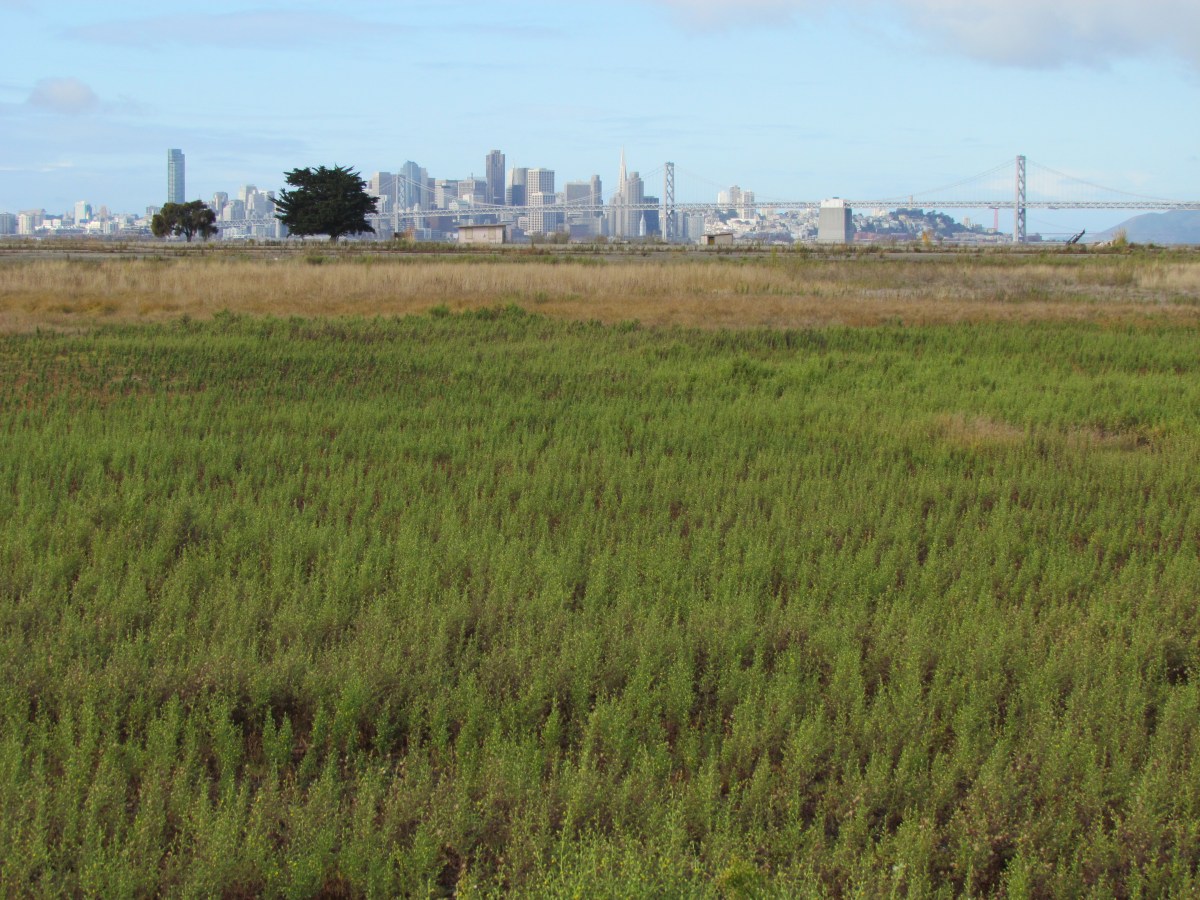
Unsurpassed Inner-City Views and Experience
Subject: East Bay Regional Park District (EBRPD) proposal for Northwest Territories
Benefits to the City of Alameda
Preserves city resources – The proposal will help defer considerable Alameda Point related costs and responsibility to the city, already having multiple difficult challenges.
Meets land use challenges – The land is not suitable for uses beyond open space and water-related uses. Current wetlands will require mitigation. Several issues surround this property that will meet challenges with most development proposals.
Enhances Alameda’s identity – Alameda’s military history, well-recognized wildlife history and resources, and East Bay shoreline location make this project the perfect fit to further enhance Alameda’s identity.
Realizes payoff from stakeholder investments – Consider stakeholders’ investments that also benefit Alameda:
The VA has spent millions of dollars to move their city-supported project forward. The proposal would allow them to see an end to conflicts that have stalled this investment. Alameda would finally become the home to the VA’s Health and Memorial complex.
The City of Alameda has also invested time and thought to uphold a position that supports the VA facility and that endangered wildlife at Alameda Point are to have top priority.
The Navy and Fish & Wildlife Service have invested time and money to maintain endangered wildlife species.
EBRPD has spent time and money to develop a plan that would resolve difficulties in a way that would meet several positive goals.
Golden Gate Audubon Society since the 1980s and Friends of the Alameda Wildlife Refuge (FAWR) since 1997 have been steadfast supporters of endangered California Least Terns at The Alameda Naval Air Station, later Alameda Point, ensuring continuous success of the colony. FAWR also provides annual elementary school Least Tern education at Alameda Schools.
Others, like the Center for Urban Environmental Law (CUEL) at Golden Gate University, have worked to develop their Greenspace proposal for this beautiful location.
Initiates Park District investment – To design and carry out the project will require an investment of many millions of dollars. The city will benefit from this investment by EBRPD.
Enhances property values – Several studies show that wildlife refuges and natural areas increase values to nearby properties.
Attracts investors – The project will attract investors, spurring Alameda Point development.
Strengthens tenant relations – Current tenants will appreciate that habitat management will have a broader plan and operation.
Attracts tourism – The project – a San Francisco Bay destination point – will be a draw to local, state, national, and even world tourists.
Brings local spending – The site will attract many welcome and diverse activities (photography, birding, hiking) that will benefit local merchants.
Adopts a workable solution – This is the only solution available that will allow both CA Least Terns and the VA project to coexist as adjacent Alameda neighbors.
Satisfies community priorities – The project satisfies a strong wish of the public for natural areas and open space expressed during Alameda Point-Going Forward meetings held in 2010-2011.
Creates inner-city showcase – The site will serve the community and others as a unique opportunity for inner-city nature experience and education.
Enhances parks-to-resident ratio – Alameda’s Park Master Plan Summary (Draft, p. 25) states that the park-acreage-to-residents ratio is low (2 acres to 1000 residents; standard for CA cities is 3 to 6 acres/1000). This proposal would improve the ratio considerably.
Aligns with park master plan – The draft Park Master Plan also states (p. 37), “Alameda Point is anticipated to be the location for passive parks operated by EBRPD.”
Builds on existing park district partnership – EBRPD has been a good partner managing Crown Beach, relieving Alameda of difficult tidal shoreline and beach management. We can count on them for similar assistance at Alameda Point.
In conclusion: The CA Least Tern colony can’t be moved, and the VA facility can. The willingness of this unusual collaboration of stakeholders to work together is a testament to the importance of the project. It is rare and refreshing to see that people with diverse goals have the ability to work together to find a solution that satisfies multiple valued needs in difficult times. With the acceptance of this proposal Alameda will be a giant step closer to moving Alameda Point toward a promising future. We must not let this opportunity escape. The alternative would be tragic, a prolonged stalemate and unknown future. Alameda’s City Council can make this work. It will be a historical decision.
Environmental cleanup of the Seaplane Lagoon has centered on two areas where storm sewers drain into the lagoon. It was commonplace to discharge all sorts of chemicals down storm sewer lines prior to the passage of the federal Clean Water Act in the early 1970s. Contaminants such as PCBs, cadmium, lead, pesticides, and radium have been found in the sediment around the sewer discharge points.
Prior to dredging, sewer lines leading to the northeast and northwest corners were either replaced or flushed out. An underwater debris pile of metal and wood was also removed at the northeast corner before dredging.
The Northeast Corner
Setup for the 6.5-acre northeast dredging area began in late 2010, and dredging was completed in April of 2011. The total amount of sediment removed was 75,628 cubic yards. Even though the contamination depth was three feet, the dredging went to five feet.
Only 1,719 cubic yards of sediment were transported to hazardous waste disposal sites, of which 11 cubic yards went to a low-level radiological waste disposal site because of the radium-226. The rest of the sediment was determined to be safe enough for reuse, in large part because the contaminants were diluted by the over-dredging of clean sediment. The clean sediment has been stockpiled on the western end of the Wildlife Refuge for future use in capping the landfill disposal sites 1 and 2.
All of the drying pad materials for the northeast corner have been removed, which will allow for the fence to be moved.
The Northwest Corner
Concrete drying pad installed at northwest corner of Seaplane Lagoon
Setup for the 3.3-acre northwest corner began in October of 2011 with the construction of a concrete, waterproof drying pad. Prior to dredging, a sunken barge was demolished and removed. The barge pieces were scanned for radiation, but none was found. The 66 tons of scrap iron was sent to a recycling facility.
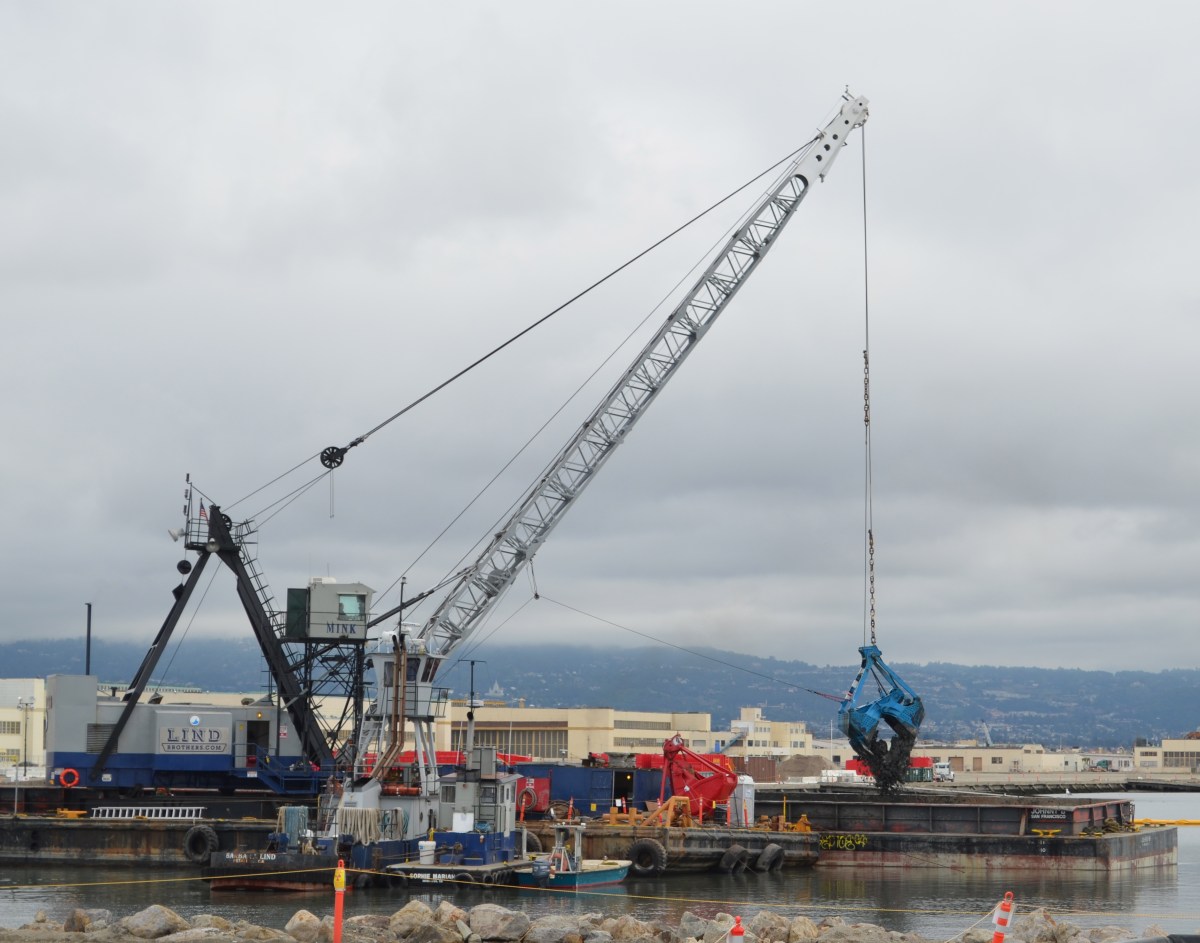
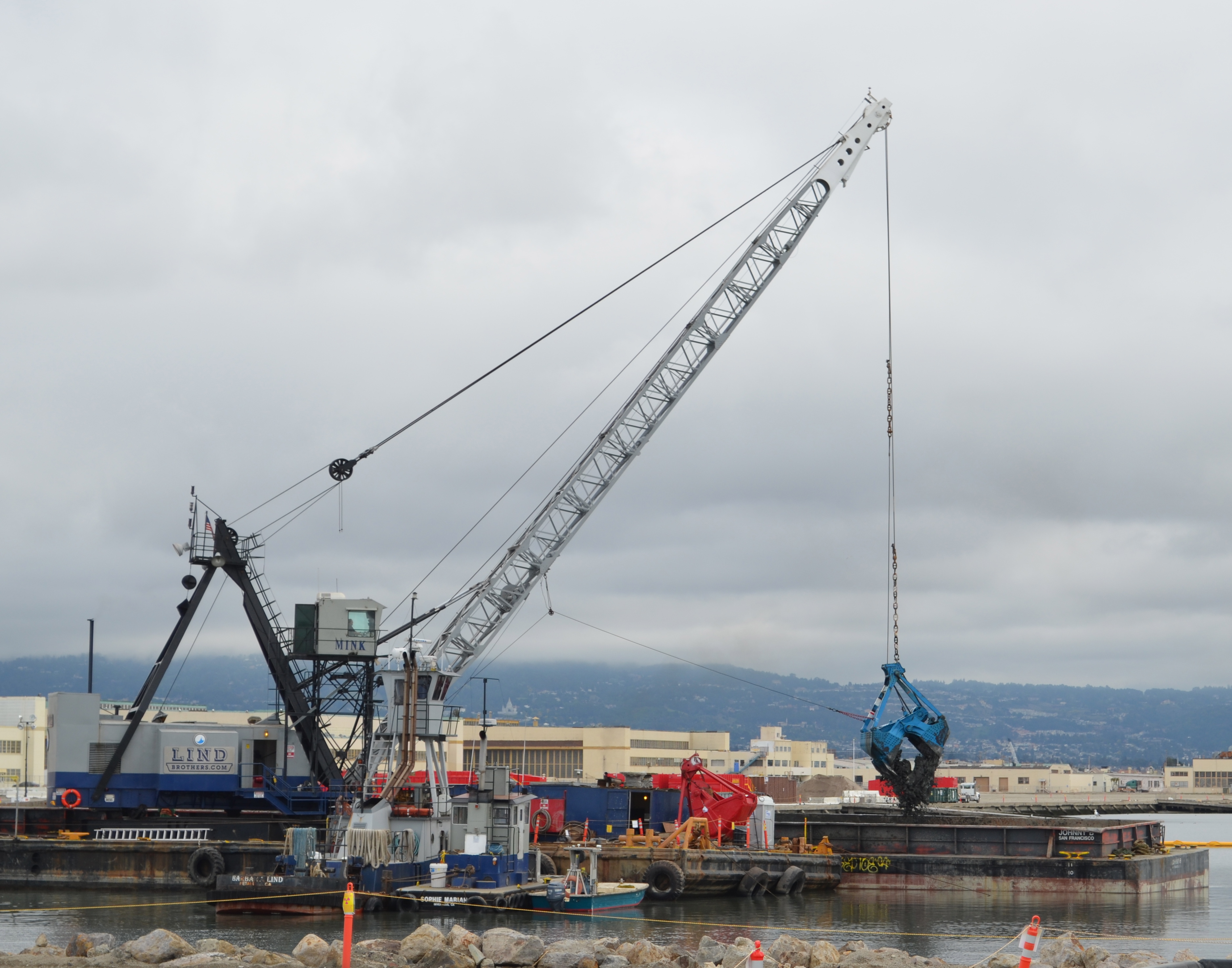
Dredging started on January 16 and ended on February 22. The dredging at the NW corner went much faster than the early dredging, partly because of the smaller area, and partly because of heftier dredging equipment.
Unlike the NE corner, however, the sediment here is expected to contain higher levels of radium-226 because the sewer line leading here was highly contaminated. As was the case at the NE corner, this sediment will have to dry out before being tested and disposed of. The project should be completed and everything removed by December.
The price tag for all of the Seaplane Lagoon dredging and hauling away sediment, when completed: $46 million.
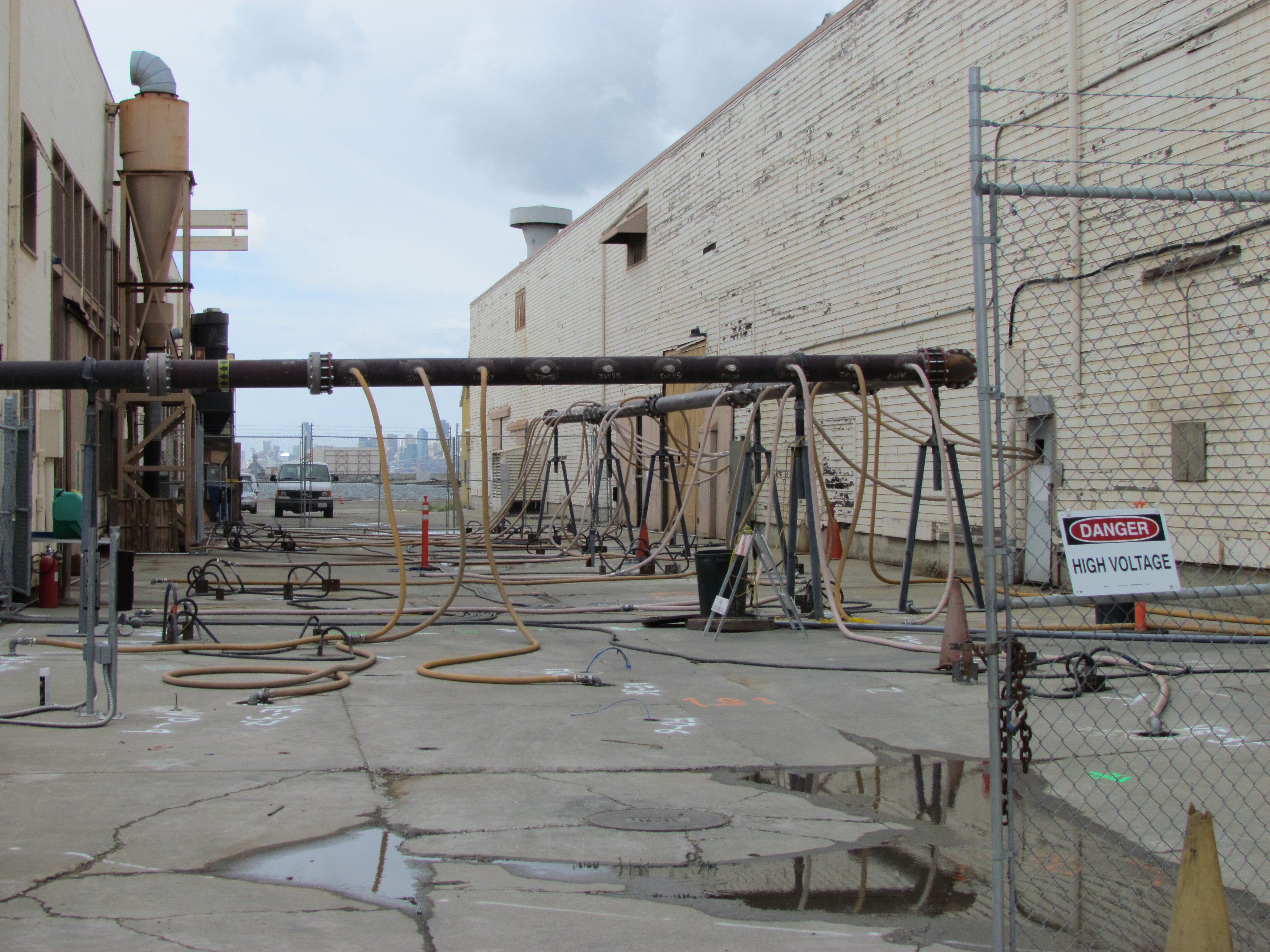
The groundwater remediation project between two buildings near the East Gate entrance, in the area known as Operating Unit 2B, finally got underway after a long delay in startup since last spring.
During set up, one of the 30-foot-long steel electrodes driven into the ground to generate heat struck a plastic sewer line. The sewer line was not on any maps and was undetectable through scanning since it is not iron. Operation of the system began last month after a sewer line bypass was installed, and it will continue through May.
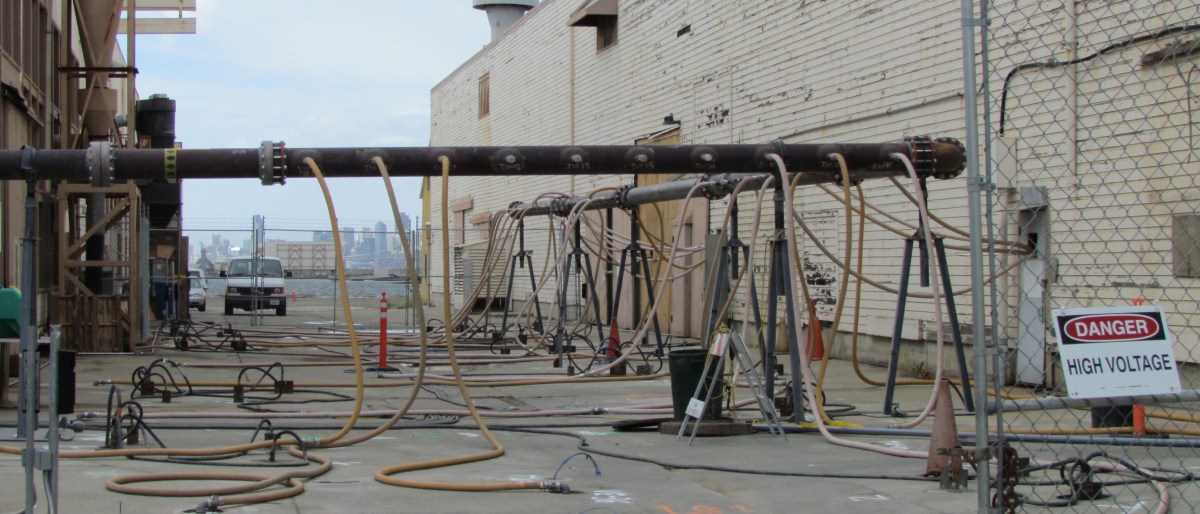
Heating and extraction of solvents in groundwater between East Gate entrance and Seaplane Lagoon.
The contamination is from nearby aircraft maintenance operations that resulted in chlorinated solvents, used in cleaning aircraft parts, ending up deep underground in the groundwater. Of the three most common methods for cleaning up groundwater contaminated with solvents and fuels – pumping in neutralizing chemicals, heating up the ground to vaporize and extract the contamination, and bioremediation using microbes – the heat treatment method was chosen for this site because it is the fastest.
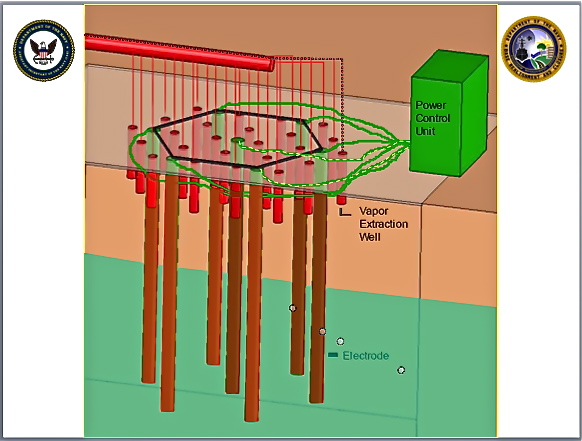
Graphic illustration of heat treatment system. Brown electrodes are heated with electricity, which heats the soil and groundwater, creating steam and toxic vapors that are sucked out into red pipe. Navy graphic.
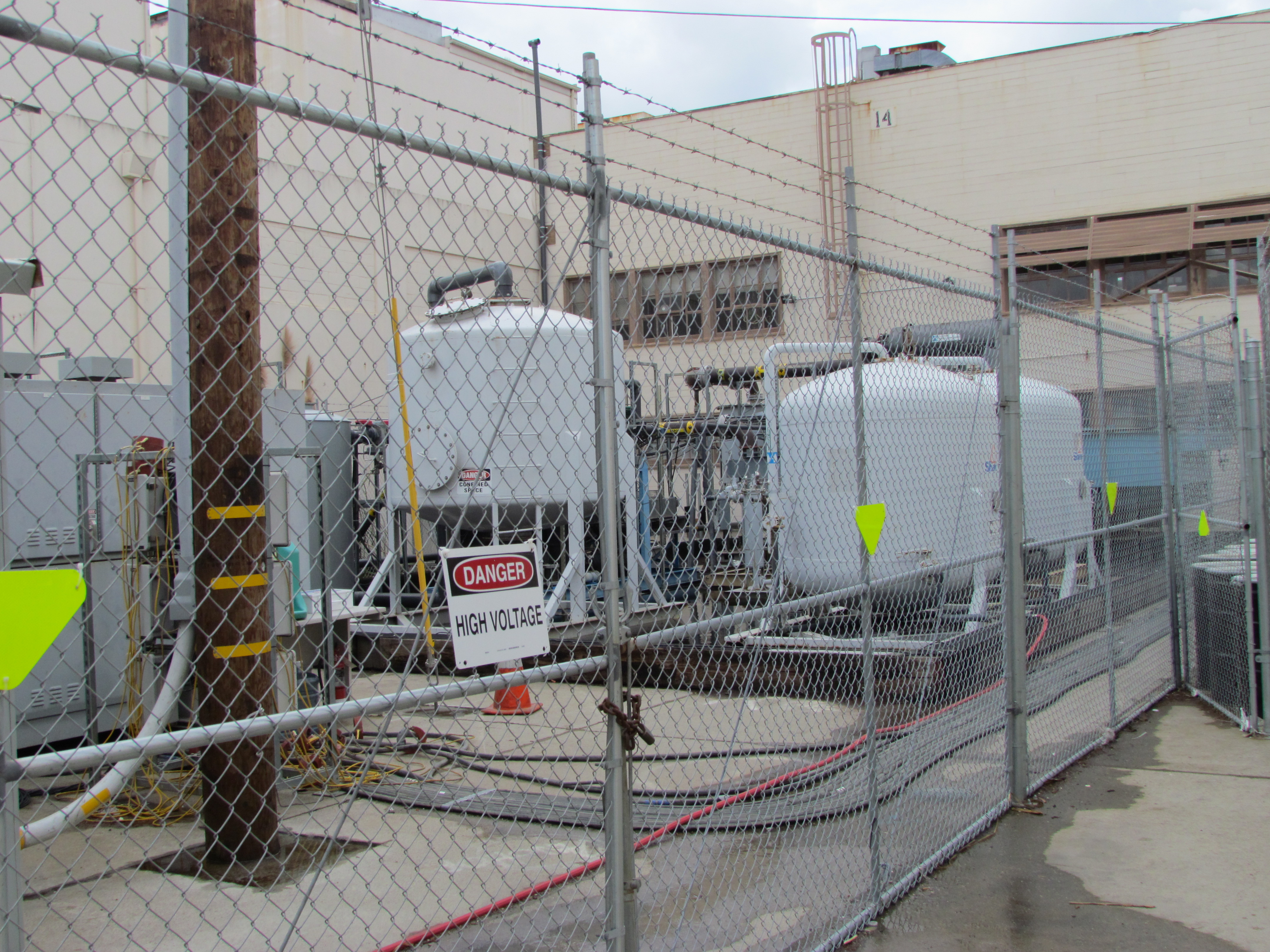
It takes weeks for the ground to get to the target temperature of 194 degrees, which is the temperature at which the solvent boils and turns to vapor. Pipes at ground level suck the vapor out of the ground and channel it through a large pipe to the granulated activated carbon filter system.
Granulated activated carbon filter system in tanks. Water vapor and toxic vapors are captured and separated.
Other groundwater contamination nearby will be treated by a different method not yet announced. The Alameda Point electrical substation is near the other treatment area, and underground electrical lines leading every which way preclude the use of electrodes to heat the groundwater.
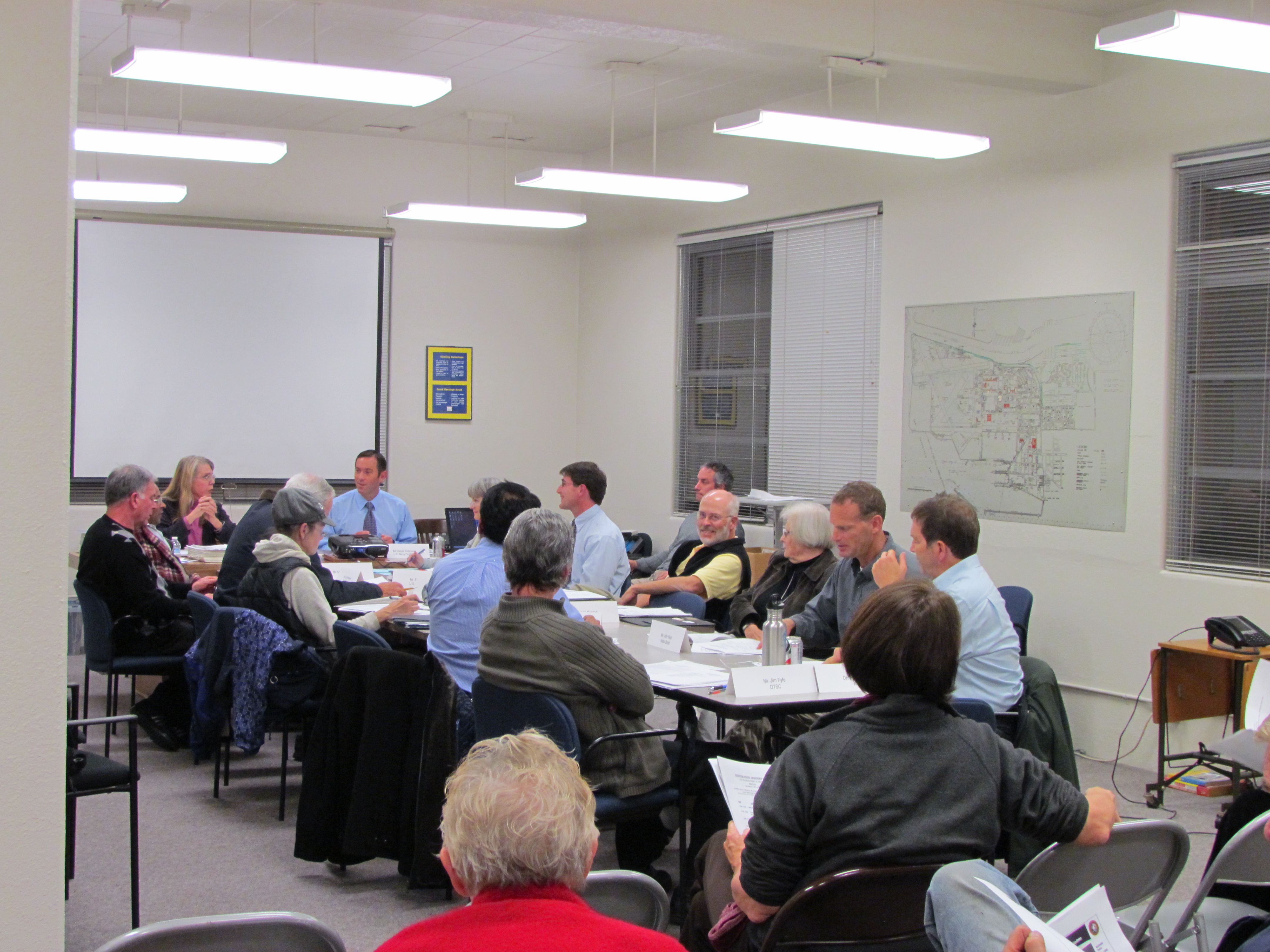
At the October 2011 Alameda Point Restoration Advisory Board (RAB) meeting, the Navy announced that Alameda Point’s monthly RAB meetings would be reduced to quarterly meetings due to budget cutbacks. The Navy said it would welcome a written response from the RAB on how the Navy might continue to carry out its responsibilities for community dialogue during difficult budgetary times.
On February 22, 2012, the RAB sent a letter to the Navy’s Environmental Coordinator for Alameda Point cleanup, Derek Robinson. The letter cited the magnitude of the cleanup effort at Alameda Point – 25 percent of the Navy’s nationwide cleanup budget in Fiscal Year 2011 – as justification for having more than four meetings per year. The RAB offered a reasonable compromise schedule that would add two meetings, bringing the total number of meetings this year to six. The Navy has already indicated that it would continue to host its annual tour of cleanup sites at Alameda Point, which would be in addition to the six meetings being proposed by the RAB.
The RAB also suggested having more than one cleanup site presentation at a meeting in order to make more efficient use of the Navy’s time and money spent on hosting the meetings. In past years, multiple presentations were made at meetings, but this practice ended because of the Navy’s concern that the meetings were too long and community members in attendance would leave before the end.
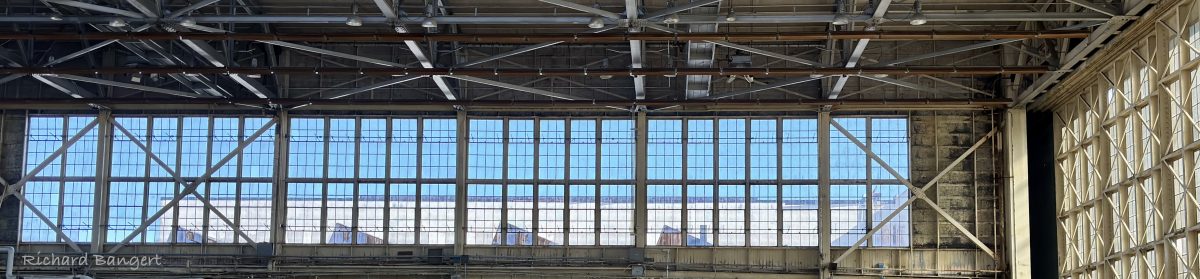

 Lizards go rogue on city’s adaptive reuse plans, setting up multi-family housing complex outside of the adaptive reuse area.

![Seaplane Lagoon cleanup dredging completed [video and slideshow]](https://alamedapointenviro.com/wp-content/uploads/2012/03/img_9647.jpg?w=1200)


 Alameda Point Environmental Report