Chevron’s tardy cleanup could lose Pacific Fusion deal for Alameda

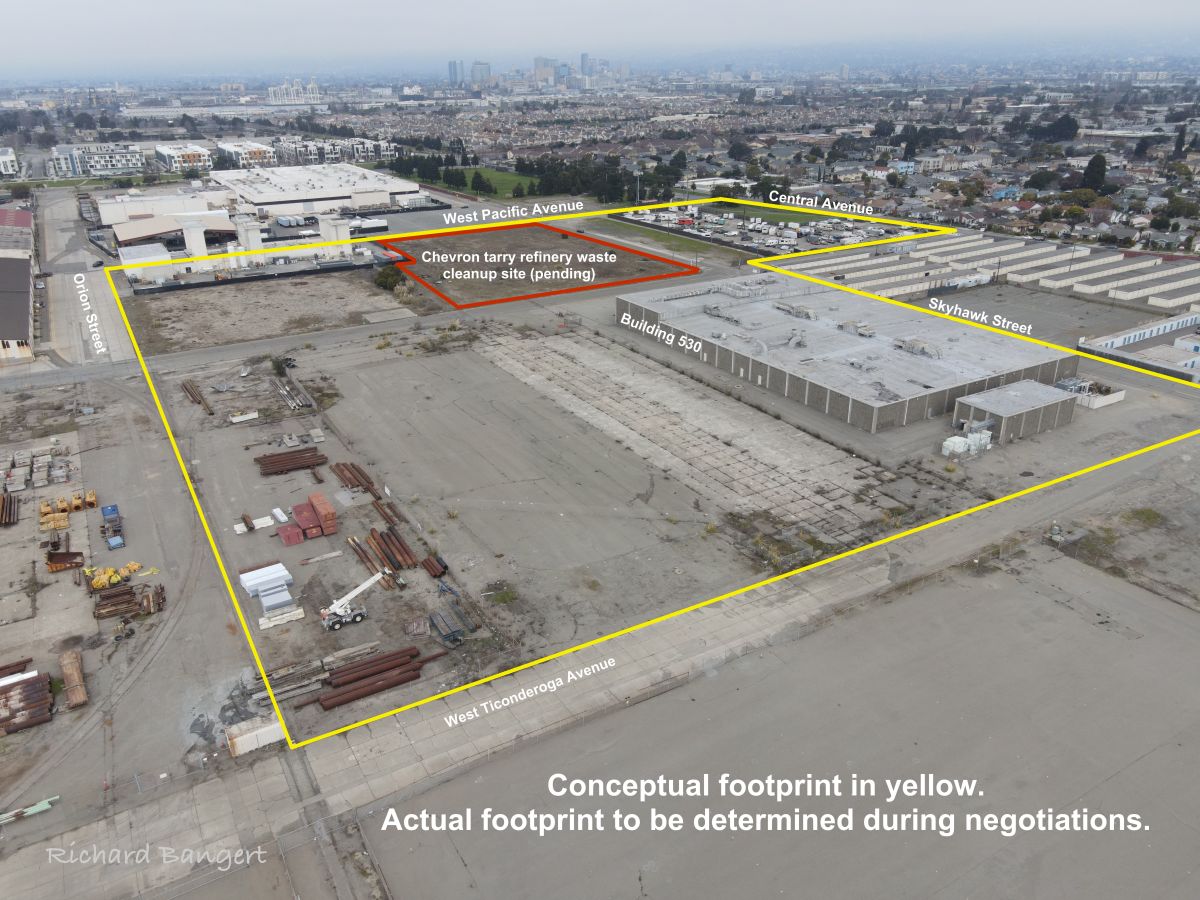
Cleaning up buried tar left behind by an oil refinery at Alameda Point in the early 1900s did not appear to be a top priority until startup company Pacific Fusion came to City Hall in 2024 with a proposal to purchase about 12 acres of land, including the area where the old refinery was located.  The proposal involves building a demonstration research facility, with $900 million in investment capital to back them up. 

Two years earlier, in 2022, the Regional Water Quality Control Board (Water Board) had reached a voluntary agreement with Chevron, which bought the refinery in the early 1900s and subsequently closed it down, to clean up the site to meet regulatory standards.  But Chevron’s two deadlines for producing a cleanup plan, the first on February 28, 2025, and the second on July 18, 2025, were not met.

Continue reading “Chevron’s tardy cleanup could lose Pacific Fusion deal for Alameda”
Burst of new development activity underway at Alameda Point

The flurry of new development activity currently underway at Alameda Point is something that hasn’t been seen since 2018 when work began on the Site A residential and commercial project.  The vast majority of demolition taking place is for long-awaited housing projects.  But two buildings were taken down simply because they were unsafe, unusable eyesores.  And a parking lot is being repurposed for the Food Bank’s new store. 

Continue reading “Burst of new development activity underway at Alameda Point”

Nuclear fusion energy company eyeing Alameda Point property

More cutting edge green energy research and development may be coming to Alameda Point.  A startup company called Pacific Fusion was formed in 2023 with the goal of commercializing new energy production technology.  The company wants to purchase property at Alameda Point to research, develop and build their demonstration fusion energy machine.

Unlike conventional nuclear power, fusion energy technology seeks to fuse together atoms, rather than split them.  The energy is considered a clean, safe, and affordable form of nuclear power that would revolutionize energy production.  It has been only in the last two years that U.S. Department of Energy research labs have finally proven on their equipment that fusion energy is possible.

Continue reading “Nuclear fusion energy company eyeing Alameda Point property”

Tidelands designation frustrates development of Alameda Point

Assemblymember Mia Bonta may again need to be called upon to fix a problem land use designation in Alameda.

There is a major strip of land, dubbed the Central Corridor, through the center of Alameda Point that is designated state “tidelands,” even though the open water tidelands were filled in by the Navy 80 years ago.  According to the California State Lands Commission, tidelands are to be held in trust for the people of the entire state, allowing only maritime, resource protection, or visitor serving uses. “Uses that do not accommodate, promote, foster or enhance the statewide public’s need for essential commercial services or their enjoyment of tidelands are not appropriate uses for public trust lands,” states this Overview of Public Trust Doctrine.

Currently, City Hall West, two blocks of lawn, a fire station, a hangar, some buildings of limited value, a parking lot, and an empty block of tarmac occupy the “tidelands” corridor and serve no Tidelands purposes.

Continue reading “Tidelands designation frustrates development of Alameda Point”

Alameda Point developer completes public art installations

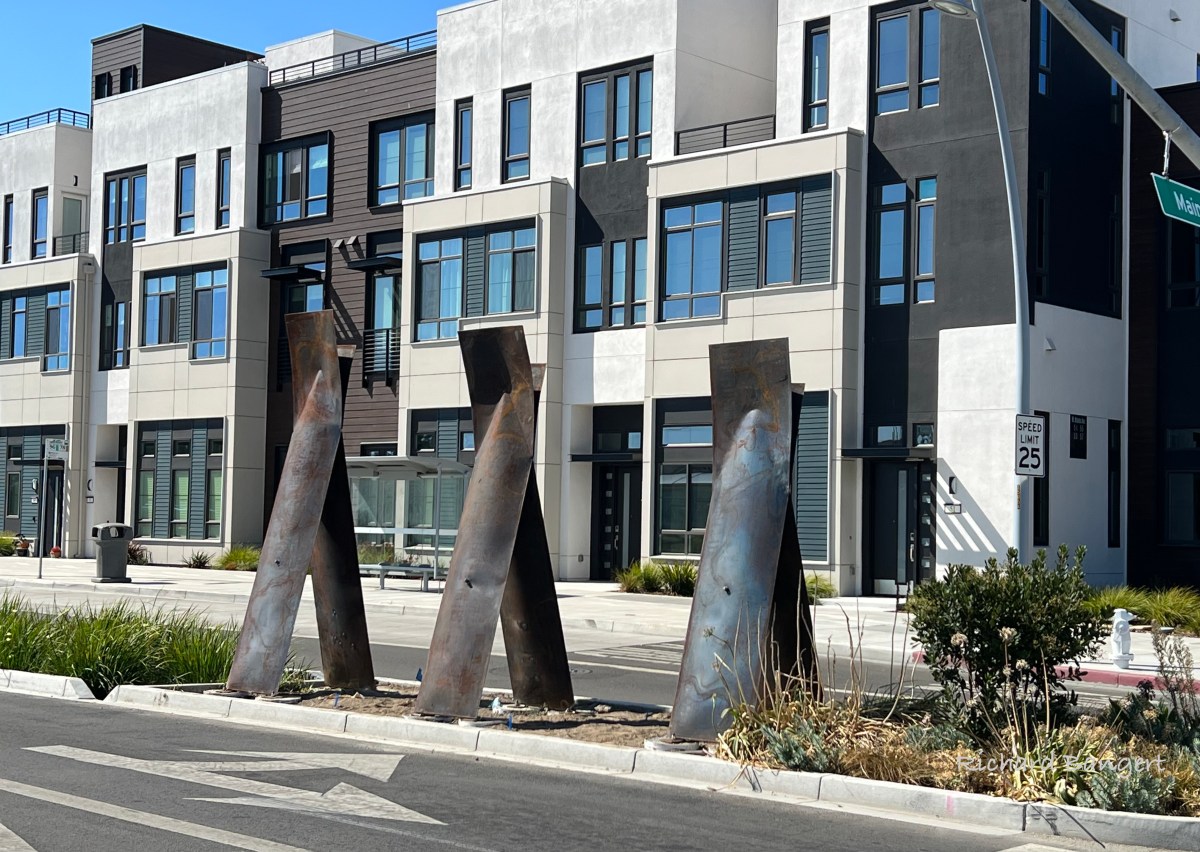
During August, an art sculpture was placed in the street median at the so-called gateway location, another in the Seaplane Lagoon waterfront park.

These two projects satisfy the city’s public art requirement in the development deal for Site A, which stipulated that the developer spend $300,000 on public art.  The budget for the gateway artwork was $100,000, and $200,000 for the waterfront park project.

In order to select its artists, the developer, Alameda Point Partners, conducted a Request for Qualifications process for the two sites at Alameda Point.  The process generated 172 submissions, which were reviewed by an evaluation panel of six Alameda community members, design professionals, and stakeholders. The panel then selected seven finalists to create proposals, offering an honorarium of $1,500 to each finalist. After reviewing the proposals, the panel conducted one round of follow-up questions before making their selections.

Continue reading “Alameda Point developer completes public art installations”

Mia Bonta introduces fix to Surplus Lands Act for Alameda Point

An amendment to the California Surplus Lands Act that went into effect in January 2020 brought long-term leasing and land sales at Alameda Point to a screeching halt for two years.  The new law mandated that no government-owned land could be sold, or leased for more than a year, without first offering the land to affordable housing providers on a state clearinghouse.  After the city listed six initial sites on the clearinghouse, the process ended in January 2022 without yielding one single unit of additional housing of any type.

In an effort to remedy the flawed law, Assembly Member Mia Bonta has introduced legislation to exempt Alameda Point from the process, citing the agreement with the Navy to follow the community base reuse plan.  Under the current process, it forces Alameda to entertain ad hoc changes, such as offering to place housing in job-generating commercial zones.  The Community Reuse Plan for Alameda Point adopted in 1996 spells out the types of uses for all of the areas, and the Navy has been conducting environmental cleanup based on those agreed-upon uses.   

Continue reading “Mia Bonta introduces fix to Surplus Lands Act for Alameda Point”

New housing law hampers economic development at Alameda Point

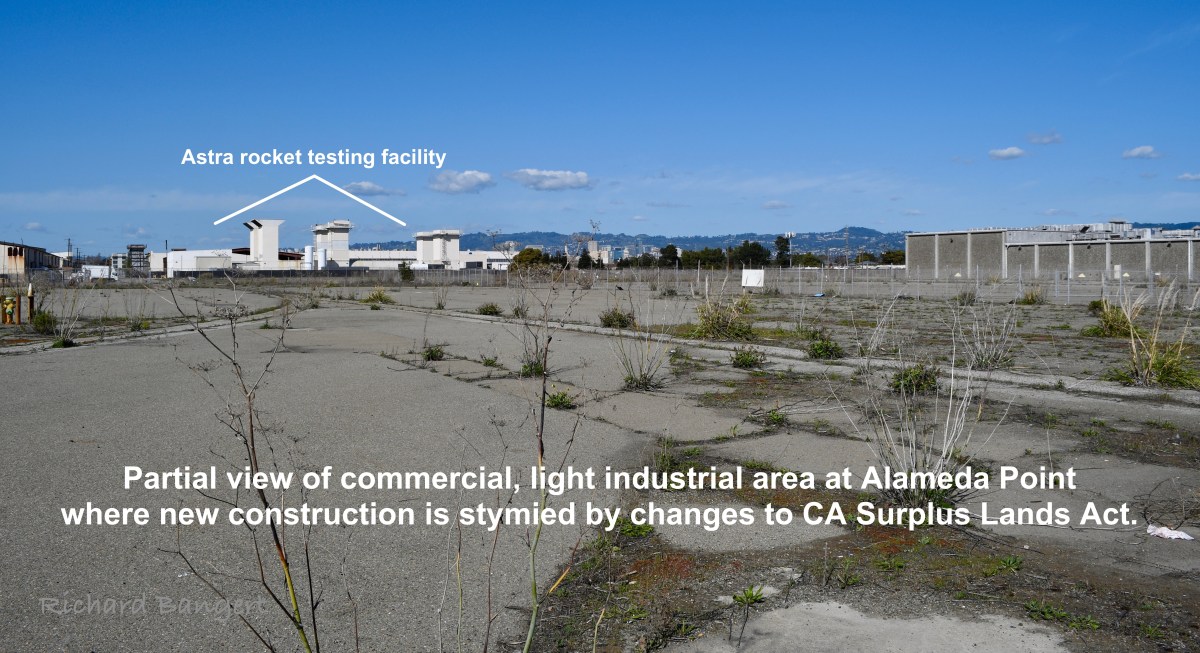
A new state law that took effect in January 2020 has stymied the City’s plan for commercial development on a plot of land at Alameda Point.  Assembly Bill No. 1486 requires cities, counties, special districts, and the state to first offer any and all “surplus” land to affordable housing developers before it can be leased for more than one year or sold.  This legislation amended the Surplus Lands Act and, unbeknownst to the city when they supported the bill, swept in former military bases.    

The city had received proposals from 10 commercial developers as a result of its marketing campaign in 2019.  Each applicant was willing to pay at least the minimum listing price of $36.5 million for 22 acres in the Enterprise District and provide a construction timeline.  The acreage is within the larger commercial and light industrial zone adjacent to Main Street, and includes the self-storage facilities.  This new law meant that the City was unable to proceed with the selection process.

“It’s ironic,” said Nanette Mocanu, Assistant Director of Base Reuse & Community Development.  “The City is a proponent for affordable housing and supported this legislation.  We and many other communities were caught off guard when the legislation was applied to leasing and base reuse properties,” said Mocanu.  “Cities across the state are working to find solutions to the unintended consequences of this legislation.” 

Continue reading “New housing law hampers economic development at Alameda Point”