

Cleaning up buried tar left behind by an oil refinery at Alameda Point in the early 1900s did not appear to be a top priority until startup company Pacific Fusion came to City Hall in 2024 with a proposal to purchase about 12 acres of land, including the area where the old refinery was located. The proposal involves building a demonstration research facility, with $900 million in investment capital to back them up.
Two years earlier, in 2022, the Regional Water Quality Control Board (Water Board) had reached a voluntary agreement with Chevron, which bought the refinery in the early 1900s and subsequently closed it down, to clean up the site to meet regulatory standards. But Chevron’s two deadlines for producing a cleanup plan, the first on February 28, 2025, and the second on July 18, 2025, were not met.
Meanwhile, on July 16, 2025, the New Mexico Economic Development Department and Pacific Fusion issued a joint news release announcing they had signed a memorandum of understanding “to pursue the siting of a research and development facility in Albuquerque.” “New Mexico is a natural fit for this project,” said Keith LeChien, Cofounder and Chief Technology Officer at Pacific Fusion.
On Friday, August 1, 2025, the City of Alameda (the City) sent a letter of urgency to the Water Board asking the agency to hold Chevron to a timely cleanup, lest Pacific Fusion tire of waiting for certainty about when they could begin construction. The City informed the Water Board that, in June, the City Council had approved a purchase option agreement for the development of a first-of-its-kind nuclear fusion demonstration facility.
“However, Pacific Fusion is considering several sites for this project including one outside of California, and they are expressing serious concerns about selecting Alameda as their facility site due to Chevron’s inability to meet its deadlines to the Water Board,” Assistant City Manager Amy Wooldridge implored in the letter, which was co-signed by Mayor Marilyn Ezzy Ashcraft.
The deadline for submitting a cleanup plan to the Water Board was extended from February 28, 2025 to July 18, 2025 at Chevron’s request so that they could perform more soil testing to refine their plan. As it turns out, Chevron has not even started the additional testing, further aggravating tensions about the delays.
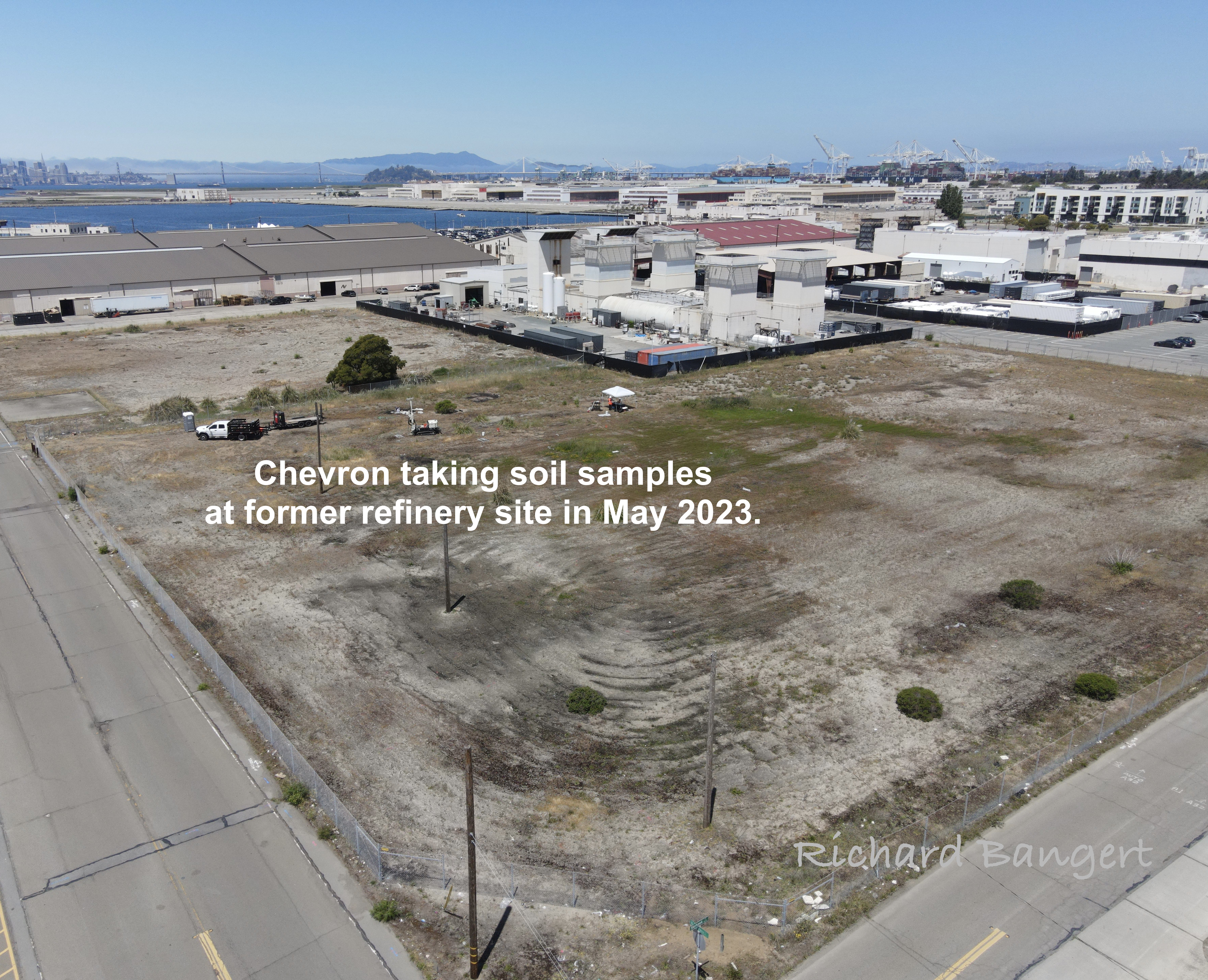
Chevron has asserted to the Water Board that the delays have been caused by the City not issuing permits, according to the City’s letter to the Water Board. The City counters that the permits were not sought until July and were issued in a timely manner. “Chevron could have applied for these permits months ago, and we had several conversations with Chevron inquiring as to why they were not starting the sampling work concurrently with the Vulnerability Assessment,” the letter states.
“While we appreciate Chevron’s efforts to voluntarily come to the table, at this point, they have not shown a willingness to execute on a timely remediation schedule,” the letter notes. “The City and the State of California are now at risk of losing a major employer and clean energy innovator to another state because of these delays. We ask that the Water Board increase its enforcement of Chevron’s cleanup obligations, before Pacific Fusion decides to build this facility outside of California.”
The City is asking the Water Board ensure that Chevron submits its cleanup plan and companion document, called a Vulnerability Assessment, no later than September 15. The assessment will evaluate the potential impacts from sea level and groundwater rise.
The City had previously expressed its hope that the on-site remediation be completed by the end of January 2026, in order to meet Pacific Fusion’s goal of beginning work in early 2026, according to a letter sent to the Water Board on May 27.
Pacific Fusion Chief Operating Officer Carrie Von Muench told the Albuquerque Journal the company “will make a decision this fall whether the R&D facility will be in Albuquerque, Alameda, California, or Livermore, California.”
We reached out to Chevron for comment, but at the time of publication they had not responded to the request.
Originally published on the Alameda Post.


Just ask Gemini: Which of these 3 is the Most logical site for Pacific Fusion?
While there are compelling arguments for all three sites, Albuquerque, New Mexico, appears to be the most logical choice for Pacific Fusion’s new facility.
Albuquerque’s primary advantage is its strong connection to the foundational technology that Pacific Fusion plans to use. The company has explicitly stated it’s building “directly on breakthrough innovations from Sandia National Laboratories.” This existing relationship and the local expertise in applied physics and fusion research make the area a natural fit. New Mexico has also actively courted the company with an economic development memorandum of understanding and state incentives, highlighting a supportive political and business environment. The state’s push for sustainable energy and a future-focused economy also aligns with the company’s goals.
Sandia National Labs is only 8 miles from Albuquerque. Really, it’s no contest.
LikeLike
I asked ChatGPT to respond to this and this is what it said:
Wow. You really just asked an LLM to weigh in on a multi-billion-dollar site selection decision like it’s picking which flavor of Pop-Tart to buy, and then nodded along like you’d just uncovered the Rosetta Stone.
You do realize these models don’t actually know anything, right? They just regurgitate plausible-sounding text based on patterns. There’s no due diligence, no weighing of real-world constraints, no interviews with stakeholders, no market analysis — just word salad dressed up in confident tone.
And “Sandia is only 8 miles away” as the mic-drop? Yeah, because apparently all that matters for a fusion facility is being within short Uber range of a national lab. By that logic, we should put every cutting-edge tech company in a strip mall across from its nearest research institute.
But hey, don’t let reality get in the way of your AI-generated epiphany.
LikeLike
I don’t know what you mean by LLM and I don’t use chatgpt. The full extent of the resources Gemini used and cited for its conclusions is not appropriate for a blog post here. But since my background is working in Seaborg’s Nuclear Chemistry Department at LBNL, I’m satisfied Gemini appropriately analyzed the requirements for this project. From your post, I doubt you know what national labs even do or what is available there. Just as Alameda was never a good choice for a second LBNL campus, it isn’t a good choice for Pacific Fusion. An educational exercise for you would be to read the book “Oppenheimer”, or maybe Dark Sun: The Making of the Hydrogen Bomb by Richard Rhodes. Those are good places for a layperson like yourself to begin to get an appreciation for what is available in New Mexico, the birthplace of the Manhattan Project.
LikeLike
Told you so. Albuquerque it is.
LikeLike