
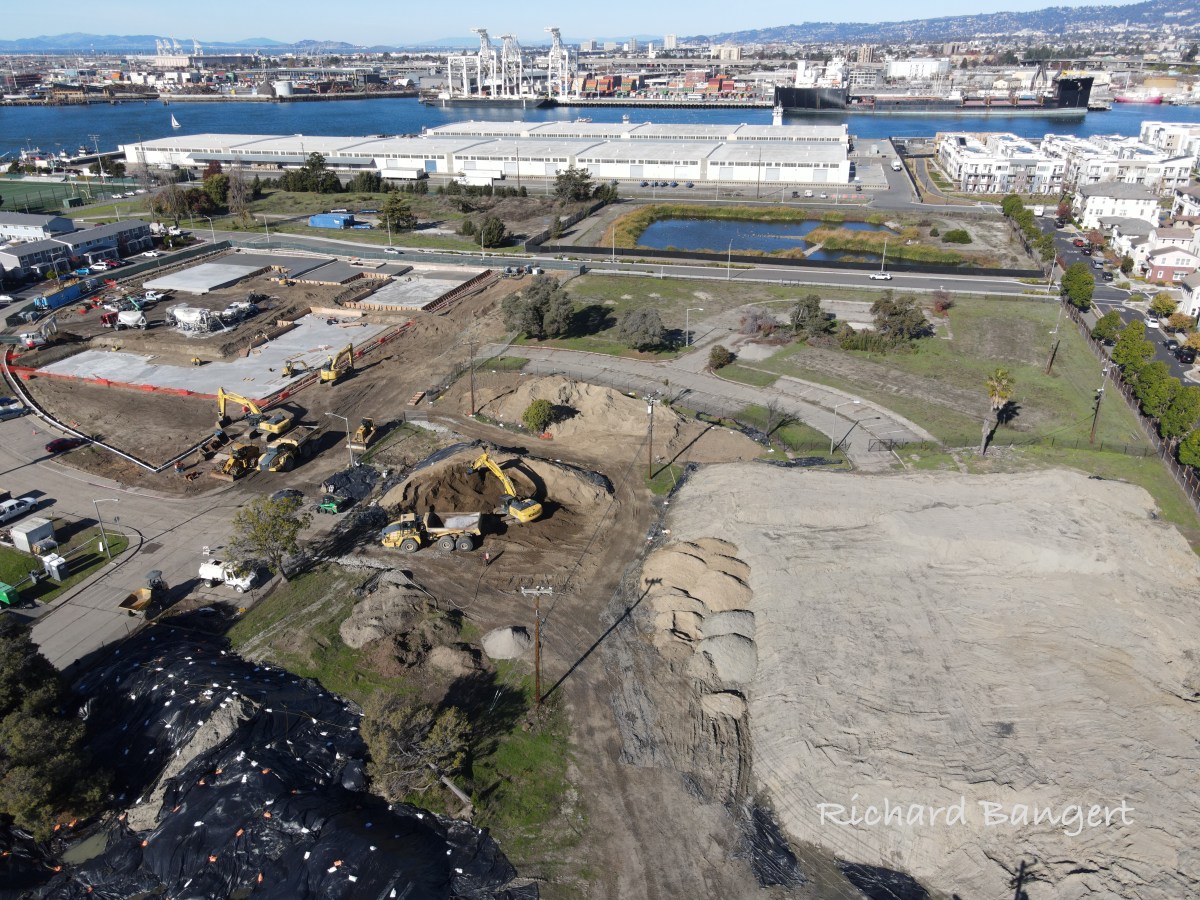
Heavy equipment arrived in early November at the corner of Lakehurst Circle and Mosley Avenue, two blocks away from Target, to begin construction of the first block of North Housing, a planned 12-acre affordable housing site owned by the City of Alameda Housing Authority.
The massive 10.5-foot-thick concrete base of the building, though dramatic in scale and ready for earthquakes and groundwater rise, is only part of the story. The excavation and exposure of 13 feet of soil layers is a reminder, both figuratively and literally, of the 200 years of social, political, and geographical events that directly influenced what is happening here today.
This article highlights the history:
- The days when the whole area was marshland;
- Industrialization that brought pollution;
- Filling in the marshland;
- Navy ownership; and
- National priorities and a social movement that laid the groundwork for today’s affordable housing plans.
The history is so real that you can smell it and see it if you dig or drill deep enough into the ground. Deep soil samples were taken for the housing authority in July 2023. Field notes recorded by drillers for the Soil Characterization Report as they packaged the samples for shipment to the lab stated “hydrocarbon odor” on three samples from five feet deep and one from 10 feet deep.
A driller doing soil testing in the neighborhood back in April 2001 even saw intact marsh vegetation in one of the columns of soil he brought up, noting in the field log: “20 – 24 feet – Organic clay, dark gray at 20 feet, 6-inch zone with clay, reeds, roots, and other organic materials. Strong odor of fuel @ 20 feet – Marsh Crust.” More on that later.
Historical turning point
A turning point in history for this area is the displacement of the people who had lived here for thousands of years. The legal ownership going back to Spain and their Catholic missions is often cited as if history began then. But the paperwork only started after the Ohlone, labelled by the Spanish as “the heathens,” were run out. “The arrival of the Europeans spelled an end to Native American culture,” wrote Alameda Post historian Dennis Evanosky in “Alameda’s First Inhabitants,” Feb. 1, 2022.
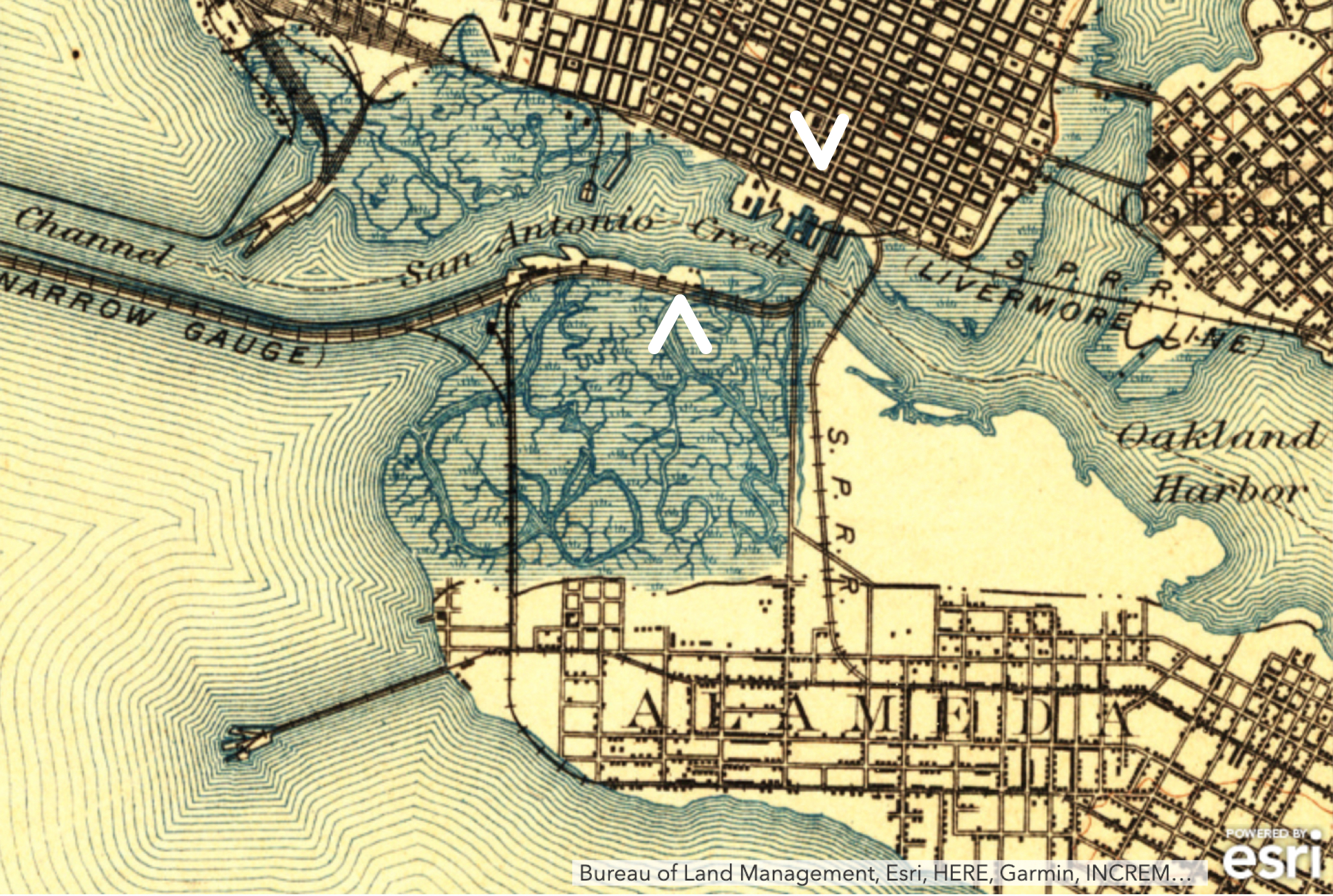
With “mission accomplished,” this paved the way for the gradual industrialization and pollution of Alameda’s shoreline and that of its neighbor Oakland on the other side of what was then San Antonio Creek.
Industrial processing of coal and oil ramps up
The Oakland industry most impactful to this area was the Oakland Gas Light Company. The company processed coal to produce a gas used for Oakland’s street lights. The plant was located where Jack London Square now stands and operated from the late 1800s to early 1900s. The carcinogenic coal tar waste from the plant was discharged directly into the creek, with much of it settling on Alameda’s marshland and in the creek.
“The specific contaminants of concern in tars can vary depending on the gas manufacturing process; however, all tars contain polycyclic aromatic hydrocarbons (PAH’s),” states a U.S. National Library of Medicine report. “PAH’s are a class of compounds containing several known carcinogens.”
The Pacific Coast Oil Refinery operated on Alameda’s western shoreline in the late 1800s and early 1900s producing kerosene from crude oil for lanterns. This business also contributed to the hydrocarbon contamination that settled on the adjacent marsh and tidelands.
Legacy of pollution still with us
Today, the housing authority property, the privately owned Admiral’s Cove apartments, and Coast Guard Family Housing all sit on top of the former marsh. And, of course, back in the day no one thought to clean up the mess before covering it up, let alone restoring and leaving it alone. This left a permanently encapsulated layer of black hydrocarbon gunk about two feet thick found at depths of 4 to 20 feet. It became known as the Marsh Crust. It even has its own special city ordinance of the same name regarding digging in the area.
To comply with the ordinance, the housing authority had to do deep soil testing to determine the fate of the excavated soil. Much of soil was deemed unsuitable for residential use by survey contractor Engeo and will eventually be hauled away for proper disposal.
Engeo’s November 1, 2023 report cited a host of contaminants that exceeded allowable levels, such as petroleum, naphthalene, various PAHs, and chromium. In soil boring sample #1, for example, at 10 feet below ground, the reading for naphthalene, which produces harmful vapors and is a water contaminant, was 36 times higher than the Department of Toxic Substances Control and US Environmental Protection Agency allowable levels for residential soil exposure. Boring #2, for example, at 7 feet, had a petroleum reading that was more than twice as high as the Regional Water Quality Control Board level for residential use.
Why was the marsh covered up?
In 1873 Oakland needed to make its port commercially viable and needed a convenient place to dump the dredge soil. The federal River and Harbor Act of 1873 authorized dredging, building stone retaining walls, and cutting a tidal channel through the Alameda Peninsula. “Between 1874 and 1894, twin stone retaining walls consuming 95,000 tons of rock were built 9,000 feet out into the Bay, and the dredged material filled in the useless and smelly marshlands on either side,” wrote Graham Claytor in “Mighty Port of Oakland,” Bay Crossings, June 2005.
More dredging and filling occurred when the University of California decided to build their short-lived airport in the same area.
When the Navy took over the land, they built housing that has since been replaced. All through the years, little did any of the residents know that their yards and park were laced with a toxic byproduct of coal and oil refining called PAHs. It wasn’t until the Coast Guard was ready to take the relatively new housing from the Navy that soil testing indicated there was a problem with PAHs. But let’s not get ahead of the story.

Why was the Coast Guard being offered land from the Navy?
Congress decided to streamline and cut costs for the military by closing bases and consolidating operations. Naval Air Station-Alameda landed on the cut list in 1993. A Community Reuse Plan determined how the main base was to be disposed of, but the North Housing area was to go to its sister federal agency the Coast Guard. The Coast Guard soon lost interest in taking the newly remodeled townhome-style neighborhood. Their change of mind happened not long after the Navy dug up and replaced two feet of soil throughout the neighborhood, including the park, contaminated with PAHs. This explains the light brown layer of soil on top of the otherwise gray soil in the new housing excavation area.
When the Coast Guard backed out, this meant the Navy had to consider a number of non-federal disposal options. One of them was a requirement to offer some of the land to a homeless housing and services provider. By 2009, the Navy, the Department of Housing and Urban Development, and the City of Alameda had agreed on a disposal plan that would deed about 12 acres to the city for at least 90 units of housing for the homeless, along with adjacent Estuary Park. It also included transferring two acres to Habitat for Humanity for 30 units of housing, which has not happened yet.
Why was the Navy legally required to offer land for the unhoused?
It is because of a federal law called the McKinney Homeless Assistance Act. It was named after its chief Republican sponsor Representative Stewart B. McKinney of Connecticut and signed into law by President Ronald Reagan in 1987. This law did not spring from the heart of one legislator. Like all major social justice legislation, a social movement preceded it. Its formation began in the early 1980s and eventually guaranteed at least some housing on this former Navy property would be for homeless individuals. It is the same law that provided land and Navy housing to the Alameda Point Collaborative in 1999, two years after the base closed.
“The early 1980s marked the emergence of what now may be considered the modern era of homelessness,” states a National Library of Medicine report on the history of homelessness in the United States.
One of the leading voices on behalf of the homeless during this period was the Community for Creative Nonviolence (CCNV). On Thanksgiving, 1981, CCNV staged a homeless camp at Lafayette Park across from the White House and served traditional dinner to 600 homeless individuals. The camp stayed in operation for four months and put homelessness on the national agenda. One of CCNV’s leaders was a flamboyant activist named Mitch Snyder, who helped thrust homelessness into the halls of Congress, most famously in a CBS 60-Minutes episode with Mike Wallace.
Why is a new type of building foundation system being used?
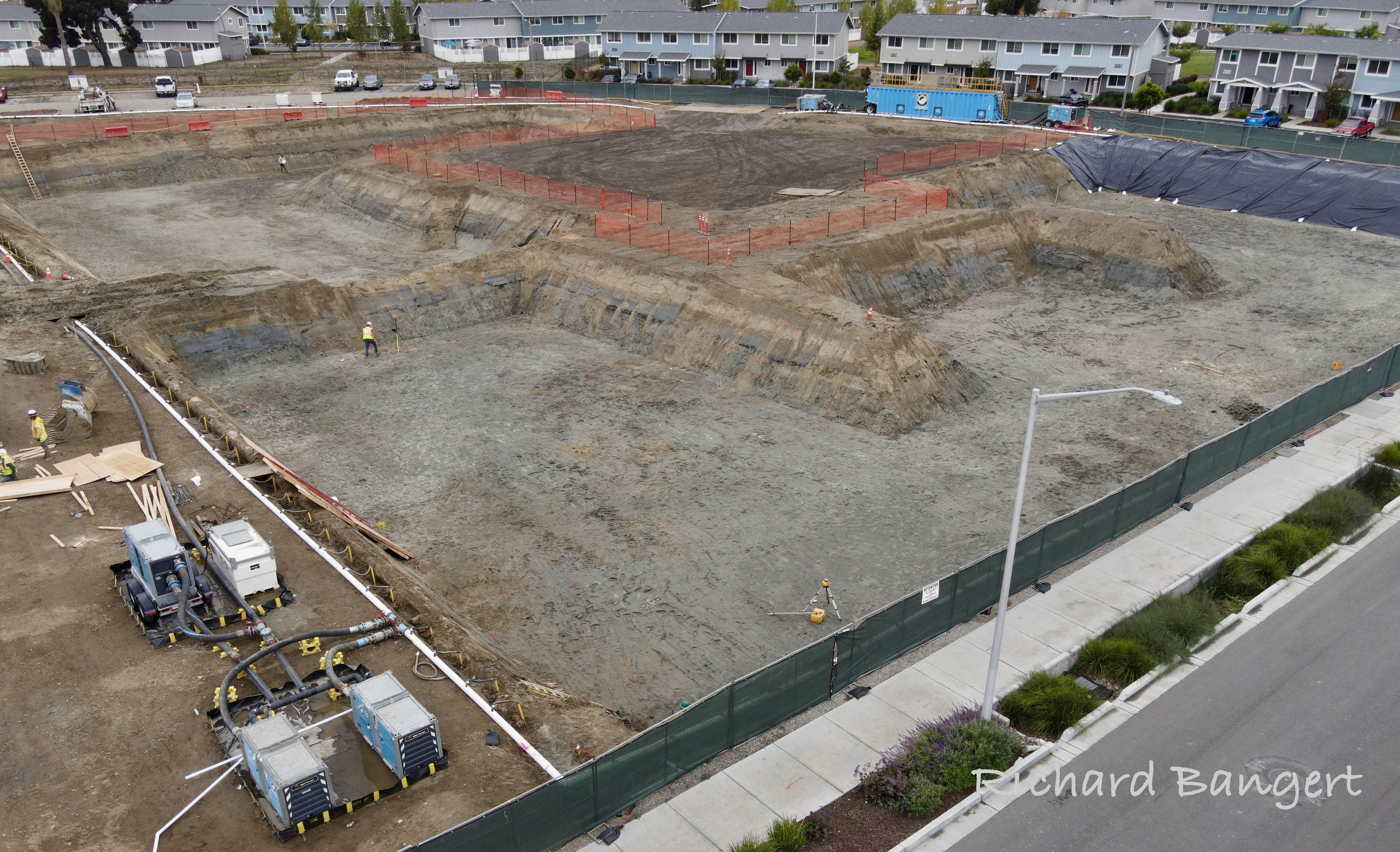
Within weeks after the heavy earthmoving equipment showed up, it looked like an underground parking garage was added to the plan for three 4-story buildings. Instead, the 13-foot-deep pits are being filled up with cement.
This is apparently the first use of this foundation system in lieu of pile driving for a multi-story building in Alameda. Alameda city planner Andrew Thomas said that in his 22 years working at the city he is not aware of it being done before.
According to the AHA Community Relations Manager, Joshua Altieri, the system is being used “for soil stabilization purposes. AHA’s engineers advised a system called cellular concrete rather than the ‘driven piles’ used elsewhere on the base,” said Altieri. When asked about the rationale for the choice and whether it was the cost factor, or the seismic factor, or something else, Altieri did not answer the question, saying only, “AHA is following the engineer’s recommended solution, and it has been approved by the city of Alameda building department.”

Storied history starts a new chapter
The site has a storied history, which got us to this day when a local housing authority is able to build an apartment complex with services for the homeless in one of the prime locations in Alameda. The housing authority has been able to parlay the Navy’s gift of land, which came with only one requirement, that being providing 90 units for the homeless, into a master planned neighborhood with up to 586 units of affordable housing.
The first two buildings on this block, Linnet Corner and Estuary 1, will start going up early next year. “We hope Estuary II will come along in late 2024, but it is still applying for additional financing,” said Altieri. “Building permit design and submittal on the remaining blocks, as well as initiation of financing applications, will start after all three Block A projects have begun construction.”


When will prospective tenants be able to apply at North Housing?
“The interest list typically opens six months ahead of construction completion, estimated in early 2025,” said Altieri. “Estuary I will serve formerly homeless tenants referred by the County of Alameda’s Coordinated Entry System. Linnet Corner will serve seniors, including sixteen units for formerly homeless veterans, also referred by the County of Alameda.” The AHA website and newsletter are the best places to look for updated information on leasing.

Originally published on the Alameda Post.
 Alameda Point Environmental Report
This is intense and scary – I would have never thought the earth would be so deeply polluted. THANKS FOR COVERING THIS. M
>
LikeLike
i lived in the north houseing. My children my parents and I especially were experiencing seizures kidney problems also my boys for two years failed to meet their growth spurts. I was talking with the epa reps and eventually was contacted by some news agency. Anyway long story short ( and much abuse and trauma . The military forced my children and I to leave houseing without clothing or any belongings. To the streets basically. the base officer told husband to either shut me up or kiss his ass and career goodbye. That’s not the worse. They had mets take me to psych hospital where I was forced to stay the nite til a dr assessed me and found I had no mental issues . My husband was given temporary lodging however was told he was to Not allow me or children to stay. Believe this I we were submitted to endure emotional a physical harm. Homeless!! I’m still not recovered And i’m 69 kidney heart disease and while in housing diagnosed with sle and my youngest was put on a monitor for 18 months or he would stop breathing while sleeping. Super fund THAT! Name is Kija ***
email rodzgia@icloud.com
LikeLike
Nice. Getting another pukey box building.
LikeLike