Alameda could find itself back at square one, or at least close to it.
In September 2025, Representative Lateefah Simon informed city officials that the U.S. Department of Veterans Affairs (VA) had decided to cancel plans for a clinic and columbarium cemetery at Alameda Point. The news became public when a letter to the VA from Congresswomen Lateefah Simon and Nancy Pelosi and Senators Adam Schiff and Alex Padilla was released on December 12, 2025.
The congressional delegation urged the VA to reconsider its decision to terminate the project. On December 15, 2025, public officials and representatives of veterans organizations made a similar plea on the steps of Alameda’s Veterans Memorial Building.
If the VA sticks to its decision to terminate the project, it is unclear what will happen next. But two land-disposal processes are on the table.
The delegation’s letter to the VA questioned why the agency plans to turn over the land to the federal General Services Administration (GSA), which handles disposing of real estate. The congressional delegation pointed out that the land could go back to the Navy, according to the VA/Navy land transfer agreement. The letter explained that the “VA and the Navy have a binding agreement that requires VA to notify the Navy of its decision to terminate the project within 30 days of its determination, and permits the Navy to receive the property if VA makes such a decision within fifteen years of this 2014 agreement.”
This means either the GSA or the Navy will dispose of the federal land. History and current events will likely play a role in both scenarios.
Scenario 1: If the property reverts back to the Navy and City.
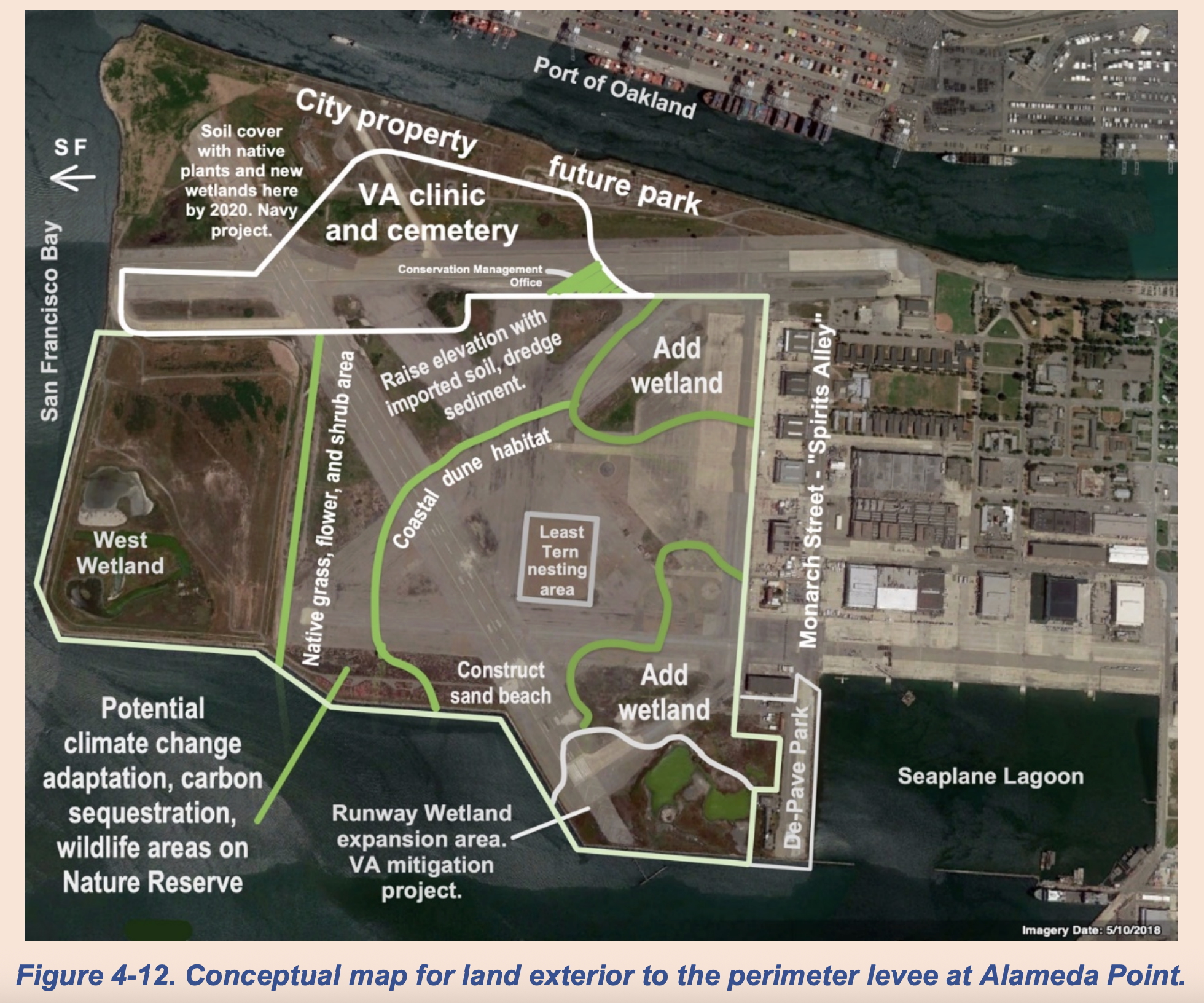
The Navy will receive the 550 acres that was originally earmarked for a National Wildlife Refuge. And the City will get back the 74 acres it relinquished in a 2013 non-binding agreement to allow the VA facilities to move further away from the least tern nesting site.
With both federal and city properties back at square one, previous plans may be revisited.
Navy would seek to dispose of the land again
The Navy would again be required to embark on a process to dispose of the land. A logical source of guidance is the congressionally mandated 1996 Community Reuse Plan for the Navy base, which was approved by the Alameda City Council and accepted as the roadmap for future uses by the Navy.
Subsequently, the base reuse plans were incorporated into the City’s 2002 General Plan amendment for Alameda Point, which contains 113 references to a wildlife refuge on the airfield. “This area … is being preserved as a National Wildlife Refuge for the protection and enhancement of migratory birds, endangered species, and other wildlife habitat,” states the amendment. The wildlife refuge was to include the rock wall, known as Breakwater Island, where pelicans roost, as well as the waterway in between.
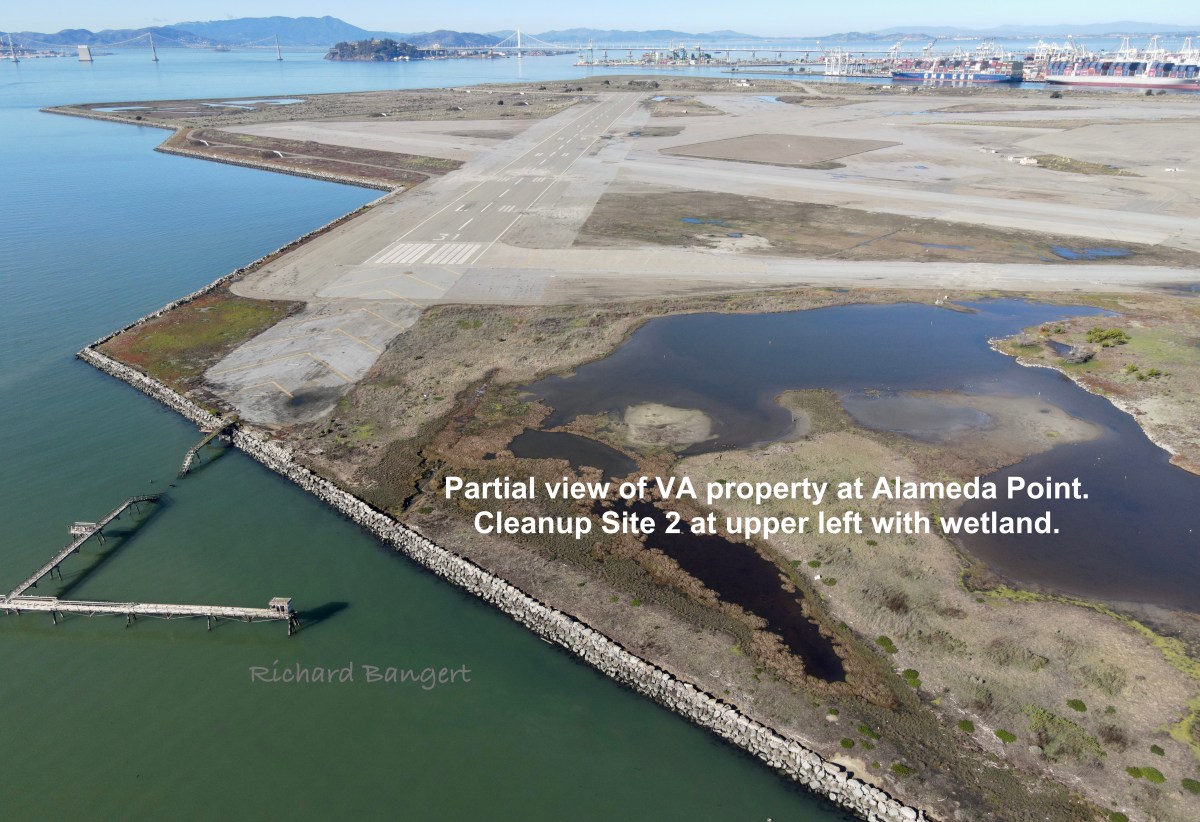
However, the transfer of land from the Navy to the U.S. Fish & Wildlife Service (Service) for a wildlife refuge never came to pass because in the early 2000s the Service would not accept the small section where the underground toxic dump is located, called Site 2, until the Navy completed a remediation plan and retained long-term responsibility for it.
“USDI [U.S. Department of Interior] policy requires that newly acquired lands do not add to the agency’s contaminant liabilities. Therefore, the Service must ensure that the Navy completes an acceptable remediation plan and retains long-term liability for remaining contaminants,” explained Marge Kolar, Chief of the Pacific Southwest Region of U.S. Fish & Wildlife Service in a 2002 document obtained through a Freedom of Information Act request.
Still, at the time, the Navy was not willing to retain long-term liability for the dump site. Eventually the Navy abandoned the effort to transfer the land to the Service and instead began discussions with the VA, which submitted a formal request for the property (exclusive of the waterway and breakwater) in 2006, according to VA’s environmental impact report.
Even though transfer of land from the Navy to the Service was at a standstill in 2007, regional officials with the Service were still determined to protect the wildlife and educational value of the property, highlighted in a PowerPoint Presentation, even if it was managed by a different agency. In July 2007, the Service emailed the East Bay Regional Park District to discuss the possibility of the park district taking the land. It is unknown if, or what, the park district responded.
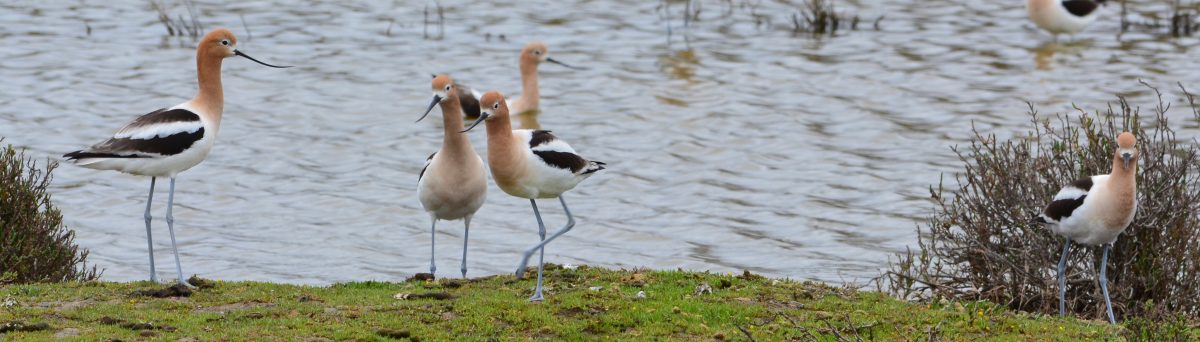
If the 550 acres is returned to Navy ownership, it is likely that the Navy will again be responsible in perpetuity for the buried industrial dump site that was certified remediated in 2017, and also PFAS chemicals, even though the VA formally assumed liability and maintenance responsibility in 2019. The Navy would also again be responsible for managing the endangered California least terns.
City would increase its regional park footprint
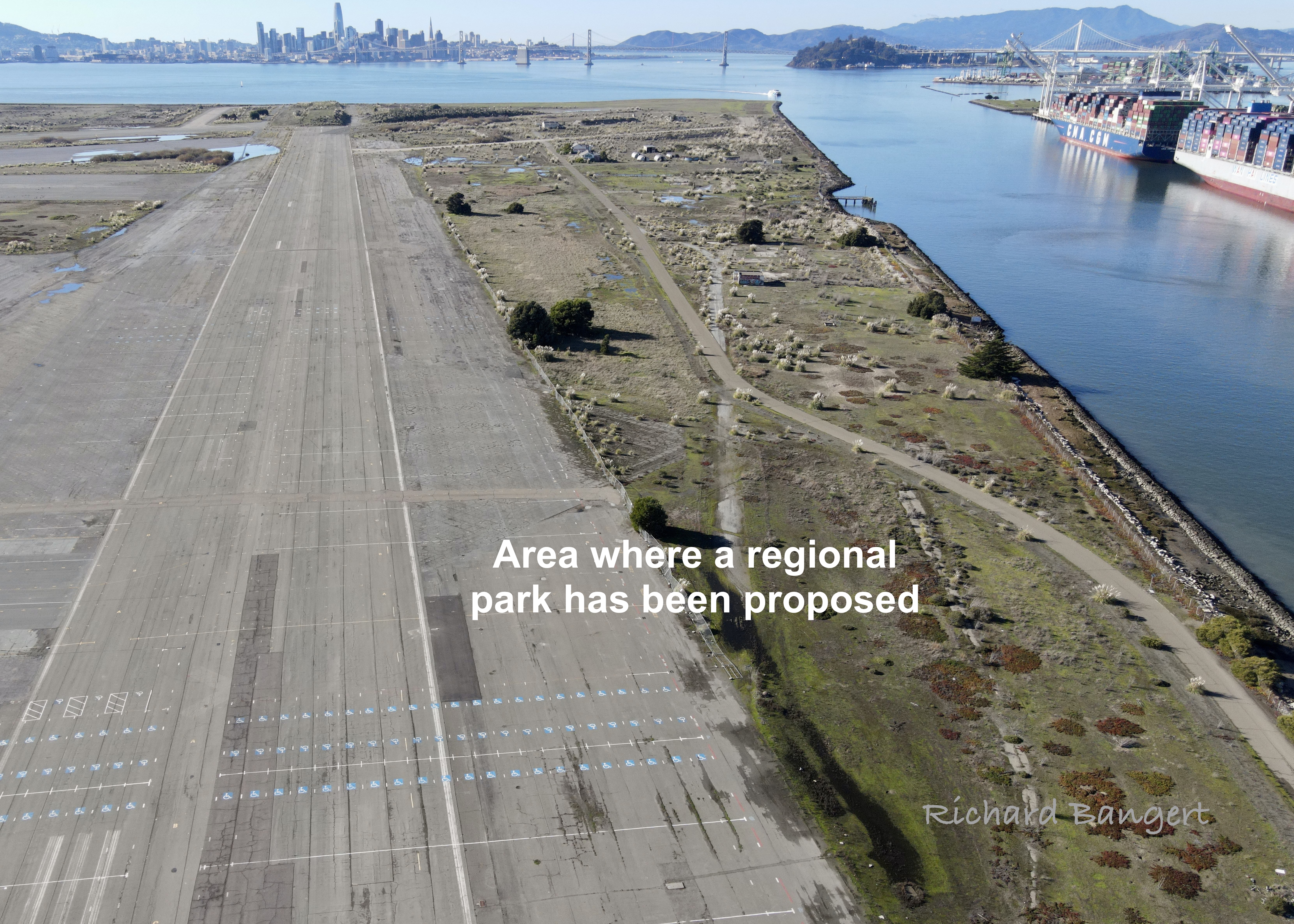
With the return of 74 acres to the City’s Northwest Territories, the footprint for the proposed regional park would increase. This would offer more contiguous open space for natural wildlife habitat and more visitor-serving design options.
Scenario 2: If VA turns the property over to GSA for disposal.
The Congressional delegation’s letter referenced the VA’s Notification statement to Congress that states, “VA will work with GSA to excess or dispose of this Alameda site through the most advantageous method.” Under this scenario, the GSA goes through a mandated land disposal process.
The GSA would make the property available for other federal agencies that might want it, including the Fish & Wildlife Service or the Golden Gate National Recreation Area. If no federal agencies want the VA property, it would then be offered to the State of California through a Public Benefit Conveyance, perhaps going to the California Department of Parks and Recreation. If the state does not want it, the GSA could offer it to the East Bay Regional Park District or the city. Acceptable public benefit conveyance uses include “Public Parks and Public Recreational Areas,” and “Wildlife conservation.”
Future owner could create sea level rise adaptive natural landscape
Regardless of which scenario plays out, the City’s Climate Adaptation and Resiliency Plan has identified opportunities to implement adaptive landscape design for the area.
Originally published on the Alameda Post.
 Alameda Point Environmental Report
This is very disappointing. The VA clinic and the Columbarium have been a promise for years. Alamedans have had to go out of Alameda to find a site for their loved ones. With Alamedas population increase it seems time for a Columbarium. As a 78 year old fifth generation Alamedan I had hoped to be buried here. I have my parent’s ashes waiting for this promise to be completed. With the Alameda Naval base history it seems more than appropriate to complete the VA clinic promise. I pray the City Council is able to hold the VA to their word.
LikeLike