
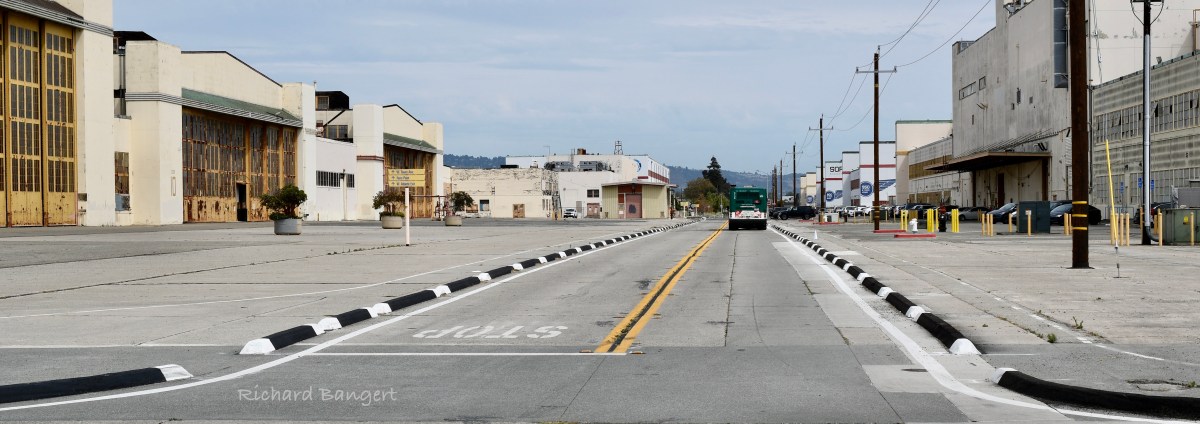
May 1,1993 – Naval Air Station-Alameda identified for closure under the Base Realignment and Closure (BRAC) Program.
August 13,1993 – President Bill Clinton speaks at the Naval Air Station about future possibilities for the base after it closes. Pledges a speedy cleanup of contamination and offers hope for economic development. Official White House video of the event.
January 1, 1996 – Community Reuse Plan adopted for the base.
April 1, 1997 – Naval Air Station-Alameda ceases operations.
January 2, 1998 – City of Alameda adopts its first Five-Year Implementation Plan.
July 1, 1999 – U.S. Environmental Protection Agency places Alameda Point on the Superfund List, setting in motion the regulatory protocol for environmental cleanup.
August 2001 – City selects Alameda Point Community Partners as master developer for Alameda Point.
December 1, 2003 – City of Oakland sues Alameda over plans to build 1,800 homes and contends that the Environmental Impact Report (EIR) inadequately addresses the effects of developing Alameda Point on the surrounding area, particularly the traffic that would flow through Oakland Chinatown.
January 1, 2004 – Oakland Chinatown Chamber of Commerce and Asian Health Services jointly file suit against Alameda, claiming that the Alameda Point EIR inadequately analyzed the impacts on Chinatown traffic.
July 15, 2004 – City issues draft Environmental Impact Report for the proposed Alameda Point golf course.
January 2, 2005 – City adopts second Alameda Point Improvement Plan, aka Five-Year Implementation Plan. Redevelopment efforts from 2003 to 2005 were limited to maintaining the status quo at Alameda Point. New plan outlines on-going efforts in economic and housing redevelopment and refers to applicable policy documents in place, such as the General Plan and the Preliminary Development Concept.
March 15, 2005 – City files revisions to Alameda Point golf course environmental impact report.
February 1, 2006 – City publishes Preliminary Development Concept to guide the master developer.
September 20, 2006 – Alameda Point Community Partners withdraws as master developer in a letter to the City. The developer cited the recent downturn in the real estate market making it no longer financially feasible to acquire the property. It also cited “the volatility in the market for environmental insurance and the demands being made upon the project by the historic preservation community.”
October 1, 2006 – City issues Request for Qualifications to select new master developer. Five companies responded: Catellus, Corky McMillin Companies, Lennar, SunCal, and United World Infrastructure. Corky McMillin Companies and United World Infrastructure subsequently withdrew from consideration.
May 1, 2007 – City selects SunCal as master developer for Alameda Point.
April 25, 2008 – City publishes Alameda Point Station Area Plan – Transit-Oriented Development Alternatives comparing three different conceptual development plans.
October 1, 2008 – City approves SunCal entering into partnership with hedge fund DE Shaw, in spite of news reports as to SunCal’s risky financial status.
March 1, 2009 – SunCal eliminates a region-serving park in the Northwest Territories in its proposed ballot initiative for redeveloping Alameda Point .
April 1, 2009 – SunCal begins a petition drive to place its development initiative on the ballot. SunCal’s subcontractor, Tramatola, tells voters that the ballot measure’s intent is to allow the developer to conduct environmental clean up on the former Naval Air Station, and not that the developer needs a voter-approved exemption from the City’s density-limiting charter provision in order to build multi-family housing.
May 1, 2009 – SunCal distributes flyers to homes in Alameda promising to build a sports complex as part of its development.
May 1, 2009 – Department of the Navy assigns approximately 44 acres of land and structures in the area where the monthly Antiques Faire is held to the Department of the Interior/National Park Service. The Park Service will subsequently convey the property to the City of Alameda Recreation and Park Department for the ultimate development of a community sports and recreation complex.
June 10, 2009 – As of June 10th, 160 signers of SunCal’s ballot initiative petition to become the master developer for Alameda Point formally had asked for their names to be removed from the petition saying they misunderstood what they were signing.
August 1, 2009 – SunCal distributes a flyer promising enhanced environmental cleanup due to raising its number of housing units from 1,800 to 4,800.
August 27, 2009 – News article reveals that SunCal has removed a proposed park from the tip of Alameda Point in its amendments to the City’s General Plan for its ballot measure.
September 9, 2009 – More signers of SunCal ballot petition ask to have their names removed, with a total of 522 signers having their names removed.
September 10, 2009 – SunCal’s PR firm Singer Associates, Inc. announces newly-formed advisory group, called Alamedans for Alameda Point Revitalization, via media and a mailer.
September 17, 2009 – Opposition group called Protect the Point submits letter to the City Council, also published in local newspaper, urging them to oppose the SunCal plan.
September 21, 2009 – Alameda Chamber of Commerce announces opposition to the SunCal ballot initiative. SunCal turns in signed petitions to qualify for the ballot.
September 24, 2009 – Renewed Hope Housing Advocates releases scathing critique of the SunCal ballot initiative titled “Doubtful Promises: A Report to the Alameda Community on the SunCal/Shaw Hedgefund Initiative.”
September 25, 2009 – SunCal changes its campaign ads from “Clean Up the Toxics” to “Clean Up the Blight.”
October 13, 2009 – Mayor Beverly Johnson withdraws her support for the SunCal ballot initiative.
October 29, 2009 – Councilmember Frank Matarrese drops support for SunCal ballot initiative.
November 3, 2009 – City Council sets election date for SunCal’s ballot initiative on February 2, 2010.
November 16, 2009 – Ballot arguments for and against the SunCal ballot initiative are submitted to the Registrar of Voters.
November 17, 2009 – Councilmember Marie Gilmore states, “The initiative, as written, is not in the best interests of the City.”
November 23, 2009 – Registrar of Voters titles the SunCal ballot initiative as Measure B – The Alameda Point Revitalization Initiative.
December 5, 2009 – Opposition group Protect the Point blankets the city with door hangers calling on voters to vote No on the measure.
December 20, 2009 – Lawn signs start appearing around Alameda with the message “Vote No on Measure B – It’s a Bad Deal for Alameda.”
December 21, 2009 – State Assemblyman Sandre Swanson, County Supervisor Alice Lai Bitker, Alameda County Building and Construction Trades Council, Alameda County Central Labor Council, Teamsters Local 853, and Alameda County Democratic Party announce opposition to SunCal’s Measure B.
December 31, 2009 – Mayor Johnson issues letter urging voters to vote No on Measure B.
December 31, 2009 – Mailer from SunCal alleges that the Navy has been failing to clean up groundwater at Alameda Point. This is at odds with the presentation made by the regional US EPA administrator to the December 3, 2009 Alameda Point Restoration Advisory Board on the status of environmental remediation.
January 7, 2010 – League of Women Voters of Alameda hosts a forum on Measure B at the Main Library with standing room only.
January 9, 2010 – “No on B – Bad for Alameda” campaign walks precincts sponsored by Alameda Labor Council – AFL-CIO and Alameda County Building and Construction Trades Council.
January 10, 2010 – Councilmember Lena Tam announces her support for Measure B via a campaign mailer.
January 20, 2010 – Alameda Education Association opposes Measure B.
January 20, 2010 – Greenbelt Alliance endorses Measure B.
January 21, 2010 – Ad showcasing a list of 1,100 opponents of Measure B appears in the Alameda Sun.
February 2, 2010 – Election results for Measure B: No 13,797 (85.39 percent) Yes 2,361 (14.61 percent).
February 4, 2010 – City issues Notice of Default to SunCal on the terms of its Exclusive Negotiating Agreement with the City.
February 6, 2010 – SunCal replies to City’s Notice of Default.
February 10, 2010 – SunCal withdraws its request to extend the Exclusive Negotiating Agreement (ENA).
July 15, 2010 – City staff report recommends denying extension of ENA with SunCal.
July 20, 2010 – City Council ends three-year ENA with SunCal by a vote of 4 Yes, with Councilmember Lena Tam abstaining.
August 4, 2010 – SunCal sues the City of Alameda for breach of contract.
August 26, 2010 – Panelists discuss other military base conversions at Alameda Point Theater. Sponsored by local residents.
September 1, 2010 – City Council votes to endorse proposal by the U.S. Department of Veterans Affairs (VA) for a medical clinic and columbarium cemetery at Alameda Point.
September 2, 2010 – City Manager introduces a new Alameda Point planning process.
September 3, 2010 – City makes bid for the Lawrence Berkeley Lab’s Second Campus to be located at Alameda Point.
November 9, 2010 – City kicks off new Alameda Point planning effort, dubbed Going Forward, at the Grand Pavilion on Bay Farm Island.
November 18, 2010 – City issues a Request for Proposals for a consultant to help in preparing a redevelopment plan for Alameda Point under the City’s leadership.
November 18, 2010 – Second Going Forward Forum held in Central Alameda at Mastick Senior Center.
December 8, 2010 – Third Going Forward Forum held in West Alameda at the O’Club on Alameda Point.
January 24, 2011 – City selects Alameda Point planning consultant team.
March 4, 2011 – City submits formal application for Lawrence Berkeley Lab Second Campus.
May 9, 2011 – Berkeley Lab names Alameda Point on its short list for its Second Campus.
May 17, 2011 – City selects developer for the Berkeley Lab Second Campus if Alameda Point is chosen.
June 13, 2011 – John Russo assumes job as City Manager.
July 13, 2011 – Berkeley Lab makes a presentation at Alameda Point Theater.
September 1, 2011 – Golden Gate University publishes Flight Park open space proposal for Alameda Point.
September 22, 2011 – Department of Defense awards City $225,000 to prepare Alameda Point economic development strategy.
September 30, 2011 – Navy agrees to convey 918 acres at Alameda Point to the City at no cost.
October 5, 2011 – City agrees to No-Cost Economic Development Conveyance Term Sheet with the Navy.
November 2, 2011 – City approves 47-year agreement with Alameda Point Collaborative for 30-units of existing housing.
January 23, 2012 – Berkeley Lab selects Richmond for its Second Campus.
February 7, 2012 – Following the end of redevelopment agencies in California, the Alameda Reuse and Redevelopment Authority (consisting of the City Council), which was responsible for Alameda Point redevelopment, officially transferred responsibility directly to the City Council.
February 11, 2012 – Court rules SunCal’s $100 million lawsuit against the City is without merit.
March 8, 2012 – East Bay Regional Park District spearheads collaborative effort to resolve conflict between VA project proposal and endangered CA least terns that nest in the vicinity.
March 16, 2012 – City asks East Bay Regional Park District to use funds from its Measure WW to help build the proposed sports complex in the area where the Antiques Faire is currently held. Park district says it needs the funds to build a park in the area.
May 31, 2012 – America’s Cup Team sets up base at Alameda Point.
July 3, 2012 – City receives $200,000 grant from Metropolitan Transportation Commission for planning town center around Seaplane Lagoon.
August 29, 2012 – U.S. Fish & Wildlife Service issues a new Biological Opinion analyzing the impacts of the new VA project proposal that would move the clinic and most of the columbarium further away from the least tern nesting site.
September 14, 2012 – VA land use plan eliminates the term “wildlife refuge” from its map and replaces it with “VA Undeveloped Area.” Plan includes using the area for emergency preparedness training and staging when the least terns are not there.
October 22, 2012 – California State Lands Commission approves a land swap of tidelands to allow for redevelopment to occur on most of the City property, but leaves a strip through the center of Alameda Point as tidelands, which has prevented the sale of valuable land and a hangar to accumulate funds for new infrastructure.
December 19, 2012 – City agrees to pay SunCal $4.1 million to settle its lawsuit in order to remove the lawsuit’s legal cloud on the land and buildings at Alameda Point the City is hoping to sell.
January 28, 2013 – City kicks off state-mandated environmental review process for Alameda Point as part of its effort to serve as the master developer going forward.
February 14, 2013 – Navy gives notice of intent to transfer land to the VA.
March 5, 2013 – City agrees to forego receiving 74 acres of land from the Navy in order for the VA to move its project further away from the least tern nesting site.
March 19, 2013 – City Council adopts resolution zoning the VA’s “Undeveloped Land” as Nature Reserve in order to memorialize the longstanding community goal of maintaining most of the old airfield as a conservation area for wildlife.
April 10, 2013 – Navy and VA hold final public meeting on their environmental assessment for the VA project at the O’Club at Alameda Point.
June 4, 2013 – City takes title to 1,379 acres of land and water as the Navy hands over the first, and largest, transfer of land and water to the City since the Naval Air Station closed in 1997.
June 24, 2013 – Under drizzly skies, some 150 dignitaries, city staffers, and residents gathered next to the jet at the Main Gate to commemorate the Navy’s transfer of 1,379 acres of the former Naval Air Station to the City.
August 20, 2013 – Alameda Point Conceptual Planning Guide published, which synthesizes 20 years of planning strategies to guide the City as it embarks on being the master developer.
November 18, 2013 – The VA’s final environmental assessment is released, paving the way for the Navy to transfer 624 acres to the VA in 2014.
February 4, 2014 – City approves Alameda Point environmental impact report, zoning ordinance, master infrastructure plan, and general plan amendment for Alameda Point.
May 5, 2014 – City issues request for qualifications from developers for a 68-acre mixed use site known as Site A, and also for commercial-only projects on an 82-acre site known as Site B.
March 31, 2014 – City adopts a Master Infrastructure Plan for Alameda Point which establishes the requirements and standards for the backbone infrastructure to support the redevelopment and reuse of Alameda Point. The backbone infrastructure is the major framework of streets and utilities.
June 9, 2014 – Planning Board approves Waterfront Town Center Plan. After intense lobbying by the Sierra Club, the Planning Board requested that language be added to the plan (which it was) that says that all buildings on the west side of the Seaplane Lagoon will be removed once funding is secured for creation of the tidal wetland area dubbed De-Pave Park.
July 10, 2014 – South Bay land developer Alameda United Commercial seeks to buy five acres of land on the taxiway on the north side of the Seaplane Lagoon and also the Bachelor Enlisted Quarters.
July 15, 2014 – City Council approves the Alameda Point Town Center and Waterfront Precise Plan.
November 3, 2014 – Navy transfers 624 acres of its former airfield at Alameda Point to the Department of Veterans Affairs (VA).
November 18, 2014 – City Council selects Alameda Point Partners as the developer for the 68-acre mixed-use area at the east entrance to Alameda Point known as Site A, which would include up to 800 units of housing.
December 2, 2014 – City Council accepts staff recommendation not to move forward with either of the finalists for the 82-acre Site B commercial area, due to a lack of commitment on a start date for construction.
December 2, 2014 – City Council approves an exclusive negotiating agreement with Alameda United Commercial for conversion of the Bachelor Enlisted Quarters into a boarding school and senior living facility.
January 31, 2015 – Negotiating agreement with Alameda United Commercial concerning the Bachelor Enlisted Quarters ends without a development agreement.
February 2, 2015 – VA submits formal budget request for $70 million for Fiscal Year 2016. Funds would be used for site work, geotechnical work, and wetlands mitigation. Future budget appropriations would be requested for construction.
February 19, 2015 – City awards contract to Urban Planning Partners to design the Main Street Neighborhood.
March 17, 2015 – Ferry maintenance facility approved with provision for a new harbor seal haul-out.
July 7, 2015 – Site A plan for 800 homes and 600,000 square feet of commercial space wins unanimous approval from the City Council.
February 2, 2016 – City accepts more land from the Navy. The Phase 2 land conveyance totaled 183 acres. Nine parcels totaled ~30 acres of uplands, and two parcels totaled ~153 acres of submerged land.
April 5, 2016 – Site A developer Alameda Point Partners agrees to build the Seaplane Lagoon Ferry Terminal.
April 14, 2016 – Wrightspeed locates its manufacturing facility at Hangar 41 on West Tower Avenue.
June 22, 2016 – 500-square-foot harbor seal float is delivered to Alameda Point at the site of the future ferry maintenance facility.
September 16, 2016 – Ferry maintenance facility groundbreaking ceremony.
February 7, 2017 – Phase 3A land transfer from the Navy approved.
July 1, 2017 – City sells first building at Alameda Point.
September 12, 2017 – City issues water quality alert for Alameda Point after an irrigation line had been inexplicably connected to the potable water line.
September 15, 2017 – Bay Area Water Board says Alameda Point water is OK.
September 19, 2017 – City accepts Phase 3B land transfer from the Navy.
October 3, 2017 – City approves sale of Building (Hangar) 40 on West Tower Avenue to the Bladium Sports Club.
November 7, 2017 – City enters into ground leases with Eden Housing on Block 8 of Site A for its 60-unit senior affordable housing project and its 70-unit family affordable housing project in order to allow Eden to have site control to become more competitive for grant funding.
November 16, 2017 – Nuclear research company Kairos plans to move into a rehabbed building on West Tower Avenue.
November 21, 2017 – City amends long-term lease with the Maritime Administration (MARAD) to year-to-year for lease of the piers for its ships. Future use of the piers is in doubt after federal funding for dredging the ship channel leading out of Alameda Point is not forthcoming.
January 16, 2018 – City accepts report on the condition of Piers 1, 2, and 3.
January 18, 2018 – Harbor seal numbers on Alameda Point harbor seal float spike during herring spawning season.
February 14, 2018 – Ocean Cleanup Project sets up shop at Alameda Point.
April 18, 2018 – Historical Advisory Board and Planning Board jointly review a City staff proposal to convert the Bachelor Enlisted Quarters into a technology campus dubbed The Campus at Spirits Point.
April 18, 2018 – Historical Advisory Board and Planning Board jointly review design plans for the Seaplane Lagoon Ferry Terminal.
May 23, 2018 – Site A mixed-use development breaks ground.
December 4, 2018 – VA makes presentation to City Council on the status of its stalled project for a health clinic and columbarium cemetery after the City sent a letter to the VA asking the agency to show what actions it is planning to take.
December 13, 2018 – Ferry maintenance facility begins operations.
April 28, 2019 – Rocket manufacturing company Astra sets up shop in Building 360.
April-May 2019 – Nautilus Data Center proposal appears on City Council agenda.
June 18, 2019 – Nautilus Data Center proposal rejected by City Council after pressure from environmentalists because of the impacts of drawing a million gallons of water a day from the Bay for the cooling system and discharging it back into the Bay.
February 2020 – Google parent company Alphabet ends funding of Makani Energy’s experimental flying energy kite.
December 2020 – East Bay Regional Park District completes its dune and beach restoration project next to the Encinal Boat Ramp.
March 2022 – City awards $31million contract for new street and utility infrastructure around a seven-block area including West Tower Avenue. Funding came from the sale of five buildings.
July 2022 – The last of the Maritime Administration (MARAD) Ready Reserve Force of ships leave the Alameda Point piers for new berths. The fleet, owned by the U.S. Department of Transportation, left Alameda because of the costs associated with dredging the channel. MARAD ships are on-call for transporting military supplies and providing humanitarian relief.
September 9, 2022 – City approves an additional 610 housing units at Site A.
July 2023 – Navy contractor performs PFAS remediation work at the site of the Navy firefighter training area next to Oakland Estuary where fire suppression foam containing PFAS forever chemicals was used.
November 7, 2023 – City Council approves plans for De-Pave Park that includes removing all buildings on the west side of the Seaplane Lagoon.
December 2023 – Affordable housing construction begins on the Alameda Housing Authority’s North Housing area near Alameda Landing, formerly owned by the Navy, by excavating and installing a 10.5-foot-thick concrete base.
March 10, 2024 – California Highway Patrol assists Alameda Police Department in stopping a car sideshow at Alameda Point after a January 2024 sideshow in a main intersection was undeterred by law enforcement.
December 6, 2024 – City’s handling of State Tidelands lease revenue at Alameda Point comes under scrutiny for co-mingling with non-tidelands funds. City subsequently changed its accounting practice and now has an Alameda Point Tidelands Fund.
January 2025 – Nuclear fusion energy company Pacific Fusion eyes Alameda Point property for demonstration facility.
July 2025 – A surf pool facility proposal for Enterprise Park creates controversy over the approval process because it introduces a commercial enterprise for a park that does not yet have a master plan.
July 2025 – Burst of construction activity is underway. Site preparation begins on the West Midway and the RESHAP housing project areas, as well as work on the new Food Bank facility.
July 23, 2025 – Navy releases results of its PFAS pilot study next to the Oakland Estuary showing that the carbon barrier injected into the ground is 99 percent to 100 percent effective in blocking the contaminant from migrating to the waterway.
January 2026 – Department of Veterans Affairs announces it is cancelling its Alameda Point project leaves an uncertain future with a number of possible outcomes.
January 2026 – Chevron and the San Francisco Bay Water Quality Board anticipate that Chevron will begin cleaning up the old refinery tar in the Spring of 2026. As of November 15, 2026, Chevron had not started work.
February 2026 – Ongoing dispute between the Navy and state regulators hinders completion of radium cleanup at the 900,000-square-foot hangar known as Building 5.
June 2026 – Air Museum’s future appears up in the air due to lack of sufficient funding.

