
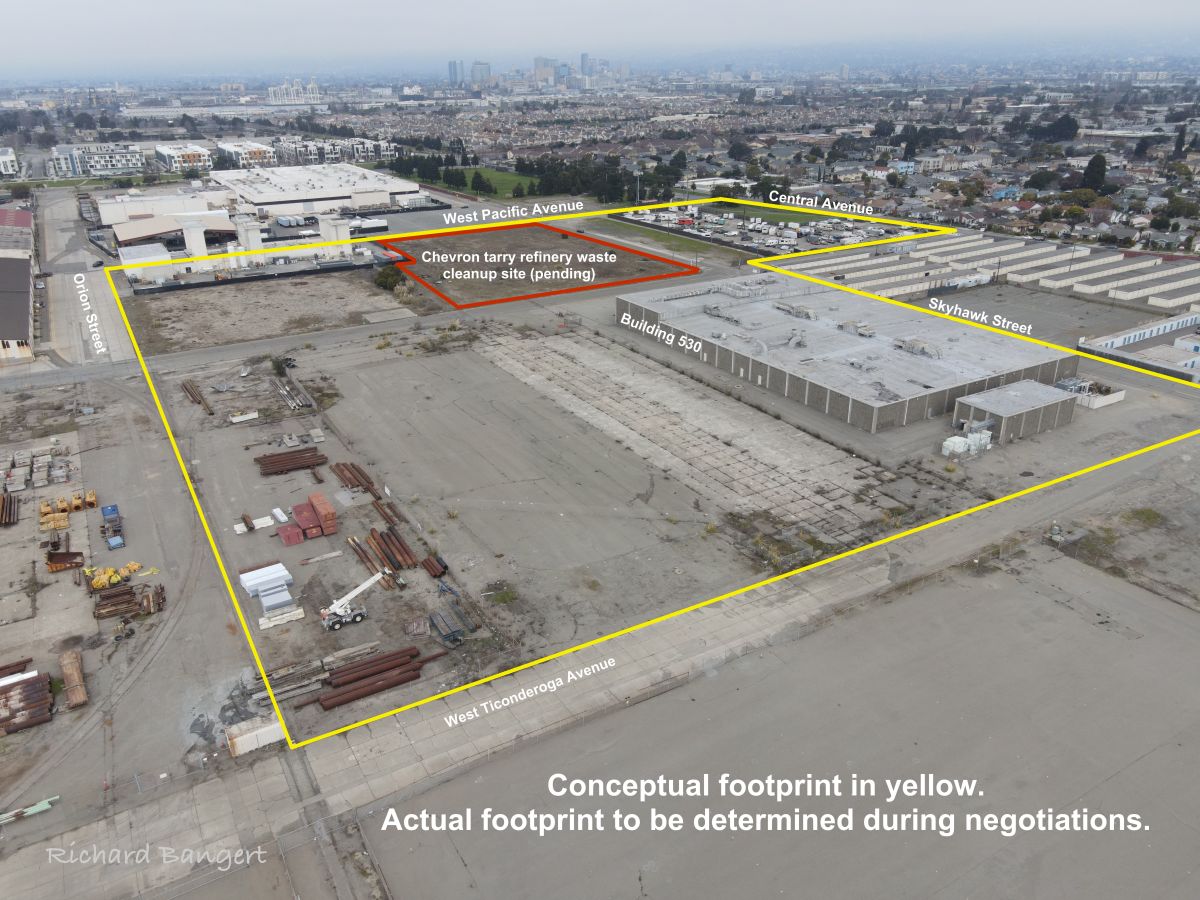
More cutting edge green energy research and development may be coming to Alameda Point. A startup company called Pacific Fusion was formed in 2023 with the goal of commercializing new energy production technology. The company wants to purchase property at Alameda Point to research, develop and build their demonstration fusion energy machine.
Unlike conventional nuclear power, fusion energy technology seeks to fuse together atoms, rather than split them. The energy is considered a clean, safe, and affordable form of nuclear power that would revolutionize energy production. It has been only in the last two years that U.S. Department of Energy research labs have finally proven on their equipment that fusion energy is possible.
On Tuesday, January 21, the Alameda City Council met in closed session to discuss entering into an exclusive negotiating agreement with Pacific Fusion that would lead to a land deal. It is expected that the land sales revenue will go toward providing much-needed infrastructure upgrades around mostly vacant land slated for commercial and light industrial development. The size and shape of the footprint will be part of the negotiations but is currently pegged at approximately 17 acres, according Base Reuse and Economic Development Director Abby Thorne-Lyman.
If approved, this will be the first land sale in the 180-acre Enterprise District zoned for commercial development since the city took ownership of the land in 2013.
“The demonstration system will not produce electricity, but it will be the same size and scale as systems that will produce electricity,” said Chief Operating Officer and cofounder Carrie von Muench. “We want to build a system that shows that we can get more fusion energy out than is required to run the system. That is what we’re doing now. That is what this system will be. We will then go build a power plant.”

President and cofounder Will Regan added, “In a real power plant if you cycle it about once every second you could produce a couple hundred megawatts of power, which would be sufficient to power about a hundred thousand homes.”
The Science
Fission is how power is generated in existing nuclear power plants. Fusion, on the other hand, is how heat and light is produced by the sun.
There are a number of fusion methods that are being considered for commercialization, including one that uses lasers and another that uses magnets. Pacific Fusion is using a system called pulse magnetic inertial fusion because they believe it will be a more cost-effective way to bring the technology online. The Department of Energy’s Sandia National Labs in Albuquerque, NM is where the magnetic method of fusion was successfully demonstrated on their lab’s Z Machine. The Z Machine was originally designed for weapons research but now has applications for energy research.
“Effectively the way our fusion system will work is it’s a large machine, it creates an electric current, that electric current creates a magnetic field because that’s what electric currents do, and that magnetic field squishes a small ‘can’ called a fusion target that holds hydrogen fuel,” said von Muench. “That fuel then burns, releases a bunch of energy, and then you put in another little target and keep repeating the process. So conceptually it’s a lot like what the laser folks do, it’s just a lot more efficient.”
The founders of Pacific Fusion elaborate on their website on how they intend to engineer their fusion system. “Our system is built of small mass-manufacturable units called bricks (two capacitors and a switch), which are assembled into modules that fit into shipping containers,” states the company. “Our fusion chamber is compact and cylindrical, facilitating low-cost maintenance. Our system is built from widely available materials. And, our fuel is vastly cheaper than fossil fuels, even accounting for consumables such as fuel containers.”
Fuel required for the system consists of deuterium and tritium. Holding up a bottle of water during an interview, Regan said, “This bottle of water has enough deuterium in it to provide as much energy as a barrel of oil. There’s a lot of it out there. The tritium is something we would make in our system using lithium,” continued Regan. “You need a small amount of tritium to get started, and then you can breed it from lithium.”
“We have enough deuterium and lithium available for millions and millions or potentially billions of years,” Regan added.
“Two major scientific breakthroughs on the inertial fusion side and engineering breakthroughs on pulse power came together such that we now not only understand the conditions required for ignition and high gain fusion,” said von Muench, “but we also have a practical way to reach those at low cost. None of that was true five years ago.”
Federal research lab furthers fusion energy potential
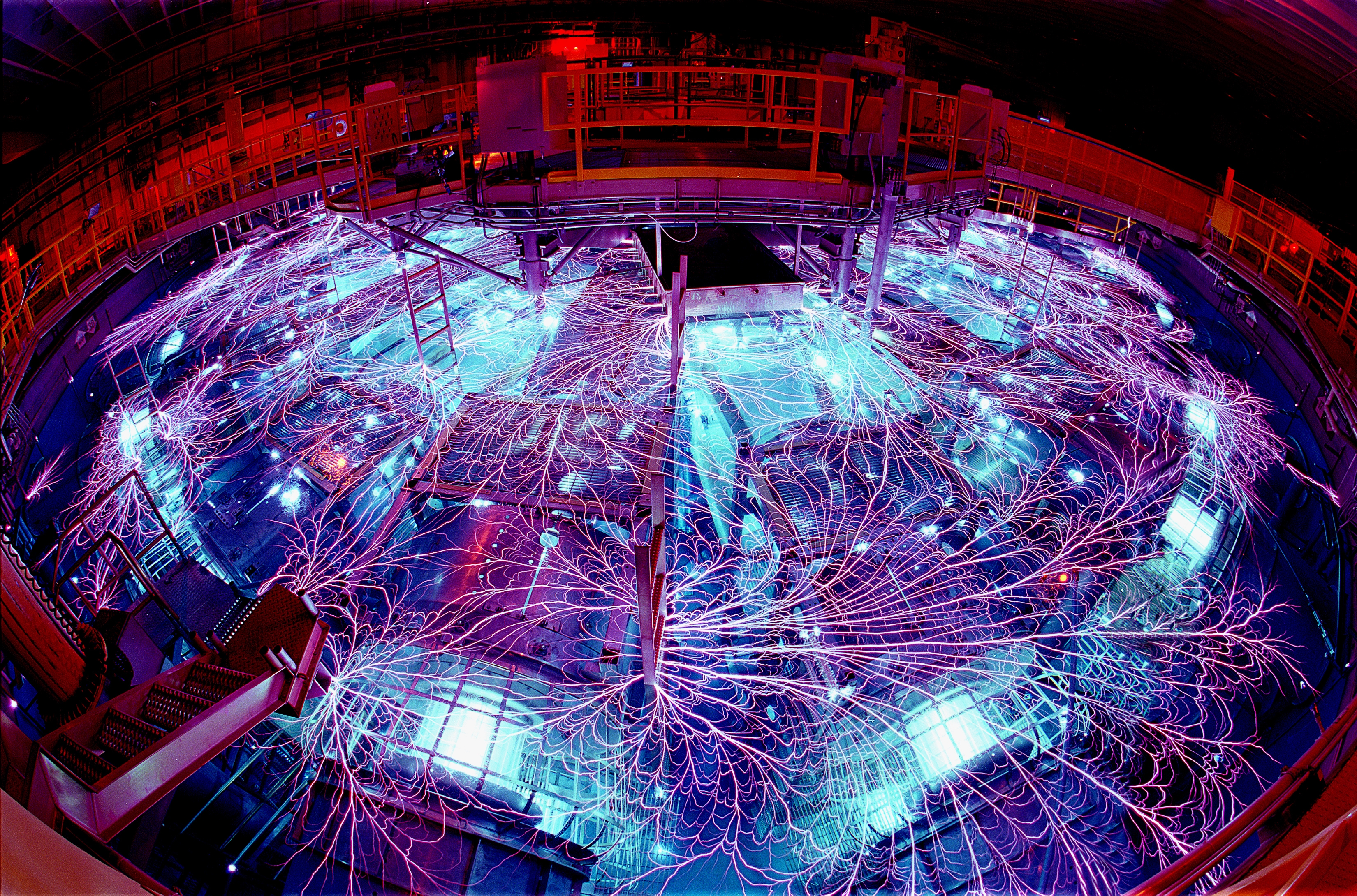
This now famous 1998 image of the Sandia Labs’ Z Machine, the size of a small swimming pool, captures the release, for just 100 nanoseconds, of roughly 200 trillion watts of x-ray energy. The machine was recently used to successfully test fusion energy potential now being adopted by Pacific Fusion. Credit: Randy Montoya, Sandia National Laboratories.
Funding
The promise of fusion energy has attracted major investors, such as General Catalyst. On October 25, 2024, the venture capital company announced that it is promising $900 million to Pacific Fusion upfront to avoid disruptions caused by piecemeal financing, provided the company achieves pre-defined milestones.
Bumpy road to economic development at Alameda Point
If past land sales at Alameda Point are a guide, revenue from the sale will be used for replacing antiquated streets and utility infrastructure, which will in turn make the area more attractive to other businesses.
In 2014, the city identified a subsection of property within the Enterprise District, 82 acres dubbed Site B, to begin trying to sell land for commercial and light industrial uses. Ultimately the city rejected the two finalists because neither of the “build-to-suit” developers was willing to commit to upfront infrastructure, land payments or a milestone schedule for implementing a development plan.
It wasn’t until five years later in 2019 that the city was ready to sell a smaller 22-acre plot on Site B for $36 million. Then a change in the state Surplus Lands Act, which required property to be first offered to an affordable housing developer, put a halt to negotiations. It took another two years before the Surplus Lands Act was amended to allow the city to proceed with marketing commercial property at Alameda Point.
Another crimp in the redevelopment plan was the unresolved cleanup of the tarry refinery waste left behind by the Pacific Coast Oil Refinery on part of the land. In 2023, rather than expecting a developer to remove the waste, at the suggestion of the regional Water Board Chevron agreed to remove the contaminated soil, and a plan for cleanup is expected to be approved by the water agency later this year.
In 2024, the city refocused its marketing directly toward businesses that need space and are ready to build. That’s when Pacific Fusion submitted a proposal to develop this property, according to the January 21, 2024 staff report.
Exclusive Negotiating Agreement in the works
Following Tuesday night’s closed session meeting, Base Reuse and Economic Development Director Abby Thorne-Lyman announced, “The City Council has directed staff to proceed with negotiating an Exclusive Negotiating Agreement with Pacific Fusion. If we reach alignment, we could bring this to Council as early as the February 18 meeting. The ENA would establish the next steps that Pacific Fusion and the City would follow to explore possible entitlement and sale of property, including a robust community engagement process.”
If the company comes to Alameda Point, it will join the ranks of other green energy research and development companies currently located there. Kairos Power, located on West Tower Avenue, is pursuing its own path to affordable and safe nuclear energy. They recently received a construction permit from the Nuclear Regulatory Commission to build a demonstration reactor in Oak Ridge, Tennessee. Natel Energy, located on Monarch Street, is designing turbines for hydropower plants that allow for fish to safely pass through.
Originally published on the Alameda Post.
 Alameda Point Environmental Report