Google wind energy kite nears launch date

Google-owned Makani, a wind energy company at Alameda Point, moved one step closer last week to full-scale testing of its flying electricity kite. The novel invention made a rare public appearance at the company’s test site near the USS Hornet to fine-tune the docking maneuver. It will be deployed at a test site being readied in Hawaii where it will reach an altitude of 1,100 feet.
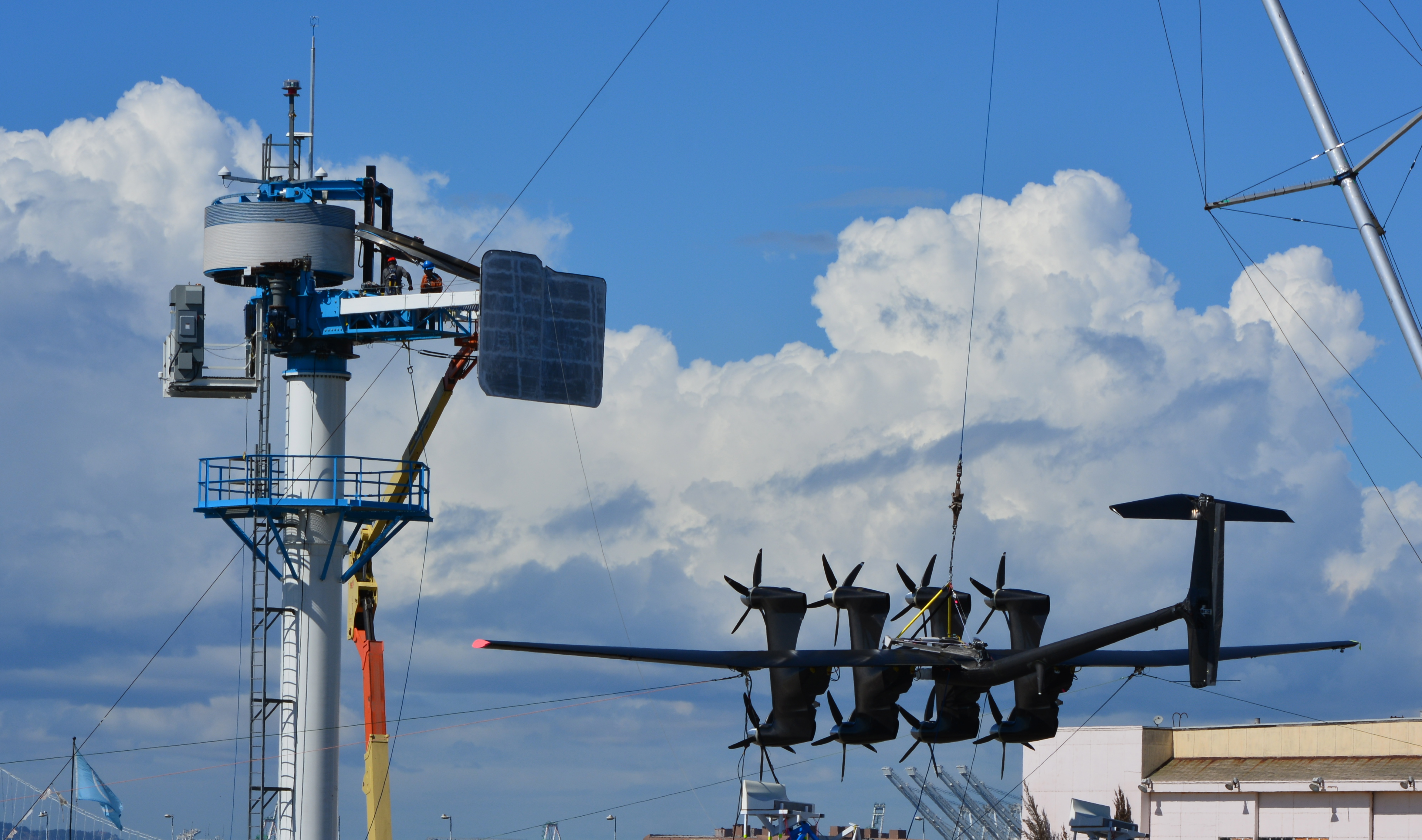
Makani energy kite undergoing testing at Alameda Point on October 1, 2015. Kite is suspended by mast on right. Tower on left is where the kite will be docked with propellers facing upward.

The wind energy craft was pioneered at Alameda Point. It employs the same principle as a stationary wind turbine, using the wind to rotate a blade connected to a generator. But unlike a traditional wind turbine, the tethered energy kite can soar to twice the height, accessing stronger wind force, while using a fraction of the materials. Electricity is transmitted to the base through the tether.

One of the big engineering challenges has been to design how the kite will launch itself into the air from a docking tower and then return when the wind dies down. An earlier prototype was tested on the former Navy airfield while tethered to a truck-mounted base.

The new model has three times the wingspan and twice as many motors and generators as its predecessor. The 84-foot carbon fiber craft uses eight motors to vertically take off and land on its base tower. Once airborne, the motors turn off, and the blades begin driving generators as the kite rotates in the wind.

Makani energy kite on transport trailer at Alameda Point test site.

Makani found an ideal spot to launch its kite at Parker Ranch in Waimea, Hawaii. The 250,000-acre cattle ranch is diversifying into clean energy projects. At a workshop on alternative energy hosted by Parker Ranch in July 2015, they referred to the local wind corridor on the Big Island as a world-class resource. A traditional wind turbine farm is on the drawing board.

Before Makani can send its kite into the sky, it must first gain approval from the Federal Aviation Administration (FAA). Makani representatives have met with local pilots in Hawaii to get their input, according to a story published on October 2 in West Hawaii Today, a daily newspaper circulated on the west side of the Big Island. The test site is five miles from the Waimea Airport.

“Makani has laid out its plans to local groups on the Big Island, including pilots last year who wanted to make sure every measure possible is taken to make sure the kite and tether are visible,” wrote West Hawaii Today’s Bret Yager. Citing Makani project manager Alden Woodrow, Yager stated, “Woodrow said on Thursday the kite will be lighted, the tether will be marked for visibility and that the FAA may provide other guidance for how the kite’s visibility should be enhanced.”
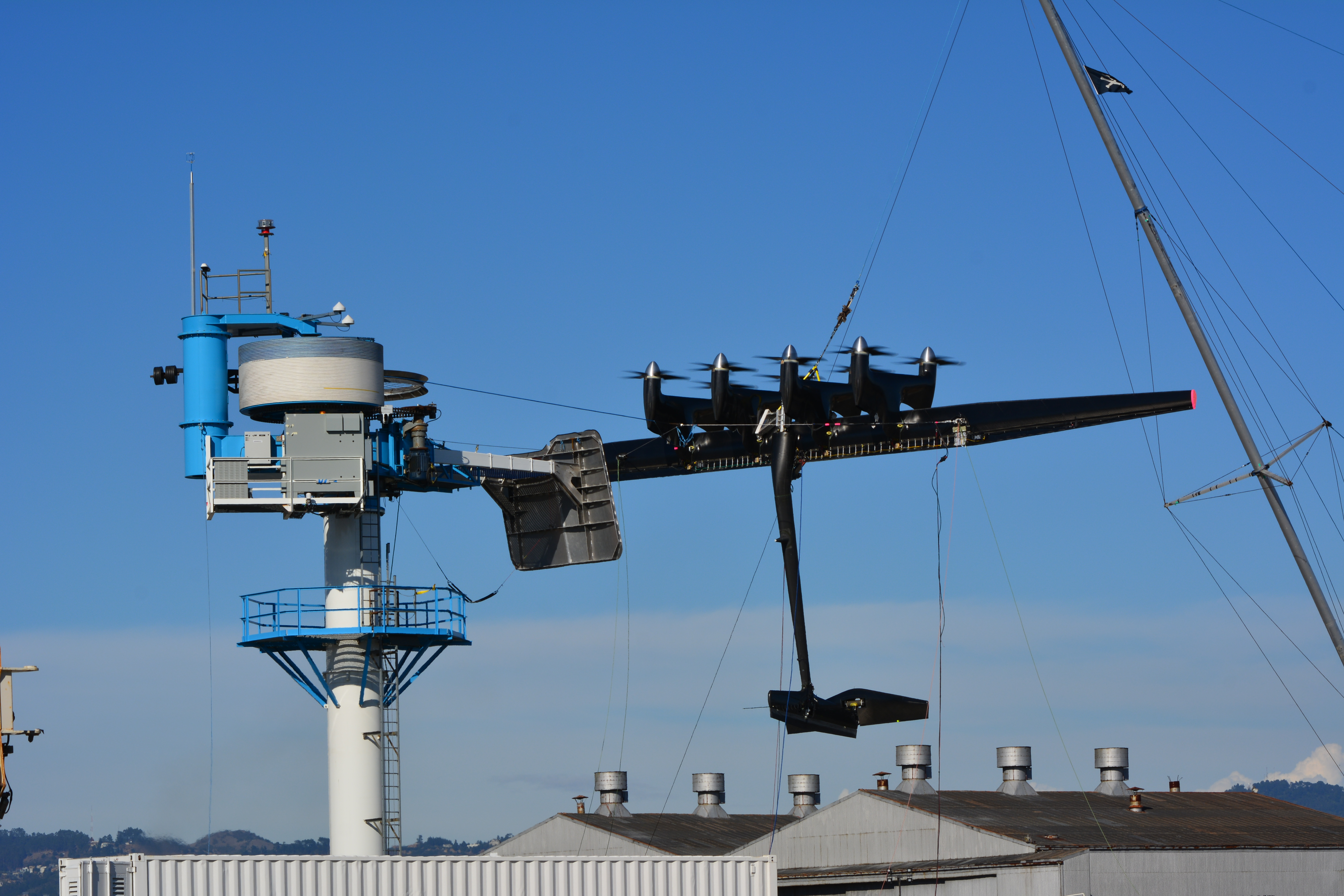
Kite with tether cable extending from tower to belly of kite, with mast suspending the kite during testing. Vertical platform extending from tower is the docking pad for the kite when not flying.

Google’s experimental product division acquired Makani in 2013. Last year they signed a leasing deal with the city for Building 400, the hangar across the street from their office in the old Air Control Tower, where the company is betting on producing a commercially viable clean energy product.

The company’s website points out that conventional wind turbines are limited by height and the available locations where prevailing winds make economic sense. “The wind moves faster and offers exponentially greater power at higher altitudes,” states Makani’s website. “When the wind speed doubles, the amount of available power increases eightfold.” One kite will produce enough electricity to power 300 homes.


Originally published in the Alameda Sun.

Additional reading:

“Google’s Makani:  From Regulatory To Technical To Wildlife Challenges”  by Mike Barnard, February 19, 2014, published on the CleanTechnica website.

Excerpt:

“Finally, a little about wildlife. While the Makani device will be better than fossil fuel generation for wildlife, the reality is that they require a thin, invisible cable to be flying from ground level to 350 meters (1000 feet) for the onshore model or 650 meters (2000 feet) for the offshore product. That cable will be flying through a cone at a speed of around 130-140 kph near the wing, and slowing as it nears the ground. This is likely to be much more difficult to perceive and avoid than any wind turbine blade for birds. The best evidence is that many species of birds including seabirds and many raptors simply adapt to wind farms and avoid them, as there are highly visible masts and blades that they perceive as they do jutting islands and trees. There is no evidence to suggest that this is true for Makani’s relatively small masts, long tethers, and flying wings. The tethers will cover a much, much greater volume of airspace than wind turbine blades. It is difficult to not see greater avian mortality as a likely outcome, with resultant challenges for safe siting.”

Makani submission to Federal Aviation Authority
Navy to transfer school property

Newly available funds from the 2014 Measure I school bond, as well as the expected growth in student enrollment, prompted Alameda Unified School District (AUSD) to submit a request to the Navy in April to acquire the vacant Island High School and Woodstock Child Development Center parcel on Singleton Avenue on the city’s West End. The Navy responded favorably.

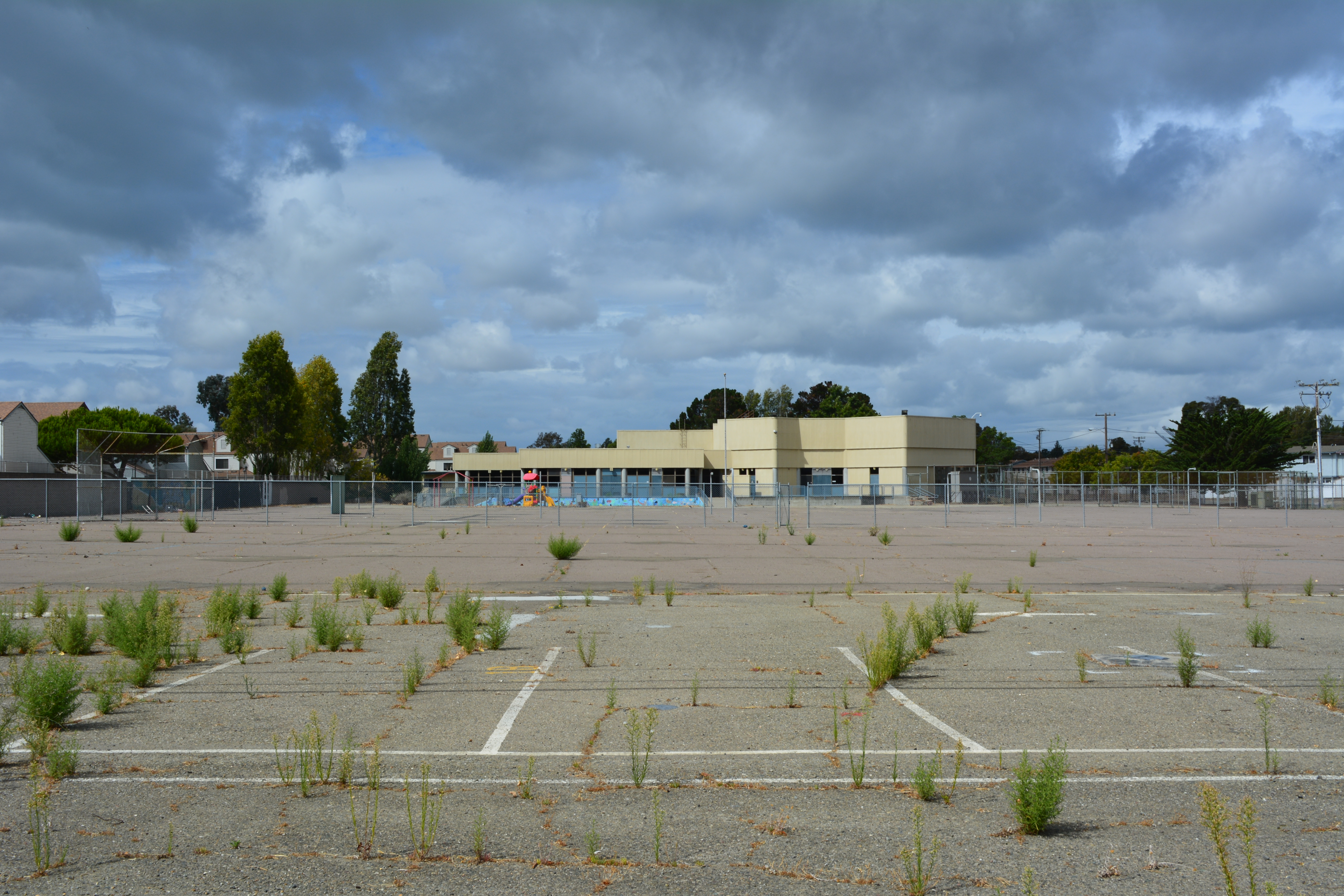
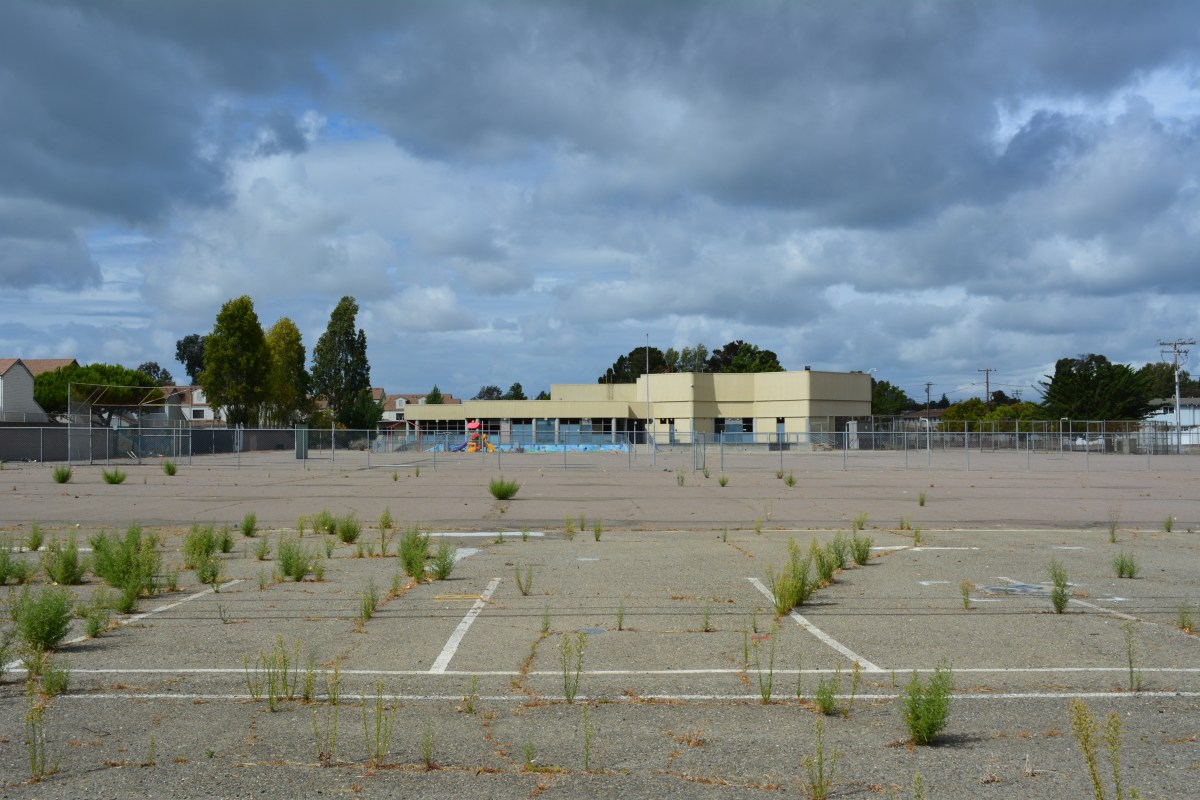
Vacant Island High School site on Singleton Avenue. Coast Guard housing is to the left. Singleton Avenue and vacant North Housing area is to the right. Woodstock Child Development Center is on the far side of the high school.

The school district previously leased the 5.9-acre parcel from the Navy at no cost. AUSD was slated to receive the two sites from the Navy under a previous application for a Public Benefit Acquisition. However, AUSD vacated the sites in 2010 and 2011 and withdrew their application due to the estimated hundreds of thousands of dollars required for upgrades to the sewer and water lines.

The school district has been resorting to creative desk shuffling in recent years to cope with a shortage of adequate space and lack of funds. One example given by School Superintendent Sean McPhetridge in the application to the Navy states, “One school has gone so far as to relocate a classroom computer lab into a former student toilet room to accommodate the growth of enrollment.”

Currently, the Woodstock Child Development Center and Island High School jointly operate on the site of the former Longfellow Elementary School. The acquisition of the property will allow the district to relocate those two programs back to Singleton Avenue where they previously operated.

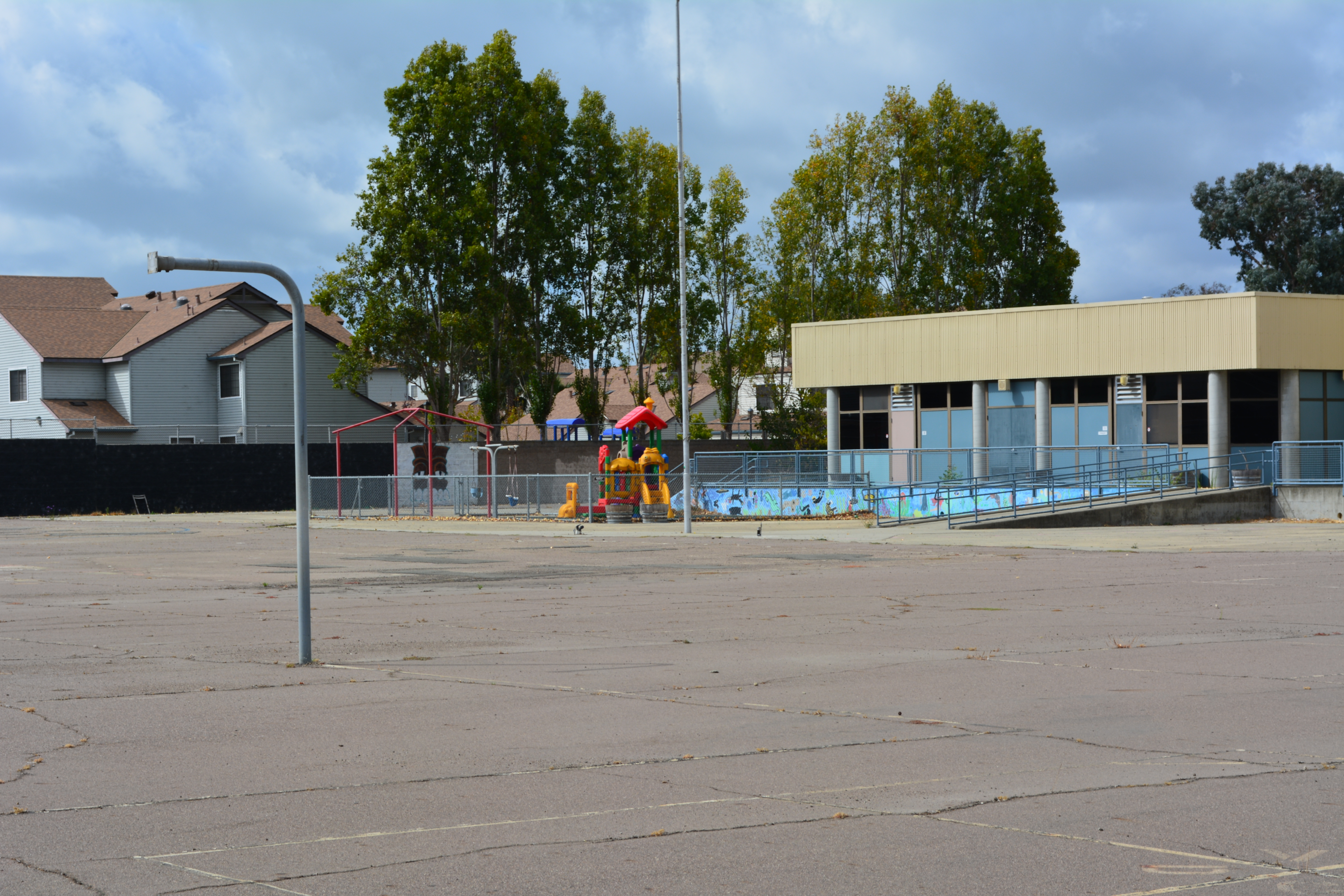
Children's playground equipment is from when the school housed Miller Elementary School prior to becoming a high school.
Children’s playground equipment is from when the school housed Miller Elementary School prior to becoming a high school.

In the application, Superintendent McPhetridge describes a veritable ripple effect of efficiencies that would ensue as a result of the acquisition. It would “open the former Longfellow Elementary School site and allow the transfer of other programs from other elementary schools currently in operation, and in turn, it would open classroom space at many existing elementary schools,” stated McPhetridge. “The transfer of programs from existing elementary schools to the former Longfellow Elementary School site would provide for the growth of students at their neighborhood schools.”

A 2014 demographic study projects that the school district will add approximately 1,000 students over the next 10 years, the majority of them on the west side of Alameda. Redeveloped Alameda Point and Alameda Landing are projected to produce approximately 600 students.

“The District has not committed to a full modernization of the buildings at this time, but is planning on committing the funds necessary to open both campuses and provide safe and updated facilities,” stated McPhetridge in the application.

The property transfer process for public benefit conveyances involves sending the parcel from the Navy via another federal agency, in this case, the Department of Education. “The U.S. Dept. of Education approved this transfer and is now waiting to get the title from the Navy,” said Susan E. Davis, Senior Manager of Community Affairs at AUSD. “Once that happens, the Department of Education will give the title to us.”

“We’re hoping that the campus will be open sometime in the 2017-18 school year,” said Davis. “Designing, getting state approval, and doing the construction on school buildings can take some time.”

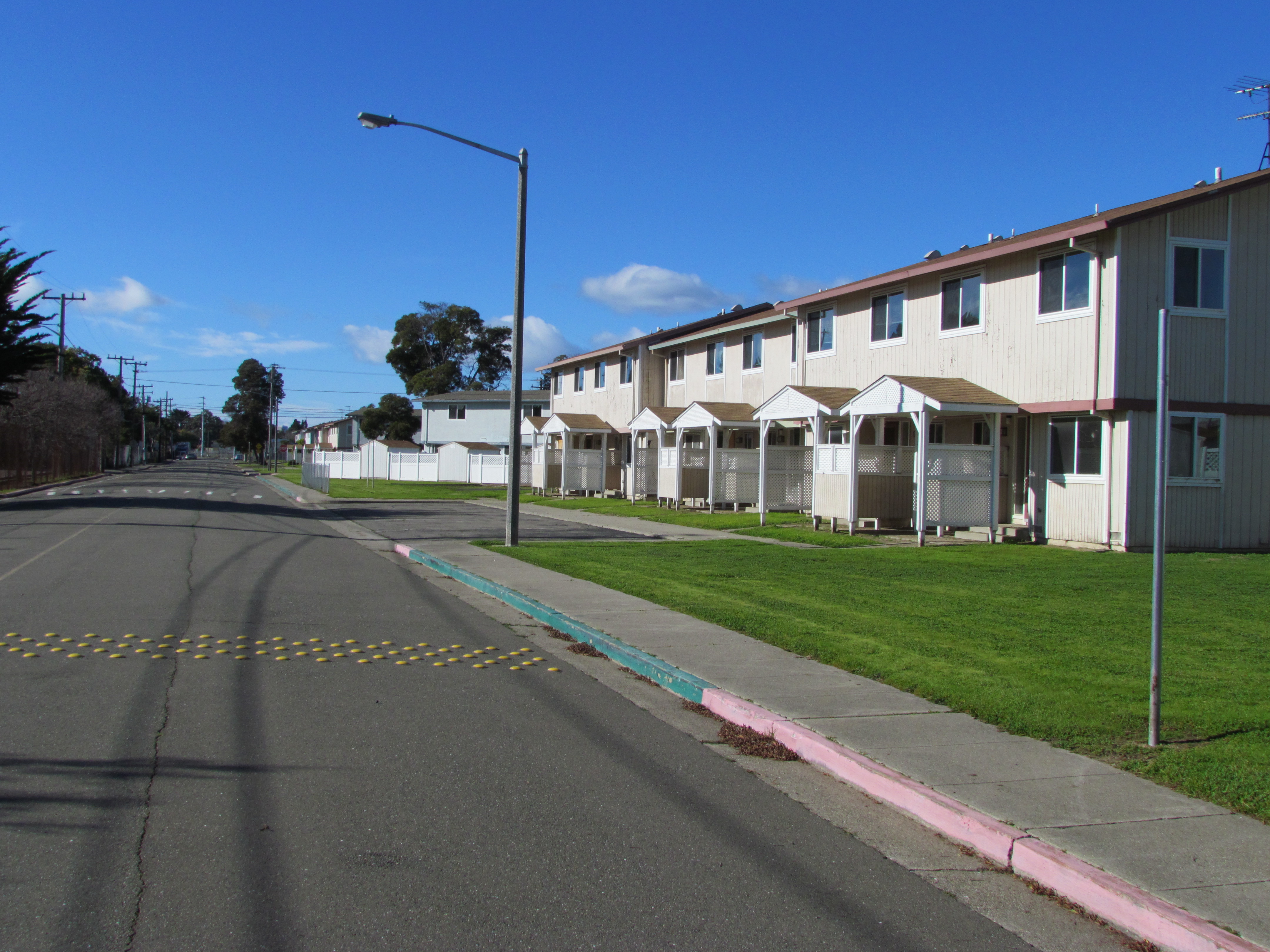
Singleton Avenue with vacant North Housing on the right. School parcel is on the left.

The Singleton Avenue school sites are located next to the Coast Guard housing to the south. Across the street and to the north of the school parcel is the vacant North Housing site, which is still owned by the Navy and zoned for a new residential neighborhood.

Originally published in the Alameda Sun.

School Board meeting April 28, 2015 regarding property request – see agenda item F – 6.